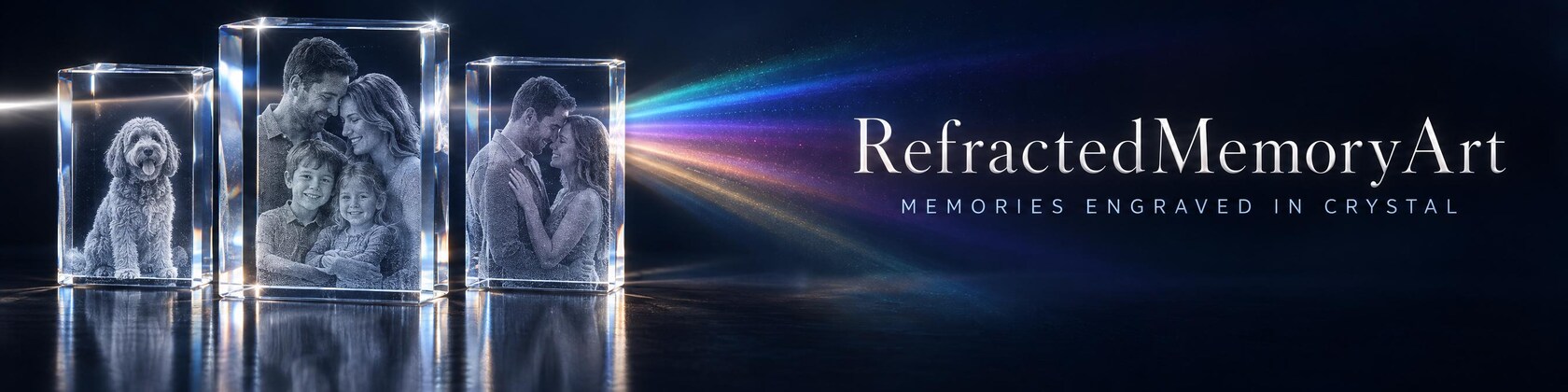
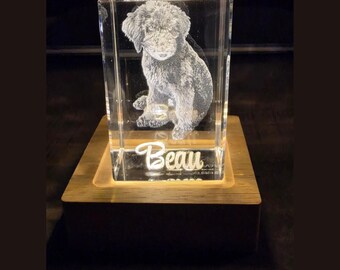
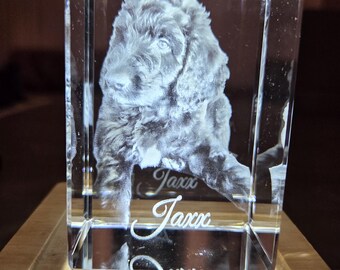

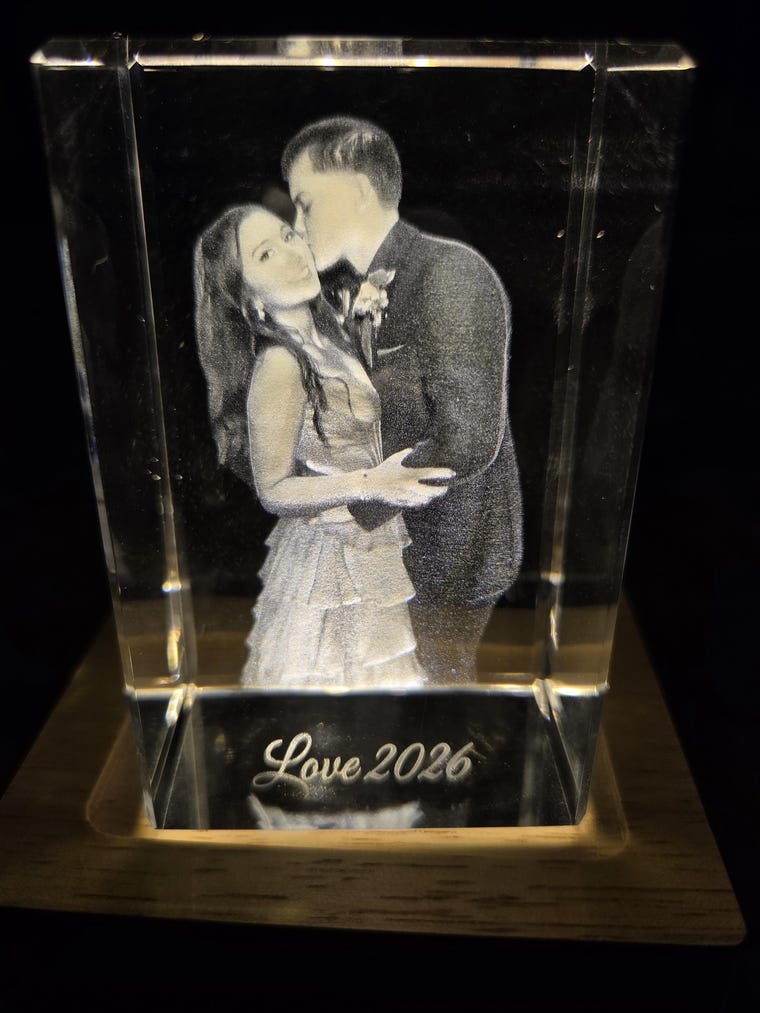
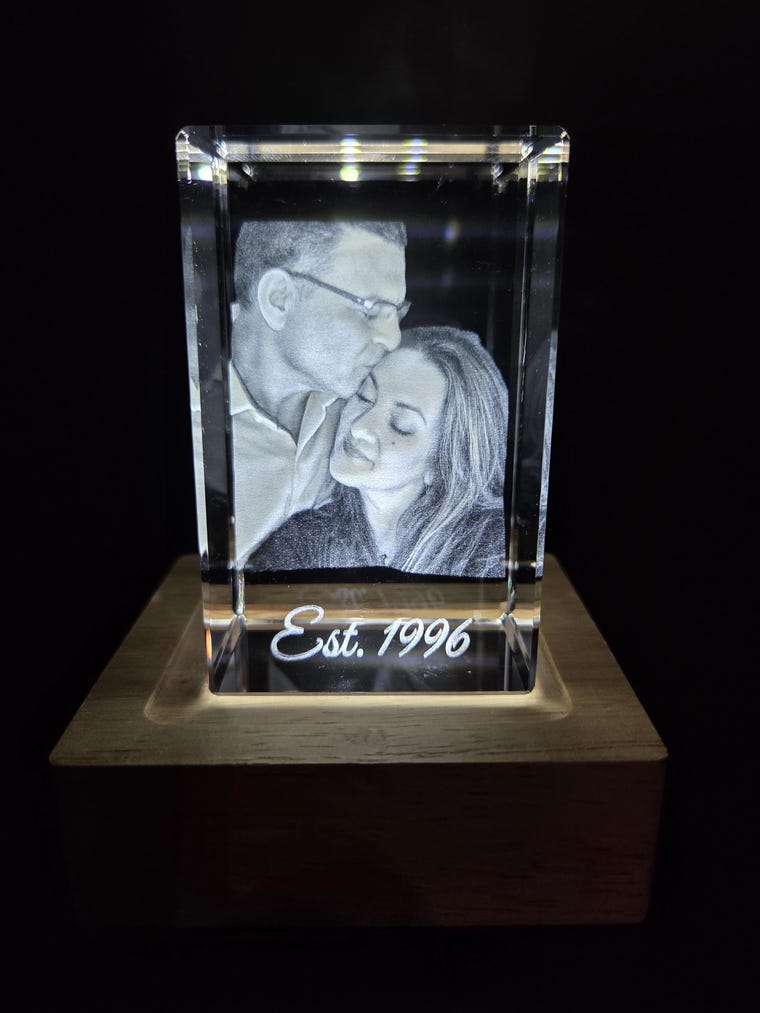
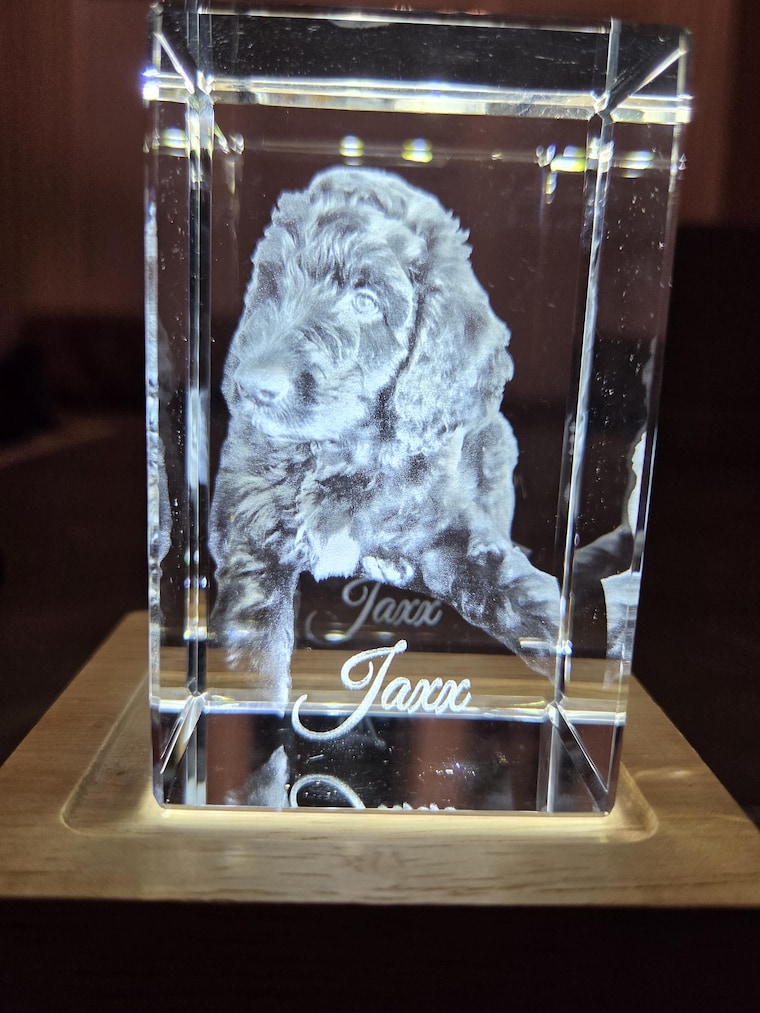
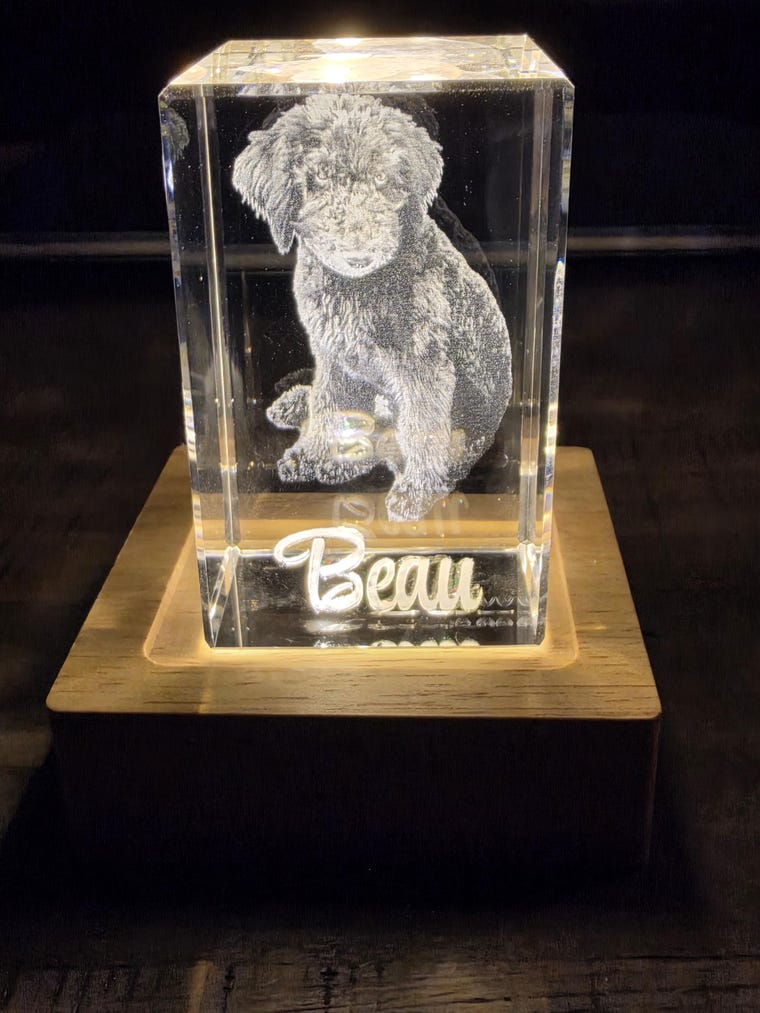
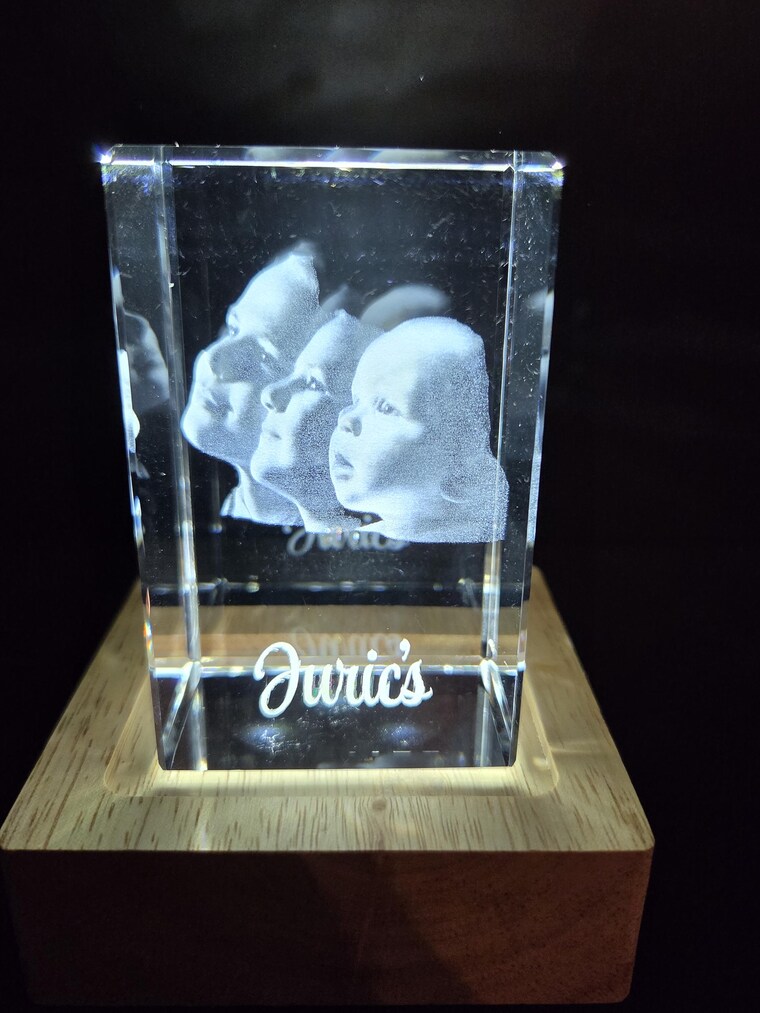
La tua foto, incisa in tre dimensioni all'interno di un cristallo massiccio. Centinaia di migliaia di punti luce, destinati a durare una vita.
Your photo, engraved in three dimensions inside solid crystal. Hundreds of thousands of points of light, made to last a lifetime
La foto che stavi quasi per cancellare
Molti di noi hanno migliaia di fotografie, ma quasi nessuna è appesa al muro. Vivono sul telefono, viste per due secondi alla volta, poi sepolte sotto altre più recenti. Le migliori sono di solito quelle che stiamo quasi per cancellare perché non sono perfette: un bambino che ride, un cane che aspetta alla porta, le mani di una nonna.
Sono proprio quelli che voglio. È da lì che è nato questo negozio.
Ciò che faccio
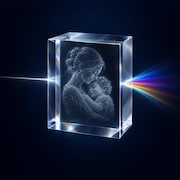
Sulla superficie non è presente alcuna stampa. Ogni pezzo è costituito da un blocco solido di cristallo ottico K9, il materiale ultra-trasparente utilizzato per le lenti, privo di sfumature verdi e bolle d'aria. L'immagine viene incisa al centro di questo blocco tramite laser, in tre dimensioni complete.
Come funziona realmente
Immaginate una stampante a matrice di punti, solo che i punti cadono all'interno del vetro anziché sulla carta. Io concentro un laser UV su un punto preciso all'interno del cristallo e, in ogni punto, l'energia crea una microfrattura, un minuscolo puntino che cattura e disperde la luce. La vostra fotografia viene ricostruita a partire da centinaia di migliaia di questi puntini, disposti lungo tutta la profondità del blocco.
Quest'ultimo aspetto è ciò che lo distingue da una fotografia stampata. Non c'è inchiostro né griglia di pixel. Avvicinandosi, si possono osservare i singoli punti luminosi sospesi nel vetro e, poiché si trovano a diverse profondità, l'immagine si sposta e cambia al variare della luce e dell'angolo di visione.
La parte che nessuno vede
Prima di procedere all'incisione, dedico molto tempo alla tua foto. La ripulisco e riparo ciò che è possibile, poi la studio attentamente per coglierne la profondità. Una fotografia è piatta; un'incisione no. Devo decidere cosa deve emergere e cosa deve rimanere in secondo piano, altrimenti il risultato sembrerà un'immagine intrappolata in una scatola anziché qualcosa di vivo all'interno del cristallo.
Le fotografie difficili da elaborare hanno lo stesso trattamento di quelle facili. Vecchie stampe scansionate, foto scattate di notte con il cellulare e animali dal pelo scuro come i cani neri richiedono un lavoro extra, e io lo eseguo prima di dirvi cosa è possibile fare. Se una foto non può essere recuperata, preferisco dirvelo subito piuttosto che intascare i vostri soldi e consegnarvi un risultato deludente.
Perché cristallo
Poiché l'immagine è incisa all'interno del materiale, non sulla sua superficie, non c'è nulla che possa usurarsi. Non sbiadisce alla luce del sole, non c'è alcun rivestimento che possa staccarsi e il blocco è solido. Tra trent'anni avrà esattamente lo stesso aspetto del giorno in cui è stato ricevuto, che è poi il vero scopo di un oggetto da collezione.
Prendersene cura
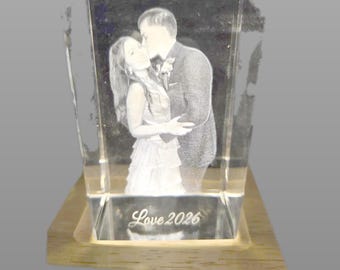
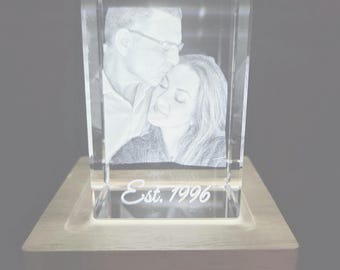
Trattatela come un buon oggetto in vetro. È più resistente di quanto sembri e sopporta benissimo l'uso quotidiano, ma non è un oggetto da far cadere su una superficie dura. Basta un panno morbido. Mettetela vicino a una finestra per la luce naturale, oppure su una base illuminata per farla brillare, e capirete perché non mi stanco mai di questo oggetto.
Inviami la tua foto
Non deve essere professionale. Deve essere qualcosa a cui torni sempre volentieri. Mandamelo e ti dirò onestamente cosa posso ricavarne.
The photo you almost deleted
Most of us have thousands of photographs and almost none of them on a wall. They live on a phone, seen for two seconds at a time, then buried under newer ones. The best ones are usually the ones people almost delete because they are not perfect: a kid mid-laugh, a dog waiting at the door, a grandmother's hands.
Those are the ones I want. That is where this shop came from.
What I make
Nothing is printed on the surface. Each piece starts as a solid block of optical K9 crystal, the ultra-clear material used for lenses, with no green tint and no bubbles inside. Your image is engraved into the middle of that block by laser, in three full dimensions.
How it actually works
It helps to picture a dot matrix printer, except the dots land inside glass instead of on paper. I focus a UV laser to a precise point inside the crystal, and at each point the energy creates a microscopic fracture, a tiny speck that catches and scatters light. Your photograph is rebuilt from hundreds of thousands of those specks, arranged through the whole depth of the block.
That last part is what makes it different from a printed photograph. There is no ink and no pixel grid. If you lean in close you can see the individual points of light hanging in the glass, and because they sit at different depths, the image shifts and changes as the light and your viewing angle change.
The part nobody sees
Before any engraving happens, I spend real time on your photo. I clean it up and repair what I can, then study it for depth. A photograph is flat; an engraving is not. I have to decide what should come forward toward you and what should sit back, or the result looks like a picture trapped in a box rather than something alive inside the crystal.
Hard photographs go in the same queue as easy ones. Old scanned prints, phone shots taken at night, and dark-coated animals such as black dogs all need extra work, and I do that work before telling you what is possible. If a photo genuinely cannot be saved, I would rather say so up front than take your money and deliver something disappointing.
Why crystal
Because the image is inside the material, not on it. There is nothing on the surface to wear away. It does not fade in sunlight, there is no coating to peel, and the block is solid. In thirty years it will look exactly as it does the day it arrives, which is rather the point of a keepsake.
Looking after it
Treat it like good glassware. It is tougher than it looks and handles everyday life perfectly well, but it is not something to drop on a hard floor. A soft cloth is all it needs. Put it near a window for daylight, or on a lit base to make it glow, and you will see why I never get tired of this.
Send me your photo
It does not need to be professional. It needs to be the one you keep going back to. Send it over and I will tell you honestly what I can make from it.