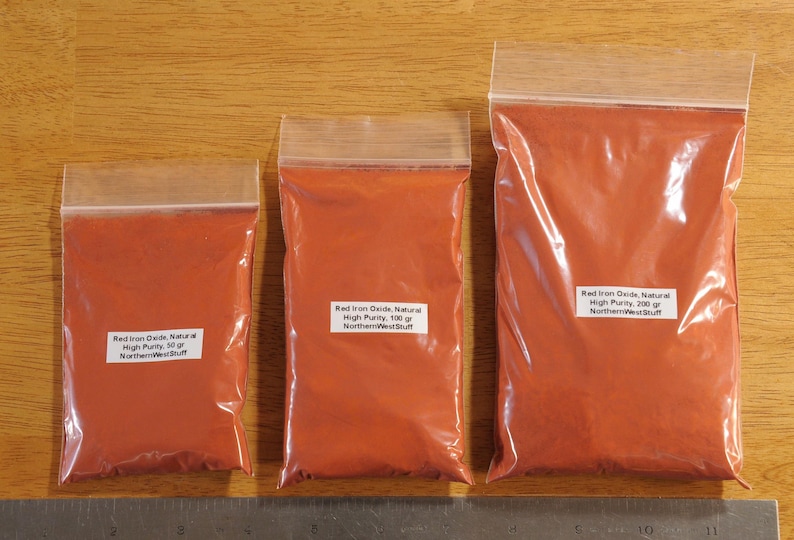


Red Iron Oxide, Natural, High Purity
Star Seller
Star Sellers have an outstanding track record for providing a great customer experience – they consistently earned 5-star reviews, dispatched orders on time, and replied quickly to any messages they received.
Seller's description
PROMPT REBATE ON ORDERS WITH 3 OR MORE “FreeShip” ITEMS! WANT TO KNOW YOUR TOTAL REBATE BEFORE PURCHASE? CONTACT US!
Please note this is a raw pigment intended to be dispersed into a liquid medium to make paints. Our raw pigments are not meant for use in cosmetics and are not cosmetic grade. Certain pigments disperse more easily than others in certain liquid mediums. For those difficult to disperse into a liquid of your choice, they will need to be ground by a muller or a mortar and pestle into the medium.
Safety note: Handle all dry pigments with care. Work slowly to avoid generating airborne dust and wear a dust mask for extra protection. Also avoid getting the dust all over your hands. Latex gloves are good at providing skin protection without "getting in the way".
This is a natural red iron oxide that has been refined to 98% pure red iron oxide (aka "ferric oxide", "Iron(III) oxide" or "Fe2O3"). Iron oxide is a very ancient pigment and there are many varieties. It finds applications in paint, ceramics, concrete, plastics, and cosmetics. Used for many things besides a pigment and filler. There are 3 main types (Fe2O3, FeO, and Fe3O4), and 3 main colors (although it is found in many shades of these): black, red, and yellow. Other well-known pigments based on or containing iron oxide are yellow ochre, burnt umber, and raw sienna, all of which we carry.
The CAMEO art materials database gives this information { http://cameo.mfa.org/wiki/Iron_oxide_red } :
"Description
Iron oxides produce a wide variety of red shades ranging from light, bright red to a deep purplish red. They can be natural, earth pigments (hematite, Indian red, Venetian red) or synthetically prepared pigments (light red). All iron oxide reds are stable, permanent pigments with good tinting strength and are the primary colorant in ochers and siennas.
Synonyms and Related Terms
Pigment Red 101; CI 77491; red iron oxide; red ocher; red ochre, rouge; Persian red; Tuscan red; Pompeian red; light red; Venetian red; English red; angel red.
Composition Fe2O3
Mohs Hardness 5.5 - 6.5
Density 4.2-5.3
Refractive Index 2.78; 3.01"
Here's some excerpts from the Digital Fire ceramics materials database:
{ https://digitalfire.com/4sight/material/iron_oxide_red_874.html } :
"Red iron oxides are available in spheroidal, rhombohedral, and irregular particle shapes. Some high purity grades are specially controlled for heavy metals and are used in drugs, cosmetics, pet foods, and soft ferrites. Highly refined grades can have 98% Fe2O3 but typically red iron is about 95% pure and very fine (less than 1% 325 mesh). Some grades of red iron do have coarser specks in them, and this can result in unwanted specking in glaze and bodies (see picture).
High iron raw materials or alternate names: burnt sienna, crocus martis, Indian red, red ochre, red oxide, Spanish red. Iron is the principal contaminant in most clay materials. A low iron content, for example, is very important in kaolins used for porcelain."
The Wiki article is here:
{ https://en.wikipedia.org/wiki/Iron(III)_oxide }
"Iron(III) oxide or ferric oxide is the inorganic compound with the formula Fe2O3. It is one of the three main oxides of iron, the other two being iron(II) oxide (FeO), which is rare, and iron(II,III) oxide (Fe3O4), which also occurs naturally as the mineral magnetite. As the mineral known as hematite, Fe2O3 is the main source of iron for the steel industry. Fe2O3 is ferromagnetic, dark red, and readily attacked by acids. Iron(III) oxide is often called rust, and to some extent this label is useful, because rust shares several properties and has a similar composition."
The article continues with some of the uses of red iron oxide:
"USES:
--Iron industry
The overwhelming application of iron(III) oxide is as the feedstock of the steel and iron industries, e.g. the production of iron, steel, and many alloys.
--Polishing
A very fine powder of ferric oxide is known as "jeweler's rouge", "red rouge", or simply rouge. It is used to put the final polish on metallic jewelry and lenses, and historically as a cosmetic. Rouge cuts more slowly than some modern polishes, such as cerium(IV) oxide, but is still used in optics fabrication and by jewelers for the superior finish it can produce. When polishing gold, the rouge slightly stains the gold, which contributes to the appearance of the finished piece. Rouge is sold as a powder, paste, laced on polishing cloths, or solid bar (with a wax or grease binder). Other polishing compounds are also often called "rouge", even when they do not contain iron oxide. Jewelers remove the residual rouge on jewelry by use of ultrasonic cleaning. Products sold as "stropping compound" are often applied to a leather strop to assist in getting a razor edge on knives, straight razors, or any other edged tool.
--Pigment
Iron(III) oxide is also used as a pigment, under names "Pigment Brown 6", "Pigment Brown 7", and "Pigment Red 101". Some of them, e.g. Pigment Red 101 and Pigment Brown 6, are approved by the US Food and Drug Administration (FDA) for use in cosmetics. Iron oxides are used as pigments in dental composites alongside titanium oxides.
Hematite is the characteristic component of the Swedish paint color Falu red.
---Magnetic recording
Iron(III) oxide was the most common magnetic particle used in all types of magnetic storage and recording media, including magnetic disks (for data storage) and magnetic tape (used in audio and video recording as well as data storage). Its use in computer disks was superseded by cobalt alloy, enabling thinner magnetic films with higher storage density.
---Medicine
Calamine lotion, used to treat mild itchiness, is chiefly composed of a combination of zinc oxide, acting as astringent, and about 0.5% iron(III) oxide, the product's active ingredient, acting as antipruritic. The red color of iron(III) oxide is also mainly responsible for the lotion's widely familiar pink color."
One last comment is the use of red iron oxide in prehistoric cave paintings going back millennia (as much as 28,000 years ago!):
{ http://www.webexhibits.org/pigments/intro/early.html } :
"The first paintings were cave paintings. Ancient peoples decorated walls of protected caves with paint made from dirt or charcoal mixed with spit or animal fat. In cave paintings, the pigments stuck to the wall partially because the pigment became trapped in the porous wall, and partially because the binding media dried and adhered the pigment to the wall....
Prehistoric painters used the pigments available in the vicinity. These pigments were the so-called earth pigments, (minerals limonite and hematite, red ochre, yellow ochre and umber), charcoal from the fire (carbon black), burnt bones (bone black) and white from grounded calcite (lime white)."
Note that "ochre" is a family of earth pigments, which includes yellow ochre, red ochre and others. The red ochre contains red iron oxide.-
=======================================================================
Item review
All reviews are from verified buyers. This review is shown automatically based on factors like recency, whether it includes comments, your chosen language, and whether the rating reflects the typical experience with the shop.
“Great product, shipped immediately and arrive on time. Thank you!”
David
24 Jun, 2026
Price:SGD 15.99+
You can only make an offer when buying a single item.
Sorry, this item doesn’t deliver to Singapore. Contact the shop to find out about available delivery options.
Reviews for this item
Great product, shipped immediately and arrive on time. Thank you!

The best and great customer service
Good quality and would recommend to others.
I would recommend this to who ever us looking for iron oxide.
Seller's description
Specifications
PROMPT REBATE ON ORDERS WITH 3 OR MORE “FreeShip” ITEMS! WANT TO KNOW YOUR TOTAL REBATE BEFORE PURCHASE? CONTACT US!
Please note this is a raw pigment intended to be dispersed into a liquid medium to make paints. Our raw pigments are not meant for use in cosmetics and are not cosmetic grade. Certain pigments disperse more easily than others in certain liquid mediums. For those difficult to disperse into a liquid of your choice, they will need to be ground by a muller or a mortar and pestle into the medium.
Safety note: Handle all dry pigments with care. Work slowly to avoid generating airborne dust and wear a dust mask for extra protection. Also avoid getting the dust all over your hands. Latex gloves are good at providing skin protection without "getting in the way".
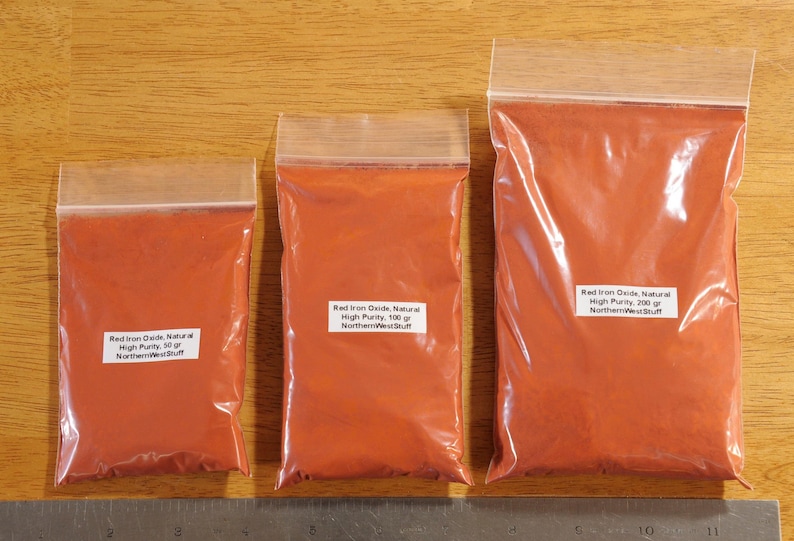
This is a natural red iron oxide that has been refined to 98% pure red iron oxide (aka "ferric oxide", "Iron(III) oxide" or "Fe2O3"). Iron oxide is a very ancient pigment and there are many varieties. It finds applications in paint, ceramics, concrete, plastics, and cosmetics. Used for many things besides a pigment and filler. There are 3 main types (Fe2O3, FeO, and Fe3O4), and 3 main colors (although it is found in many shades of these): black, red, and yellow. Other well-known pigments based on or containing iron oxide are yellow ochre, burnt umber, and raw sienna, all of which we carry.
The CAMEO art materials database gives this information { http://cameo.mfa.org/wiki/Iron_oxide_red } :
"Description
Iron oxides produce a wide variety of red shades ranging from light, bright red to a deep purplish red. They can be natural, earth pigments (hematite, Indian red, Venetian red) or synthetically prepared pigments (light red). All iron oxide reds are stable, permanent pigments with good tinting strength and are the primary colorant in ochers and siennas.
Synonyms and Related Terms
Pigment Red 101; CI 77491; red iron oxide; red ocher; red ochre, rouge; Persian red; Tuscan red; Pompeian red; light red; Venetian red; English red; angel red.
Composition Fe2O3
Mohs Hardness 5.5 - 6.5
Density 4.2-5.3
Refractive Index 2.78; 3.01"
Here's some excerpts from the Digital Fire ceramics materials database:
{ https://digitalfire.com/4sight/material/iron_oxide_red_874.html } :
"Red iron oxides are available in spheroidal, rhombohedral, and irregular particle shapes. Some high purity grades are specially controlled for heavy metals and are used in drugs, cosmetics, pet foods, and soft ferrites. Highly refined grades can have 98% Fe2O3 but typically red iron is about 95% pure and very fine (less than 1% 325 mesh). Some grades of red iron do have coarser specks in them, and this can result in unwanted specking in glaze and bodies (see picture).
High iron raw materials or alternate names: burnt sienna, crocus martis, Indian red, red ochre, red oxide, Spanish red. Iron is the principal contaminant in most clay materials. A low iron content, for example, is very important in kaolins used for porcelain."
The Wiki article is here:
{ https://en.wikipedia.org/wiki/Iron(III)_oxide }
"Iron(III) oxide or ferric oxide is the inorganic compound with the formula Fe2O3. It is one of the three main oxides of iron, the other two being iron(II) oxide (FeO), which is rare, and iron(II,III) oxide (Fe3O4), which also occurs naturally as the mineral magnetite. As the mineral known as hematite, Fe2O3 is the main source of iron for the steel industry. Fe2O3 is ferromagnetic, dark red, and readily attacked by acids. Iron(III) oxide is often called rust, and to some extent this label is useful, because rust shares several properties and has a similar composition."
The article continues with some of the uses of red iron oxide:
"USES:
--Iron industry
The overwhelming application of iron(III) oxide is as the feedstock of the steel and iron industries, e.g. the production of iron, steel, and many alloys.
--Polishing
A very fine powder of ferric oxide is known as "jeweler's rouge", "red rouge", or simply rouge. It is used to put the final polish on metallic jewelry and lenses, and historically as a cosmetic. Rouge cuts more slowly than some modern polishes, such as cerium(IV) oxide, but is still used in optics fabrication and by jewelers for the superior finish it can produce. When polishing gold, the rouge slightly stains the gold, which contributes to the appearance of the finished piece. Rouge is sold as a powder, paste, laced on polishing cloths, or solid bar (with a wax or grease binder). Other polishing compounds are also often called "rouge", even when they do not contain iron oxide. Jewelers remove the residual rouge on jewelry by use of ultrasonic cleaning. Products sold as "stropping compound" are often applied to a leather strop to assist in getting a razor edge on knives, straight razors, or any other edged tool.
--Pigment
Iron(III) oxide is also used as a pigment, under names "Pigment Brown 6", "Pigment Brown 7", and "Pigment Red 101". Some of them, e.g. Pigment Red 101 and Pigment Brown 6, are approved by the US Food and Drug Administration (FDA) for use in cosmetics. Iron oxides are used as pigments in dental composites alongside titanium oxides.
Hematite is the characteristic component of the Swedish paint color Falu red.
---Magnetic recording
Iron(III) oxide was the most common magnetic particle used in all types of magnetic storage and recording media, including magnetic disks (for data storage) and magnetic tape (used in audio and video recording as well as data storage). Its use in computer disks was superseded by cobalt alloy, enabling thinner magnetic films with higher storage density.
---Medicine
Calamine lotion, used to treat mild itchiness, is chiefly composed of a combination of zinc oxide, acting as astringent, and about 0.5% iron(III) oxide, the product's active ingredient, acting as antipruritic. The red color of iron(III) oxide is also mainly responsible for the lotion's widely familiar pink color."
One last comment is the use of red iron oxide in prehistoric cave paintings going back millennia (as much as 28,000 years ago!):
{ http://www.webexhibits.org/pigments/intro/early.html } :
"The first paintings were cave paintings. Ancient peoples decorated walls of protected caves with paint made from dirt or charcoal mixed with spit or animal fat. In cave paintings, the pigments stuck to the wall partially because the pigment became trapped in the porous wall, and partially because the binding media dried and adhered the pigment to the wall....
Prehistoric painters used the pigments available in the vicinity. These pigments were the so-called earth pigments, (minerals limonite and hematite, red ochre, yellow ochre and umber), charcoal from the fire (carbon black), burnt bones (bone black) and white from grounded calcite (lime white)."
Note that "ochre" is a family of earth pigments, which includes yellow ochre, red ochre and others. The red ochre contains red iron oxide.-
=======================================================================
-
Sourced by
-
UseSupplies for making crafts
Delivery details and policies
-
Returns and exchangesNot accepted
But please contact me if you have problems with your order
-
Sent fromUnited States
-
Cost to deliver
Sorry, this item doesn’t deliver to Singapore. Contact the shop to find out about available delivery options.
There was a problem calculating your postage. Please try again.
This seller consistently earned 5-star reviews, dispatched orders on time, and replied quickly to messages.
If something goes wrong with an order, we've got your back on all eligible purchases. View programme terms
Etsy supports climate solutions, from electric delivery trucks to carbon offsets for every delivery. View how
Meet your seller


Usually responds in a few hours
Smooth dispatch Has a history of dispatching on time with tracking.
Speedy replies Has a history of replying to messages quickly.
Rave reviews Average review rating is 4.8 or higher.
More from this shop
-

Copper Carbonate Pigment
SGD 8.13
-

Paraloid (Acryloid) Acrylic B-72 Copolymer Lacquer/Adhesive
SGD 16.96
-
Veegum T (Vee Gum T), Super Plasticizer
SGD 18.71
-
Reflective Glass Beads, Very Coarse, 0.74 mm, Paint Additive, Resin Filler
SGD 15.61
-

French Chalk, Very Fine and White, For Gesso
SGD 16.44
-

Crumb Rubber, Tire Regrind, 150-500 Micron, Latex Extender
SGD 14.32
-
Copper Red Pigment | Handmade for Oil, Watercolor, Encaustic, Fresco, Tempera
SGD 23.31
-

Powder Iron Oxide - 400 grams Colorant / Pigment Red
SGD 24.30
-

Dragon's Blood Red Pigment | Natural, Plant for Oil, Watercolor, Encaustic, Fresco, Tempera
SGD 17.48
-

100g BRICK RED iron oxide for Concrete, Render, Mortar & Cement Pigment Powder Color Dye Cement Paver Stone Pottery Molds Red Oxide
SGD 17.12
-
Perylene Crimson Pigment | Handmade, PR178 for Oil, Watercolor, Encaustic, Fresco, Tempera
SGD 17.48
-
Pyrrol Red Pigment | Handmade, PR 254 for Oil, Watercolor, Encaustic, Fresco, Tempera
SGD 23.31
-
Burnt Sienna Pigment Powder ppdp- 001
SGD 19.72
-

1oz. BLOOD ORANGE Bath Bomb DYE, Fd&c Red 40, 89-94%, Batch Certified, Powdered Water Soluble Colorant, Container Packaging, Two Wild Hares
Sale Price SGD 20.37
Original Price SGD 22.63
-

Madder Lake Intense Pigment | Natural, Plant Red for Oil, Watercolor, Encaustic, Fresco, Tempera, Violin
SGD 23.31
-
1oz. BLOOD ORANGE Bath Bomb DYE, Fd&c Red 40, 89-94%, Batch Certified, Powdered Water Soluble Colorant, Container Packaging, Two Wild Hares
Sale Price SGD 20.37
Original Price SGD 22.63
-
Red Glow Powder, Ring Making Supplies, Glow in the Dark Pigment Powder, Glow Powder for Inlay, UV Glow Powder, Glow Ring, Resin Ring
SGD 26.21
-
Madder Deep Lake Pigment | Natural, Plant Red for Oil, Watercolor, Encaustic, Fresco, Tempera
SGD 23.31
Disclaimer: Etsy assumes no responsibility for the accuracy, labelling, or content of sellers' listings and products. Electrical or electronic products may pose a risk of fire or electrocution. Vintage, handmade, refurbished, or modified electrical or electronic products may not meet current safety standards and may not be in safe working order. Inspect carefully before use and message the seller if you have concerns relating to the product. Do not use a vintage electrical or electronic item if its safety can't be verified. To reduce the risk of fire, never leave vintage electrical or electronic products plugged in unattended. See Etsy's Terms of Use for more information.
Shoppers with similar taste loved these
-

Ceramic Paint Palette and Brush Rest, Mushroom Palette Flat With Snail Brush Rest. Kit or Single Item. Handmade in Italy.
Sale Price SGD 35.98
Original Price SGD 37.88
-
Speckled rustuc handmade ceramic palette
Sale Price SGD 29.75
Original Price SGD 34.20
-

Ceramic Paint Palette with Lid and Brush Rest, Sea Turtle Shaped. Kit or Single Item. Handmade in Italy.
Sale Price SGD 40.14
Original Price SGD 42.25
-
Ceramic Palette and Brush Rest, Whale Shaped. Unique Gift for Painters and Illustrators. Kit or Single Item. Handmade in Italy.
Sale Price SGD 40.14
Original Price SGD 42.25
-
Handmade Ceramic Hexagon mini Watercolor Palette, Artist Paint Palette
Sale Price SGD 20.50
Original Price SGD 23.57
-

Ceramic Paint Palette Bee Shaped, Flower Paint Water Cup, Bee Brush Rest. The Lid is a Water Bowl for Brushes. Kit or Single Item. Handmade
Sale Price SGD 40.14
Original Price SGD 42.25
-

Handmade Ceramic Artist Palette – Speckled Glaze, Botanical Design
Sale Price SGD 28.82
Original Price SGD 33.13
-

Ceramic Chameleon Brush Rest, Paintbrush Rest in Pink or Blue. Handmade in Italy
Sale Price SGD 47.76
Original Price SGD 50.27
-

Calligraphy Kit Bunny shaped or Watercolor Set with Paintbrush rest and Ink pot, Handmade Ceramic. Kit or Single Item. Made in Italy.
Sale Price SGD 31.84
Original Price SGD 33.51
-

Watercolor Brush Rest. Ceramic Brush Holder Handmade in Italy
Sale Price SGD 47.76
Original Price SGD 50.27
-

Animal Brush Rest, Special Gifts for Painter or Calligrapher. Choose Sea Turtle, Cat, Panda, Bunny or Whale Shapes. Handmade in Italy.
Sale Price SGD 40.14
Original Price SGD 42.25
-

Hedgehog Brush Rest. A Special Porcupine Shaped Pen or Brush Rest, Handmade in Italy.
Sale Price SGD 47.76
Original Price SGD 50.27


