

Deer-Resistant Sunny Border Plan, 32x15 ft Perennial Design (PDF Download)
Item highlights
Seller's description
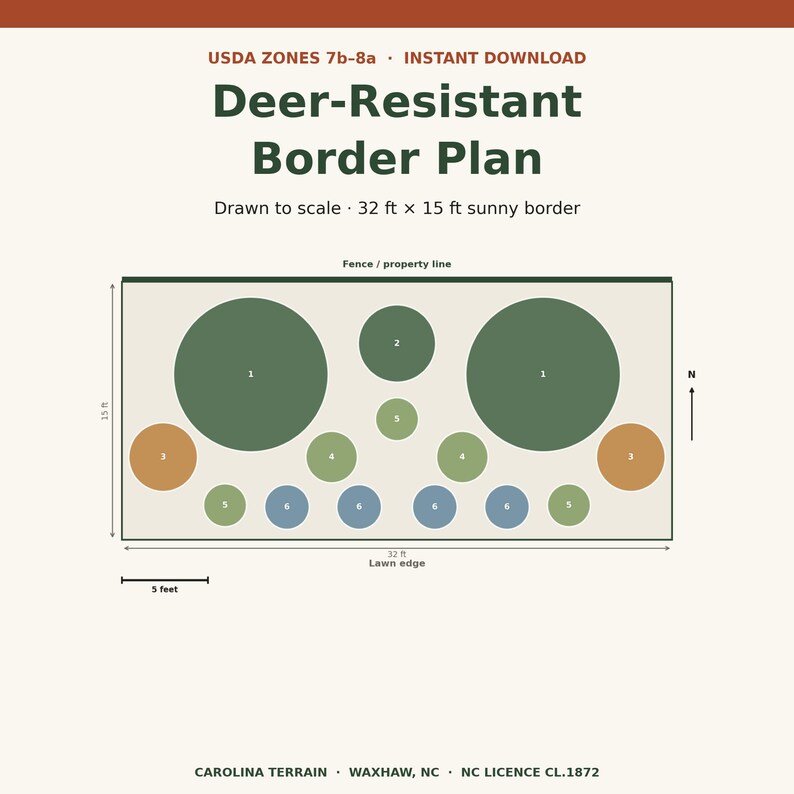
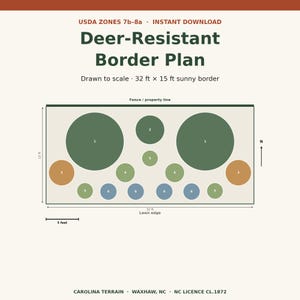
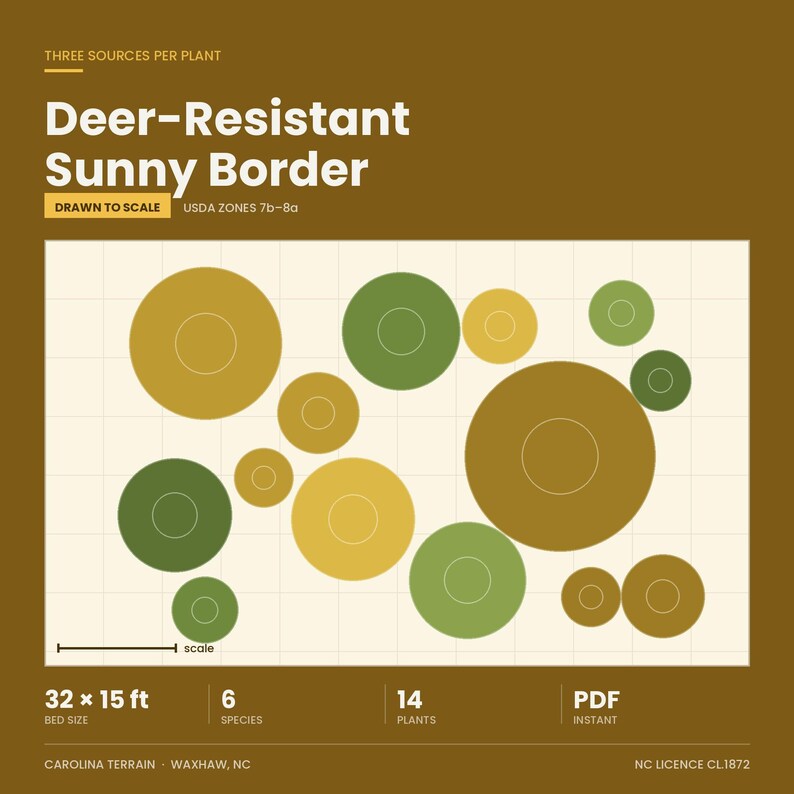
A drawn, to-scale planting plan for a 32 ft x 15 ft sunny border. Six species, fourteen plants - and every single one carries three or more independent sources saying deer leave it alone.
SIX SPECIES. THAT IS THE POINT, NOT A LIMITATION.
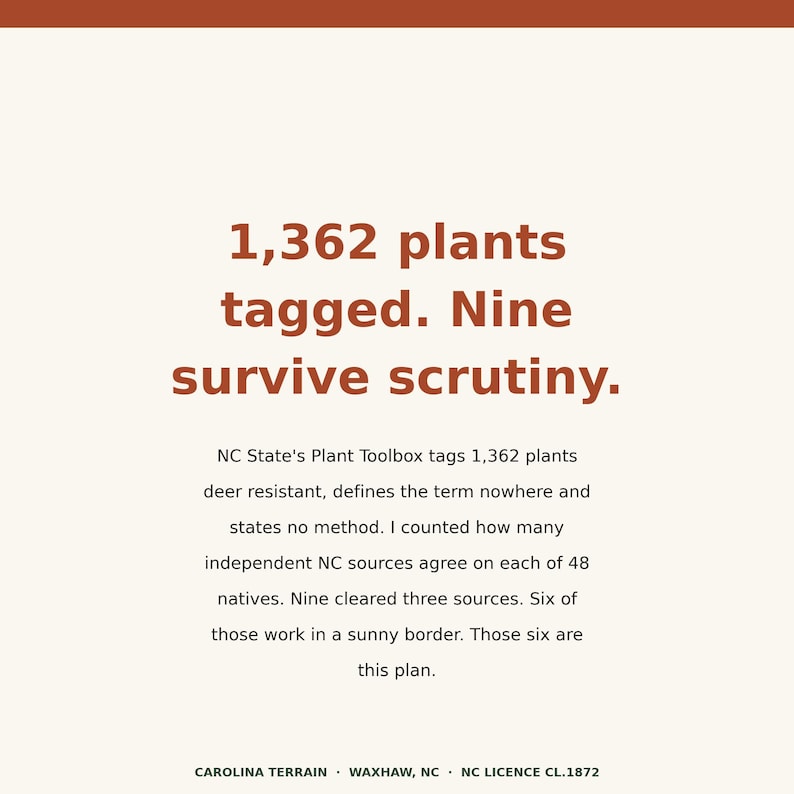
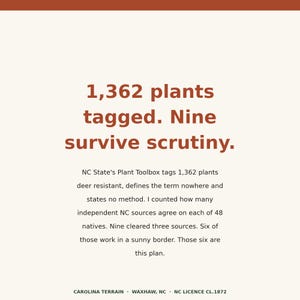
NC State's Plant Toolbox tags 1,362 plants as deer resistant. It never defines the term, never states a method, and the filter is binary - a plant is either tagged or it is not, with no way to tell "highly resistant" from "mildly".
So I went through 48 natives and counted how many INDEPENDENT sources agree on each one. Nine cleared three or more. Six of those nine work in a sunny border. Those six are this plan.
A longer list would have been easy to write and worth less.
WHAT YOU GET (6-page PDF, instant download)
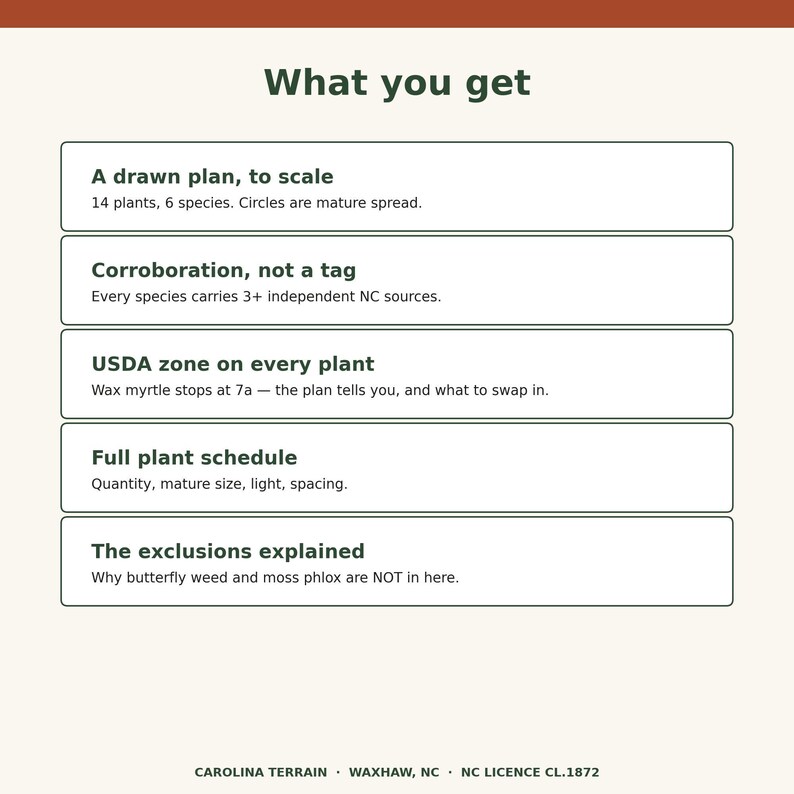
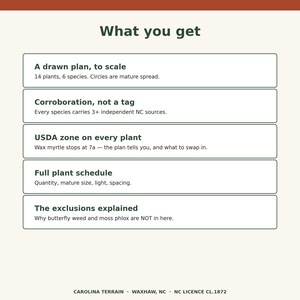
- The plan, drawn to scale, on a full page - circles are mature spread, nothing overlaps
- Plant schedule: 14 plants, 6 species, with quantity, mature size, light and spacing
- A USDA hardiness zone range on every plant, looked up individually
- How the six were chosen, and which sources were counted
- The plants I deliberately left out, and why
- Installation sequence and first-two-years care
- Sources, cited
THE PLANTS I LEFT OUT
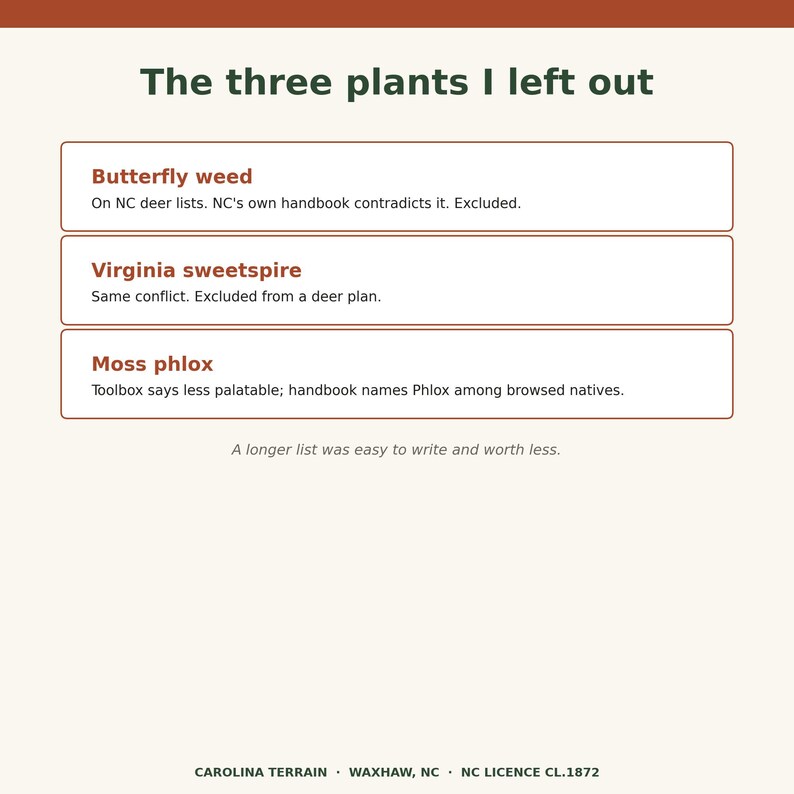
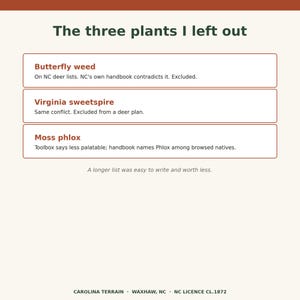
Butterfly weed, Virginia sweetspire and moss phlox are all sold as deer-resistant and all appear on regional deer lists. The sources contradict each other on all three - the Toolbox calls moss phlox "less palatable to deer" while the Extension handbook names Phlox among frequently browsed natives. None of them are in this plan.
NOTHING HERE IS DEER-PROOF
I will not sell it as such. Under enough pressure - a hard winter, a drought, a herd with nothing else left - a deer will eat almost anything on this page.
New plantings get browsed more than established ones, because young growth is softer. A plant that will be ignored in year three can be stripped in year one. Protect new plants for the first season or two. That matters more than species choice.
If deer pressure is severe, the honest answer is a fence.
WHERE IT APPLIES
Drawn from USDA Zones 7b-8a. Five of the six species run from Zone 3, 4, 5 or 6 up to Zone 9 or 10, so the planting is hardy across most of the eastern United States. Wax myrtle is the exception at 7a - the plan tells you what to substitute if you are colder.
Deer browse pressure is local in a way hardiness is not. The corroboration counts here come from North Carolina sources. Rutgers and Penn State publish defined graded scales for their own regions and both are better structured; if you garden in the mid-Atlantic or Northeast, cross-check these six against those too. I would rather you did that than trust my region blindly.
WHAT THIS IS NOT
Not a design for your property. Not a fence specification. Not a guarantee. I am a licensed North Carolina landscape contractor (CL.1872), not a professional engineer and not a registered landscape architect.
Instant download. Nothing ships.
Price:£16.87
You can only make an offer when buying a single item.
Delivery
Instant download
Your files will be available to download once payment is confirmed. Here's how.
Instant download items don't accept returns, exchanges or cancellations. Please contact the seller about any problems with your order.
Seller's description
Specifications
A drawn, to-scale planting plan for a 32 ft x 15 ft sunny border. Six species, fourteen plants - and every single one carries three or more independent sources saying deer leave it alone.
SIX SPECIES. THAT IS THE POINT, NOT A LIMITATION.
NC State's Plant Toolbox tags 1,362 plants as deer resistant. It never defines the term, never states a method, and the filter is binary - a plant is either tagged or it is not, with no way to tell "highly resistant" from "mildly".
So I went through 48 natives and counted how many INDEPENDENT sources agree on each one. Nine cleared three or more. Six of those nine work in a sunny border. Those six are this plan.
A longer list would have been easy to write and worth less.
WHAT YOU GET (6-page PDF, instant download)
- The plan, drawn to scale, on a full page - circles are mature spread, nothing overlaps
- Plant schedule: 14 plants, 6 species, with quantity, mature size, light and spacing
- A USDA hardiness zone range on every plant, looked up individually
- How the six were chosen, and which sources were counted
- The plants I deliberately left out, and why
- Installation sequence and first-two-years care
- Sources, cited
THE PLANTS I LEFT OUT
Butterfly weed, Virginia sweetspire and moss phlox are all sold as deer-resistant and all appear on regional deer lists. The sources contradict each other on all three - the Toolbox calls moss phlox "less palatable to deer" while the Extension handbook names Phlox among frequently browsed natives. None of them are in this plan.
NOTHING HERE IS DEER-PROOF
I will not sell it as such. Under enough pressure - a hard winter, a drought, a herd with nothing else left - a deer will eat almost anything on this page.
New plantings get browsed more than established ones, because young growth is softer. A plant that will be ignored in year three can be stripped in year one. Protect new plants for the first season or two. That matters more than species choice.
If deer pressure is severe, the honest answer is a fence.
WHERE IT APPLIES
Drawn from USDA Zones 7b-8a. Five of the six species run from Zone 3, 4, 5 or 6 up to Zone 9 or 10, so the planting is hardy across most of the eastern United States. Wax myrtle is the exception at 7a - the plan tells you what to substitute if you are colder.
Deer browse pressure is local in a way hardiness is not. The corroboration counts here come from North Carolina sources. Rutgers and Penn State publish defined graded scales for their own regions and both are better structured; if you garden in the mid-Atlantic or Northeast, cross-check these six against those too. I would rather you did that than trust my region blindly.
WHAT THIS IS NOT
Not a design for your property. Not a fence specification. Not a guarantee. I am a licensed North Carolina landscape contractor (CL.1872), not a professional engineer and not a registered landscape architect.
Instant download. Nothing ships.
-
Designed by
-
Item typeDigital download
-
Digital file type(s)1 PDF
If something goes wrong with an order, we've got your back on all eligible purchases. View programme terms
Meet your seller


More from this shop
-
Digital download
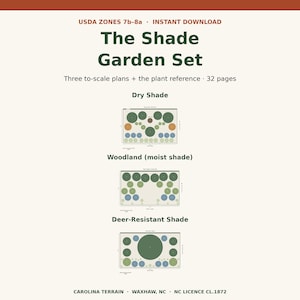
Shade Garden Plan Bundle, 3 To-Scale Layouts, Plant Guide (Digital Download)
£27.18
-
Digital download
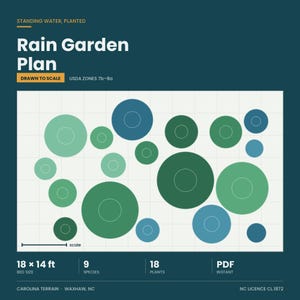
Rain Garden Design Plan, 18x14 ft Basin, 9 Native Species (PDF Download)
£16.87
-

Digital download
Tree Planting Guide for Clay Soil, Root Flare Depth Chart, Staking & Mulching (PDF)
£8.43
-
Digital download
NC Piedmont Lawn Care Calendar, Fescue Bermuda Zoysia Guide (PDF Download)
£8.43
-
Digital download
North Carolina Soil Test Guide, Lime & Fertilizer Calculator (PDF)
£8.43
-
Digital download
NC Piedmont Winter Garden Checklist, Pruning Calendar, Frost Protection Guide (PDF)
£8.43
-
Digital download
Deer-Resistant Shade Garden Plan | Full Shade Foundation Planting Design | Front Yard Landscape Layout
£11.24
-

Digital download
Whitetail Sanctuary Guide: Deer Bedding Areas, Habitat Improvement (Digital Download)
£14.05
-
Digital download
Landscape design – Deer Resistant Garden Plan – Full Sun, Pollinator Friendly (PDF Download)
£11.24
-
Digital download
Mule Deer Hunting Guide: Mastering the Hunt for Western Icons
£14.05
-

Digital download
Tall Fence Gate Plan, Wild Hog Panel, PDF Download
£12.17
-

Digital download
A Beginner's Guide to Scouting for Whitetail Deer
£11.24
-
Digital download
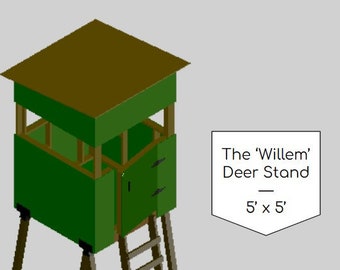
5'x5' Deer Stand (The 'Willem') - PDF Digital Plans
£9.37
-
Digital download
Reference Card Template- Mountain Time Bundle
£14.06
-

Digital download
Fence Plan, Wild Hog Panel 60x72, PDF Download
£18.73
-
Digital download
Whitetail Deer Hunting Strategy Guide (PDF Printable)
£14.05
-

Digital download
Fence Panel Plan, Wild Hog Panel, PDF Download
£9.36
-
Digital download
Reference Card Template - Halter - Mountain Time
£9.37
Shoppers with similar taste loved these
-
Long Wooden Planters Bespoke Sizes
Sale Price £67.99
Original Price £84.99
£77.98 incl. postage
-
Corner Garden Bench Planters
Sale Price £319.99
Original Price £399.99
£329.98 incl. postage
-
120cm Long Wooden Planters
Sale Price £123.99
Original Price £154.99
FREE delivery
-

Digital download
Silly Goose Wall Art Cute Goose Poster Girl Nursery Decor Beige Farm Animal Printable Girl's Room Poster Butterfly Wall Art Kid's Room Print
£5.81
-

Handmade Somerset Garden Planter Box – Treated Wood Trough Pot
£109.99
FREE delivery
-

40cm Square Wooden Planters
Sale Price £91.55
Original Price £114.44
£101.54 incl. postage
-

Wall | Mounted Garden Hose Holder | Heavy-Duty Irrigation | Agriculture Hose Storage Rack"
£70.93
FREE delivery
-

Black Metal Garden Hose Holder: Freestanding, Modern Design, 100 ft+ Capacity
£159.36
Plus postage
-

Garden Hose Reel Holder Stand Storage w/ Ground Stakes -Upto 125-Ft Hoses
Sale Price £93.74
Original Price £156.24
Plus postage
-

Downspout Drain Guard for Rodents & Pests
£14.06
£34.64+ incl. postage
-

6-Hose Guides with Ball Ends, Wrought Iron (SET of 6)
£89.05
Plus postage
-

6-Hose Guides with Leaf ends, Wrought Iron (SET of 6)
£89.05
£174.70+ incl. postage

