














AhoraPrecio:MX$400.98
Precio original: MX$514.00
-22 %
La oferta termina el 10 octubre
Retirement Planner Spreadsheet | Can I Retire Calculator, Retirement Paycheck, Budget, Social Security, Checklist | Excel Google Sheets
Vendedor estrella
Los vendedores estrella tienen un excelente historial probado de experiencia de cliente: reciben reseñas de 5 estrellas de cada pedido, envían con puntualidad y responden rápido a los mensajes que reciben.
Solo puedes hacer una oferta por compras de un único artículo
Vendedor estrella. Este vendedor recibió sistemáticamente reseñas de 5 estrellas, envió los pedidos de manera puntual y respondió rápidamente a los mensajes que recibió.
Puntos destacables
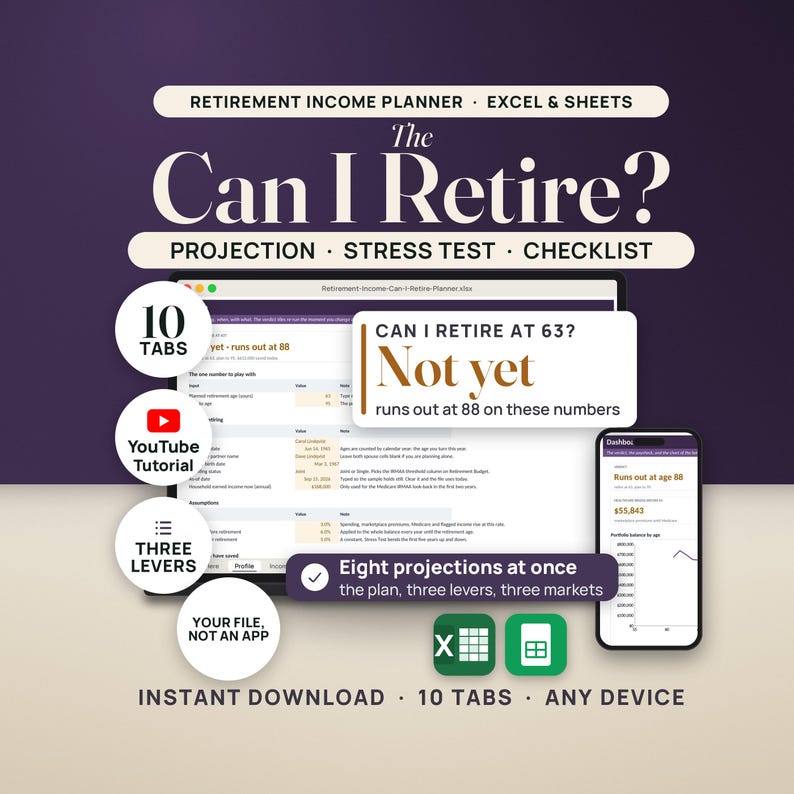
The Retirement Income + "Can I Retire?" Planner is a ten-tab Excel and Google Sheets workbook for someone a few years out from retiring, for answering can I retire, at what age, and what my monthly retirement paycheck would be. One workbook (.xlsx) in four color editions, for Excel or Google Sheets. Instant download.
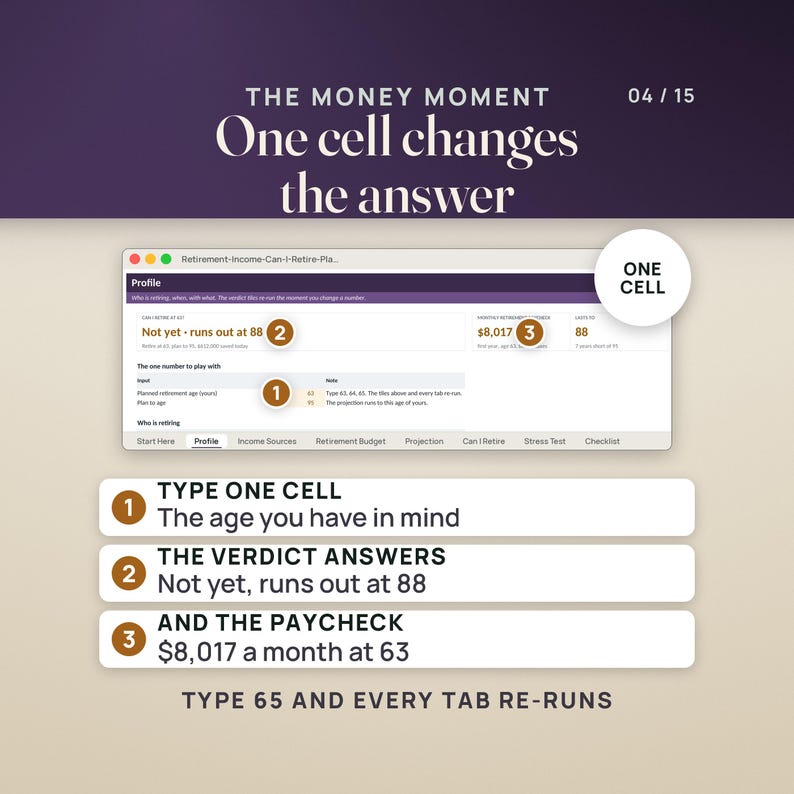
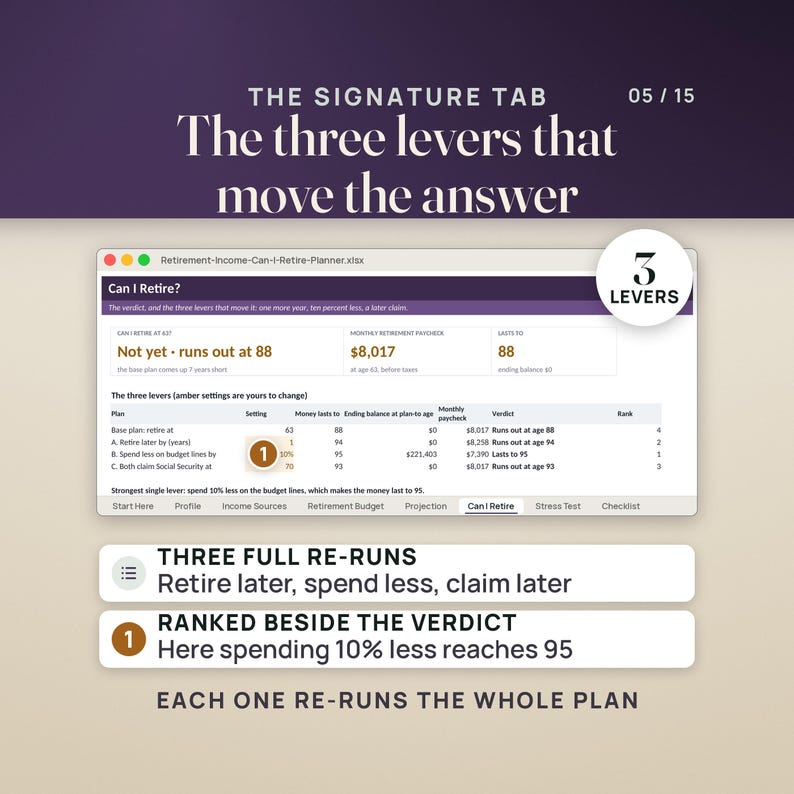
You have a number saved and an age in mind, and nothing that puts the two together. A readiness score out of 100 does not tell you what to change, and neither does a black box that runs a thousand simulations and hands back one probability of success. The sample this file opens with is a couple of 61 and 59 with $612,000 saved who would like to stop at 63, and the file answers in one line: Not yet, runs out at 88, on a monthly retirement paycheck of $8,017.03 before taxes. Change the retirement age from 63 to 65 and the same file says Yes, lasts to 95, with $372,728.69 still there at 95 and the healthcare bridge before Medicare down from $55,843 to $18,370. Then it shows you the three levers that move the answer, and what a bad first five years in the market would do to it.
Type your own figures into the amber cells in Excel on a laptop, upload the file to Google Sheets and read the three tiles on your phone, or print the Checklist and work down it.
————————————————————
📦 WHAT'S INCLUDED (6 FILES)
————————————————————
01. Retirement-Income-Can-I-Retire-Planner.xlsx (the Colorful edition)
The workbook: ten tabs, one row per year of your age out to the age you plan to, eight full projections running at once, 6,885 formulas. Open this one first.
02. Retirement-Income-Can-I-Retire-Planner-Editorial.xlsx
The same workbook, cell for cell, in a quieter editorial palette.
03. Retirement-Income-Can-I-Retire-Planner-Light.xlsx
The same workbook again, light, inside Retirement-Income-Can-I-Retire-Planner-3color.zip.
04. Retirement-Income-Can-I-Retire-Planner-Dark.xlsx
The same workbook again, dark, also inside the 3color zip.
05. QUICK-START-Retirement-Income-Planner.pdf
Two pages: the four things to do first, what every tab holds, and the honest warnings.
06. START-HERE.txt
The one-screen version, in plain text.
————————————————————
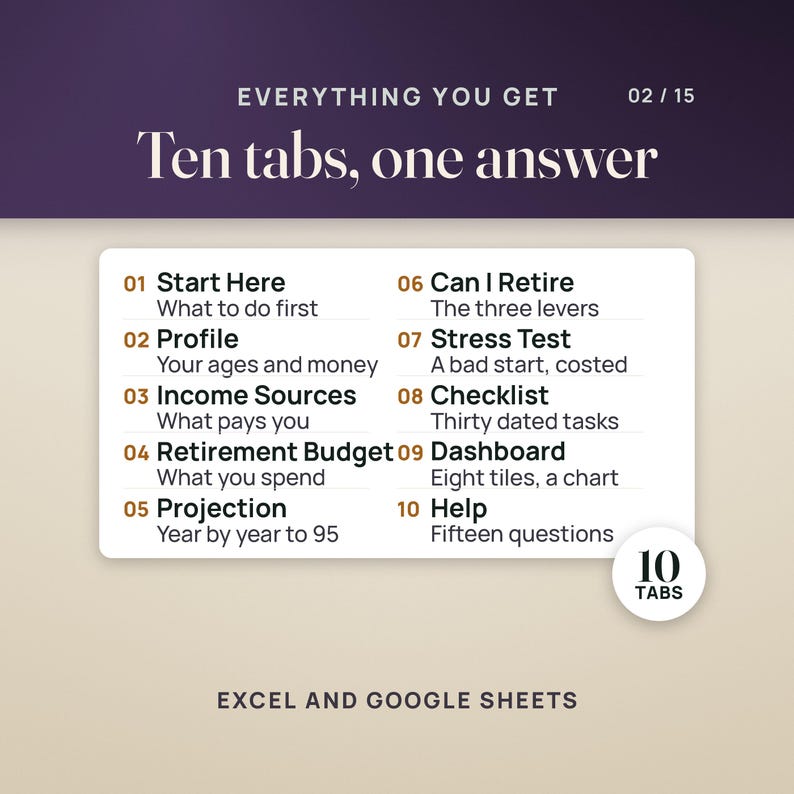
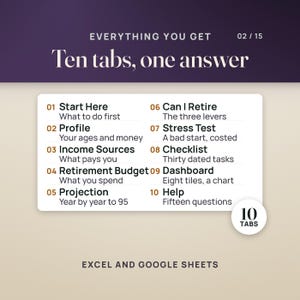
📑 THE TEN TABS
————————————————————
Start Here: what the file answers, the four first steps, how the arithmetic works, the figures to check every year, and the line that says none of this is advice.
Profile: two birth dates, the retirement age you have in mind, the plan-to age, inflation, the return before and after you retire, four balances (pre-tax, Roth, taxable, cash) and the contribution you are still making, under three tiles that re-run while you type: the verdict (CAN I RETIRE AT 63? in the sample), MONTHLY RETIREMENT PAYCHECK and LASTS TO.
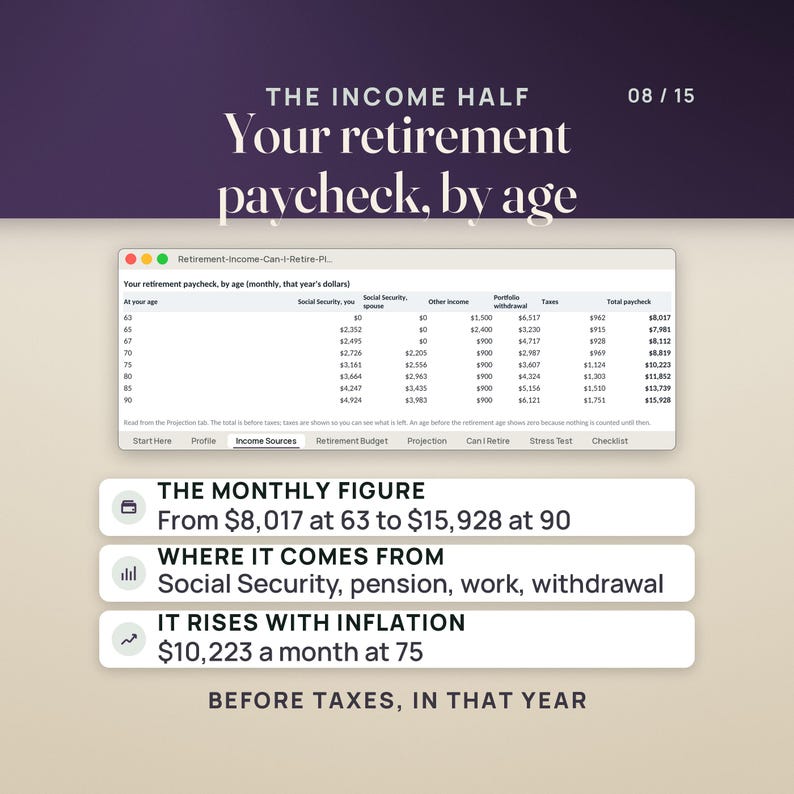
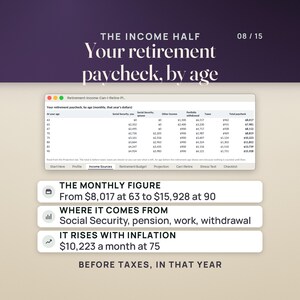
Income Sources: each person's Social Security benefit at full retirement age with the claiming factor table from 62 to 70, eight other-income rows (pension, annuity, rental, part-time work and anything else) each with a start age, a stop age and whether it rises with inflation, and the retirement paycheck by age, which in the sample runs from $8,017 a month at 63 to $15,928 at 90 as inflation lifts the budget.
Retirement Budget: eighteen category rows split Essential and Discretionary, the marketplace premium for each of you before 65, Medicare Part B, Part D and a supplement from 65, the six-tier 2026 IRMAA surcharge table, one effective tax rate, and what the budget costs in each phase.
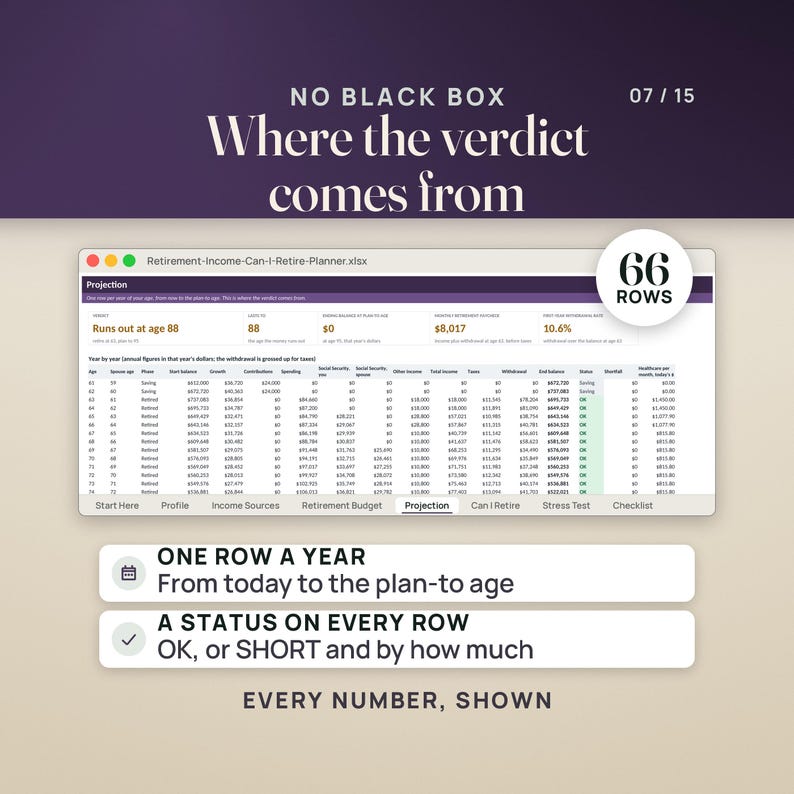
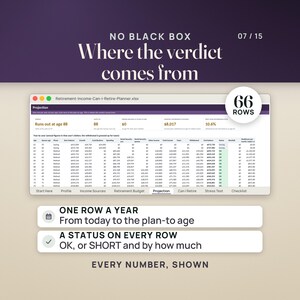
Projection: one row per year of your age with the starting balance, growth, contributions, spending, both Social Security columns, other income, tax, the withdrawal, the ending balance, the status, the healthcare cost that year, the bridge premium, your projected income and the IRMAA tier it lands in.
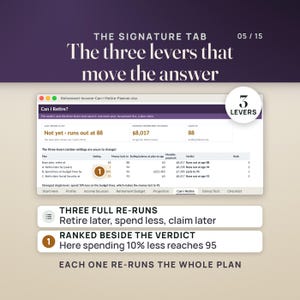
Can I Retire: the verdict, then three levers, each one a complete re-run of your whole plan sitting beside it: retire one year later, spend 10% less on the budget lines, both claim Social Security at 70. Ranked 1 to 4, with the strongest lever named in a sentence.
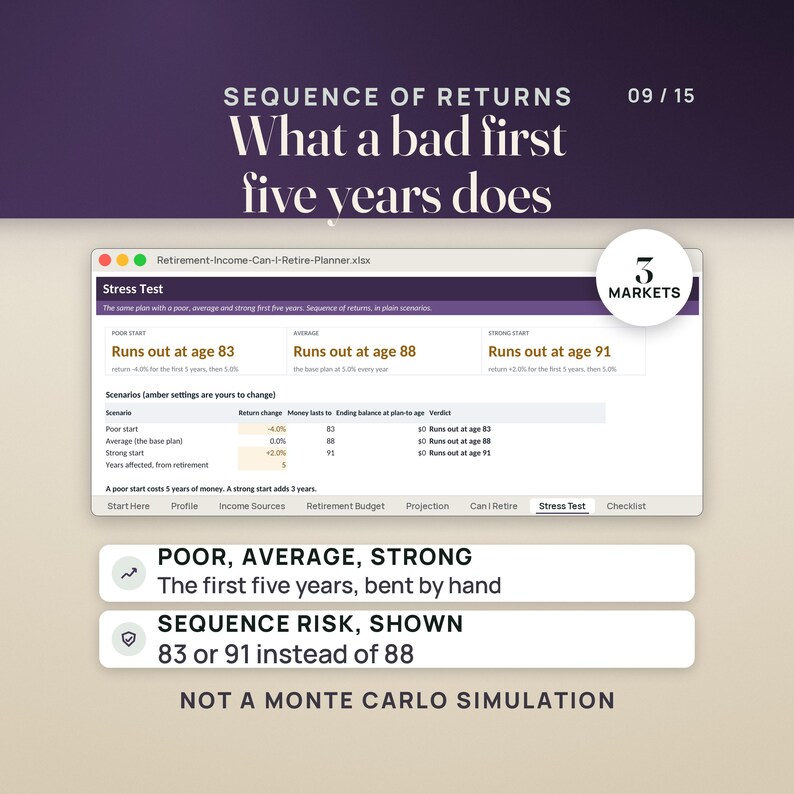
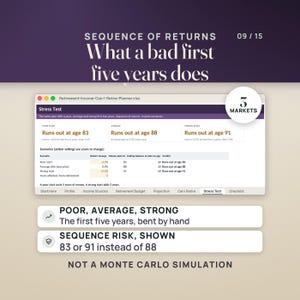
Stress Test: the same plan with a poor, an average and a strong first five years, three full projections side by side, and a line that says what a bad start costs in years.
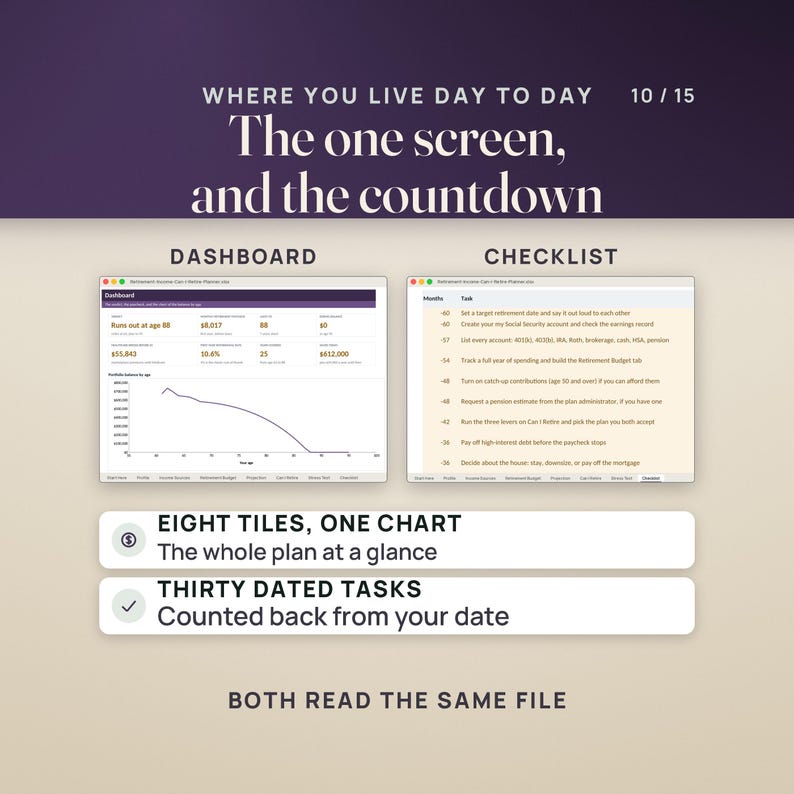
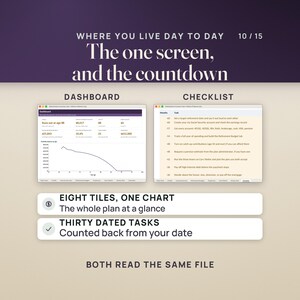
Checklist: thirty pre-retirement tasks dated backward from your retirement date, with done boxes, a status and an open flag.
Dashboard: eight tiles, the balance-by-age chart, the lever table, the stress table, and where your first retirement paycheck actually comes from.
Help: fifteen questions answered in plain English, then the arithmetic explained cell by cell.
————————————————————
👤 WHO THIS IS FOR
————————————————————
Someone within a few years of the age they have in mind who wants a straight answer and wants to see the arithmetic it came out of, not a score and not a black box.
A couple with two birth years, two benefits and two claiming ages who need one plan instead of two calculators. The second person's Medicare and Social Security switch on at their own age.
Someone planning to stop before 65, who needs the years of marketplace premiums before Medicare priced into the plan, and the IRMAA surcharge after it.
————————————————————
🚫 WHO THIS IS NOT FOR
————————————————————
Anyone who wants to be told what to do. The verdict is arithmetic on the assumptions you type, not a recommendation, and nothing here is financial advice.
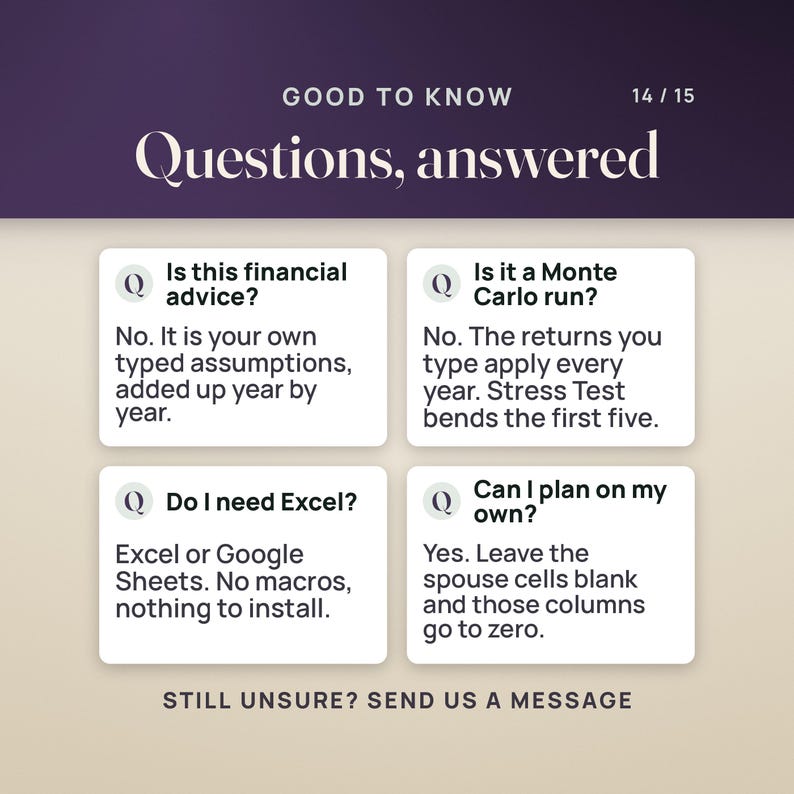
Anyone who wants a Monte Carlo run and a probability of success. The returns here are constants you choose and they apply every year; Stress Test bends the first five years in three plain scenarios instead.
————————————————————
✅ KEY BENEFITS
————————————————————
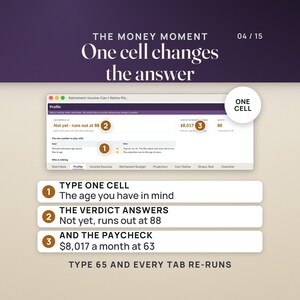
A verdict on the age you type, with the paycheck beside it. At 63 the sample reads Not yet, runs out at 88, a monthly retirement paycheck of $8,017.03 before taxes and a first-year withdrawal rate of 10.6%. At 65 it reads Yes, lasts to 95, $7,981.25 a month, $372,728.69 left at 95 and a withdrawal rate of 4.4%. That is one cell.
Three levers, each one a full re-run of your plan rather than a rule of thumb. From the sample's 63: one more year of work reaches 94, spending 10% less on the budget lines reaches 95 with $221,403 left over, and both claiming Social Security at 70 reaches 93. The file ranks all four and names the strongest.
The healthcare bridge before 65, priced: $55,843 of marketplace premiums retiring at 63 against $18,370 retiring at 65, then Part B, Part D and a supplement from 65, with the 2026 six-tier IRMAA surcharge looked up from your own projected income two years earlier.
A sequence-of-returns test in plain scenarios rather than a simulation: a poor first five years runs the sample out at 83, average at 88, strong at 91. Same money, same budget, a different first five years.
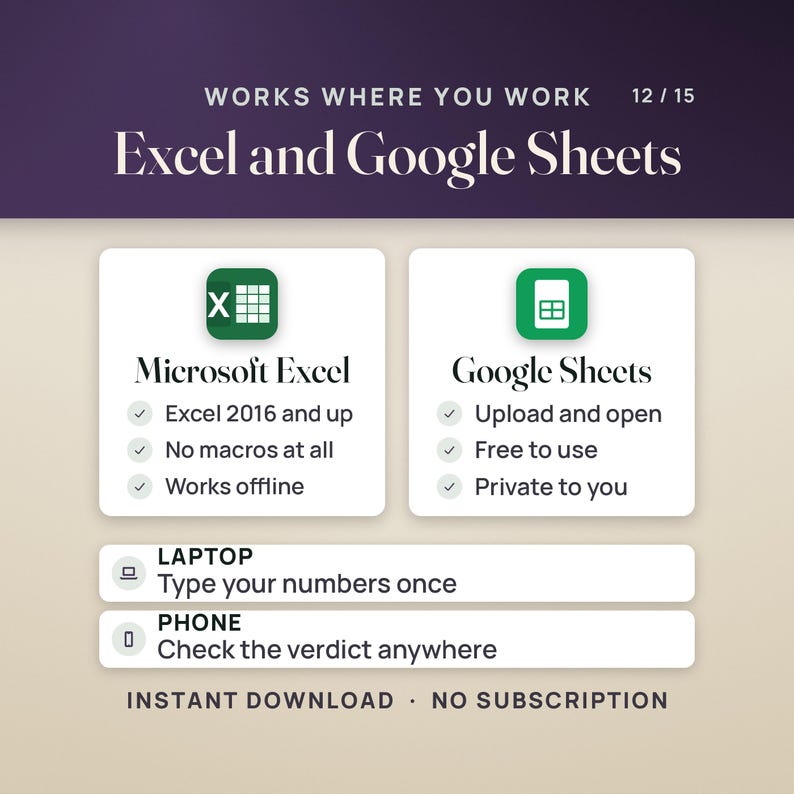
6,885 formulas in every edition and eight complete projections running side by side (your plan, the three levers, the three markets), recalculated with zero errors, and both Excel and Google Sheets fully working. No macros, no add-ons, no account, nothing to install.
————————————————————
🔧 HOW IT WORKS
————————————————————
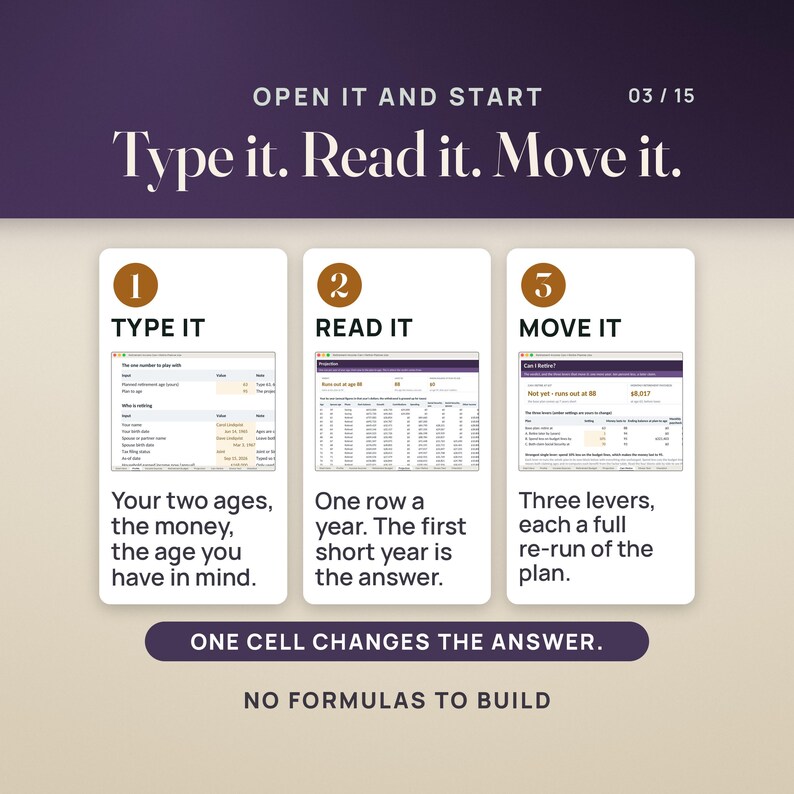
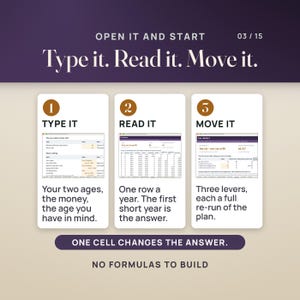
1. On Profile type over the sample: two birth dates, the retirement age you have in mind, the plan-to age, inflation, the return before and after you retire, your four balances and what you are still contributing. Then Income Sources (each benefit at full retirement age and the claiming age you want, from 62 to 70, plus pension, annuity, rental or part-time work with start and stop ages) and Retirement Budget (what you spend a month, the marketplace premium before 65, Medicare from 65, the IRMAA table and one effective tax rate).
2. Read the three tiles at the top of Profile. The sample couple (Carol and Dave Lindqvist, 61 and 59, both invented) have $612,000 saved, spend $5,200 a month on the budget lines and want to stop at 63: the tile reads CAN I RETIRE AT 63? Not yet, runs out at 88, with a monthly retirement paycheck of $8,017.03, a first-year withdrawal rate of 10.6% and $55,843 of marketplace premiums to cover before Medicare. Type 65 into that one cell and the whole file re-runs: Yes, lasts to 95, $7,981.25 a month, $372,728.69 left at 95, a 4.4% withdrawal rate and an $18,370 bridge.
3. When the answer is Not yet, work the levers. Can I Retire re-runs your plan three more ways beside the original and ranks them, Stress Test shows what a poor first five years does to the same plan, and the Checklist dates thirty pre-retirement tasks backward from the retirement date you settle on.
————————————————————
❓ QUESTIONS BUYERS ASK
————————————————————
What format is this? One workbook (.xlsx) in four color editions, Colorful, Editorial, Light and Dark, plus a two-page quick-start PDF and a plain-text START-HERE file. You get a zip file to download the moment payment clears.
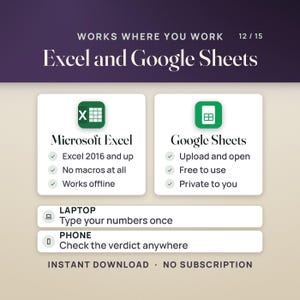
What do I need to open it? Excel 2016 or later, or Google Sheets (File, Import, Upload, then Replace spreadsheet), on a computer or through the Excel or Sheets app on a phone or tablet. It was tested in LibreOffice Calc as well. Apple Numbers opens it but drops some of the formatting, so Excel or Sheets is the better home. There are no macros, no add-ons and nothing to install. Every formula ships with its value saved, so the sample shows up in protected view, in the Sheets preview and on a phone instead of blanks.
What does it compute? Whether the money lasts to your plan-to age or the age it runs out; your monthly retirement paycheck in the first retirement year and in every year after it; the first-year withdrawal rate; Social Security for each of you from the claiming age you pick, using the factor table from 62 to 70; every other income source between its start and stop ages; your spending inflated year by year, with healthcare split into marketplace premiums before 65 and Medicare with an IRMAA surcharge after it; the withdrawal each year, grossed up so that spending plus tax is met; the ending balance at your plan-to age; the run-out age under three levers and under three market scenarios; and thirty checklist dates counted back from your retirement date.
Is this financial advice? No. It is a spreadsheet doing arithmetic on assumptions you type, and the verdict is that arithmetic and nothing more. It is not a Monte Carlo simulation either: the return and the inflation you type apply every single year, and Stress Test bends the first five years by an amount you choose in three plain scenarios. Every name and figure in the sample, including Carol and Dave Lindqvist, was invented for the example. Talk to a professional about your own situation.
————————————————————
⚠️ PLEASE READ
————————————————————
Nothing in this file is financial, tax, legal or Medicare advice. The verdict is the file's arithmetic on the assumptions you type, and when you change one of them the answer changes.
Returns and inflation are constants you choose, applied every single year. Real markets do not behave that way. This is not a Monte Carlo simulation and it is not a forecast. Stress Test re-runs the same plan with a poor, an average and a strong first five years so you can see what a bad start costs; in the sample that is the return less 4.0 points for five years and the return plus 2.0 points, both of them cells you can change, and none of the three is a prediction.
The 2026 IRMAA brackets and surcharges, the Medicare Part B, Part D and supplement premiums, and the Social Security claiming factors from 62 to 70 are amber inputs holding 2026 figures. Nothing in the file updates them. Check them against ssa.gov and medicare.gov each year and retype them, along with your own benefit at full retirement age.
Tax is one effective rate you type, applied to withdrawals plus taxable income, where the taxable share of Social Security is a percentage you type rather than the provisional-income rules. Required minimum distributions, Roth conversions, capital gains rates, the standard deduction and state rules are not modeled, and the four balances are treated as one pot: the Roth split is recorded for your own reference.
The IRMAA tier for a year is looked up from the plan's own projected income two years earlier, compared in today's dollars against the bracket table, so the brackets are assumed to keep pace with inflation. For the first two years there is no earlier plan year to read, so the household earned income you type on Profile stands in. There is no life-changing-event appeal.
Everything lands once a year rather than once a month, so the ages are right to the year and the balances are not right to the month. A surplus year is treated as spent rather than reinvested, which is conservative on purpose. Income before the retirement age is not counted, because until then your paycheck is assumed to cover your spending.
Long-term care is not modeled at all, and it is the largest single risk a plan like this misses. The Checklist says so in the task at twelve months out.
The plan has room for 66 years of rows, which covers a 30 year old planning to 95. Ages are counted by calendar year, and the projection is indexed by the first person's age.
Amber cells are the ones to type in, and every other cell is calculated. The four color editions are separate files, so a figure typed into Light does not appear in Dark.
Every name and figure in the sample, including Carol and Dave Lindqvist, was invented for the example.
————————————————————
📥 INSTANT DOWNLOAD
————————————————————
Your files are available the moment your payment clears. Nothing is shipped.
Start with the quick-start guide: the four things to do first and what every tab holds.
🎬 WATCH THE FULL WALKTHROUGH before you buy — seven minutes, every tab of the real workbook:
https://youtu.be/3a2ZrlLZUAY
Questions? Send a message. I read and answer them myself.
Descarga inmediata
Los archivos estarán disponibles para descargar una vez que se confirme el pago. Sigue estas instrucciones.
No se admiten cambios, devoluciones ni cancelaciones de los artículos de descarga inmediata. Ponte en contacto con el vendedor si tienes algún problema con tu pedido.
Protección de compras de Etsy
Compra con confianza en Etsy sabiendo que estamos a tu lado si surge un problema con un pedido que reúne los requisitos.
Consulta las condiciones del programa

Revisa este artículo antes de nadie

Respuestas rápidas Tiene un historial de respuestas rápidas a los mensajes.
Buenas reseñas La valoración media de las reseñas es 4,8 o más alta.
Más artículos de esta tienda
Visitar tienda-
Descarga digital
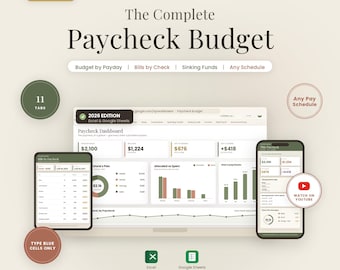
Hoja de cálculo para presupuesto por nómina Planificador de presupuesto por nómina para Excel y Google Sheets Facturas quincenales Fondos de reserva y ahorros
Precio en oferta MX$208.29
Precio original MX$267.02
-
Descarga digital
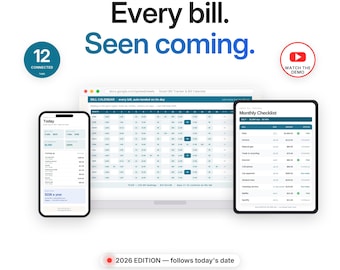
Hoja de cálculo para seguimiento de facturas, calendario de facturas y lista de verificación de pagos mensuales para Excel y Google Sheets, organizador de suscripciones con fecha de vencimiento y pago automático.
Precio en oferta MX$160.04
Precio original MX$205.28
-

Descarga digital
Retirement Withdrawal Spreadsheet | RMD, Roth Conversion and Social Security Timing Planner for Excel and Google Sheets | Drawdown Order
Precio en oferta MX$529.25
Precio original MX$678.64
-
Descarga digital
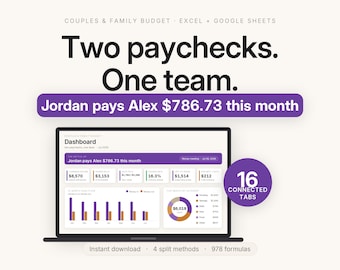
Couples Budget Spreadsheet Bill Split Calculator Who Owes Who Family Budget Planner Excel Google Sheets Shared Expense Tracker
Precio en oferta MX$240.41
Precio original MX$308.18


