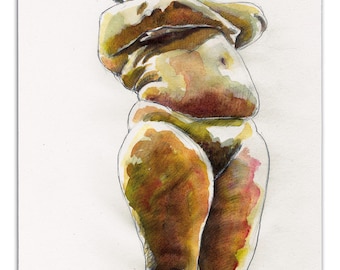
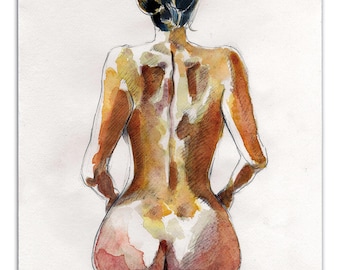
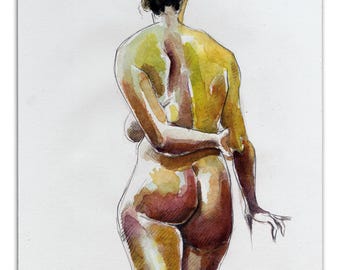
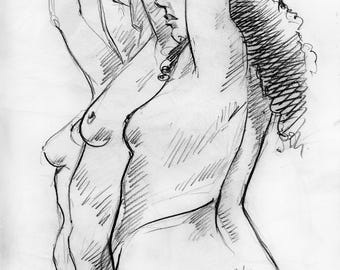
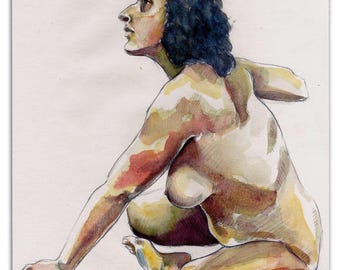
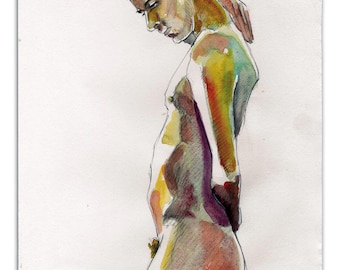
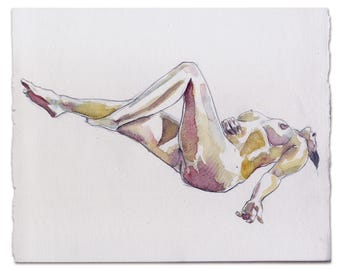
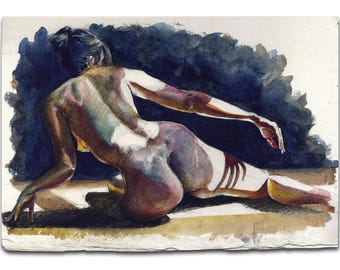
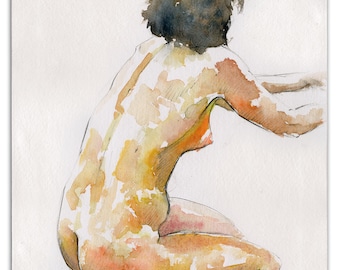
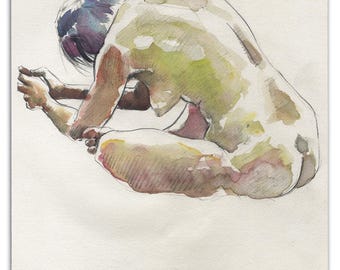
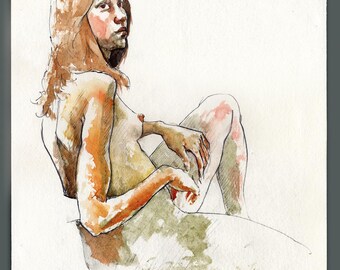
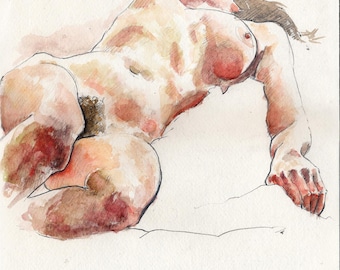

Nude portraits
I’ve been drawing naked people for a very long time. It’s OK, they all know I’m doing it, and so does my wife (who doesn’t mind in the least!). In fact, there is usually some financial arrangement by which I pay for the session either direct to the model or via the organising group. But recently there’s been an interesting development — People have been paying me to draw them. This is how it came about.
Student Days
My first foray into life drawing took place during a year long Foundation Course in Art & Design at Dyfed College of Art in 1982. I was taught by the softly-spoken figurative artist Paul Edwards, himself an artist of enviable pedigree and skill. He had been taught by Lucien Freud at the Slade, who had in turn been taught by Walter Sickert, and he, by Whistler and Edgar Degas. An artistic lineage I have subsequently proclaimed for myself!
The first time you have a model reveal themself to you there is undoubtedly a brief frisson of excitement at the oddness of the arrangement by which they are naked, exposed, while everyone else is fully clothed. Then you start to draw and you might as well be drawing a sideboard. You concentrate on the task at hand.
When I look back at my earliest life drawings I can see that I had an eye for proportion even if the quality of my linework was a little gauche. From the outset I was more interested in the line than the tone or colour and made efforts to delineate emphasis by varying the strength of my line rather than heavily shading or crosshatching. I still experimented, as directed, with paint, charcoal and pastels, but my abiding love affair with the pencil had already taken root. I have always been fascinated by all the potential masterpieces contained in the slim form of a pencil.
I continued to seek out life drawing classes when I moved on to the next level of education, a HND in Technical Illustration at Swansea Institute of Higher Education. The course valued drawing and was happy for us to add ourselves to other courses’ life sessions that were open to all-comers in the Faculty of Art. In addition, I learned analytical drawing and the perspective of air — the technical illustration technique by which you increase the thickness of a line that is on the outside of an object or in front of another part of the same. Lines underneath objects are also given more emphasis to suggest the object’s weight. This technique can also be applied to the figure, or anything you draw in fact. I still employ it today.
I spent these developmental years working almost entirely in monochrome. There was so much to perfect with just a pencil that I did not feel the need to add colour to the equation. I still fiddled about with pastels and coloured pencils but not with the same application.
Glasslight
When I left Higher Education (briefly, as it was to turn out) I continued to attend life drawing sessions in my hometown of Swansea. These were held at the time in the Glasslight Studios, in the old pump house of the Marina (now a chain pub). Glasslight was run by a collective of stained glass artists who had trained at the world renowned course in the city and arranged a life class with a rota of models on a Thursday night. This weekly discipline kept my skills up and helped make a number of useful contacts in the arts community. When I met my wife in 1988 I continued to attend while also benefitting from drawing her svelte form at home.
We went travelling for a year in late 1990 and aside from a couple of classes I joined in Oregon I didn’t do any life drawing until we returned and settled down again, a break of nearly two years.
The Glynn Vivian
Swansea has a small but impressive Edwardian art gallery, the Glynn Vivian and it was here that I went for a few years to draw nudes again. The sessions, again on a Thursday, were held in the main foyer, a space of beautifully tiled floors and balustraded staircases and balconies. As the class was very well attended, and in such a large space, they provided two models at the same time, spoiling us for choice. The classes ran for a few years until the council decided to withdraw funding, though how they didn’t turn a profit with so many attendees was beyond me.
A word here about the models. Not everyone can do this job. You need confidence, determination, patience and a surprising amount of strength and stamina. I am almost always in awe of them. You do get the odd lacklustre model who are finicky and unwilling to make much of an effort with their poses, but thankfully they are the exception to the rule. The discipline attracts a certain character regardless of their background or upbringing. I’ve drawn builders, retired teachers, soldiers, dancers, fellow artists, yoga gurus and rugby players, from eighteen to eighty (in truth, not so many eighty-year-old rugby players), and they have all had an admirable self-awareness and a comfort in their own skin. From what I understand, I’ve never tried it myself, posing gives them a body positivity that would take most of us a long time in therapy to achieve. It’s generally a part-time job but there are a few models who make a living out of it, posing for colleges and universities as well as doing the rounds of the various classes about the area. There are also opportunities to pose one-to-one for artists in their studios, but I have never engaged a model on this basis myself. It may not be surprising that some models use pseudonyms to remain anonymous but most are completely open about what they do.
Naturally, I’ve experienced a few oddities along the way. There has been the occasional model who got an erection —usually ignored by all until it fades. We’ve had a couple of late stage pregnant women whose nipples have started dripping, and we had one unfortunate elderly gent who posed, blissfully unaware that he was sporting a tail of toilet paper. I don’t think anyone included it in their drawing. I didn’t find any of these incidents embarrassing, in all cases you are just reminded of the humanity that you are being privileged to witness.
Teaching
Around 1998 I was asked to teach the life drawing class on the Foundation course at Swansea Institute. I have always enjoyed the hands on teaching that drawing necessitates, but I found it frustrating to be in a life room for two or three hours without doing any drawing myself. Consequently although I was involved in life drawing, I was not doing so much myself! I had taught a number of subjects as a part time lecturer previously, including analytical drawing, graphic design and perspective drawing, but life drawing is another thing entirely.
In a group of mixed abilities (which are obvious from the first drawing the student makes) I found that the best approach was to demonstrate the way I draw and then to encourage the artist to find their own way. Every artist wants to find their original style, and it is virtually impossible, and somewhat fatuous, to proscribe or predict what this may be. There are so many variables in approach, technique and materials alone, that you can only really teach them how to look.
I have taught many classes over the years and in the main I feel that if a student can find the spark that defines the life-form before them, my job is done.
I have recently been teaching again, holding life drawing masterclasses for other artists at the Royal Cambrian Academy of Art (where I am a member) in North Wales and in Amsterdam at the Galerie du Nord.
The Lull
As our family grew to four children and work became more demanding, my regular drawing became erratic for five or six years. It was difficult to have any routine with my wife and I both working full time and ferrying the kids through childhood’s occasionally turbulent waters. For part of this time I attended the relocated remnants of the Glynn Vivian sessions at Swansea Print Workshop, and this eventually became my venue of choice for several years to come. During this period I doubt I filled more than a couple of sketchbooks in total, but that could not be helped.
Regular Drawing Resumes
Eventually, I began to have time for a regular weekly session again and even began treating myself to an occasional Monday morning session at the Print Workshop too. This introduced me to a different set of artists of the more mature variety. These old guys had been drawing for forty years plus and were a fantastic bunch of characters with a wealth of experience and stories to relate. A couple were very good artists indeed, time served craftsmen. I enjoyed sharing my work with them and gained an appreciation that age was not an issue when it came to drawing. It’s a lifelong urge. There was also a little illicit thrill to nicking off work for the morning to draw, a privilege that running your own business can allow from time to time.
I’d been promoting my work on a website for some time by now with little success when I got a call out of the blue from a pregnant woman in Manchester who wanted to commission some nude portraits. We agreed a fee that covered my time and travel, and I went up for the day to draw her while her husband and I listened to the cricket on the radio. Anyone who hasn’t been to a life drawing class might find this odd, and I am acutely aware of the ‘Carry On’, nudge, nudge, wink, wink attitude that is foremost in most people’s minds, but it is not in the least bit unusual or uncomfortable once you are engaged in the situation. The couple were very happy with the unique, personal memento of the pregnancy, and I enjoyed their company and was well paid for my effort. We won the cricket too.
The Thursday evening group at the Print Workshop had been going so long by now that it had developed its own unspoken rules. The same people (more or less) would appear every week and sit in the same places. Run by Steve, a painter and decorator in work hours, who arranged the models in a rota of six or so regulars, opened and closed the workspace and took the money. He even filled in as the model on occasions when there was a no show. And all this on a voluntary basis, it wouldn’t have surprised me if he also paid to draw. I marvel at selfless people like this, they are the oil that keeps much of society running. The only issue for me was that the stable of regular models they employed began to get a bit too familiar with repetition. The poses tended to be the same, each model has their own repertoire, and I started to miss the weeks with models I was not keen on drawing. The group has now been running for nearly twenty years and continues to do so after an enforced pandemic lay-off but I have only been a couple of times in the last eighteen months and found it difficult to re-integrate.
Around 2017 I found that I could attend the life drawing group run by Swansea University art society. This presented a different model each week from an eager band of students, often posing as part of their bucket list. I always find it remarkable that a complete novice can quickly become comfortable nude in front of a group of strangers. Many of the students I drew were posing for the very first time, yet had a professionalism and calmness in the task that seemed to suggest they’d been doing it for years.
I sometimes travelled up the valley to Pontardawe Arts Centre’s Saturday morning group around the same period, and also to an occasional class in Crickhowell run by the always excellent Tony Tribe. In each case I found the groups attracted a similar type of person, not surprisingly people I often had a lot in common with.
The same was true of the group that began weekly on Tuesdays at the Elysium Gallery in the city in about 2018. The setup here was very nice with a range of different models to the ones I was overly accustomed to drawing at the Print Workshop. It was also held in the gallery bar, and the entry fee included a drink. It was a pleasing novelty to sit with a pint of Gower Gold while drawing for two hours!
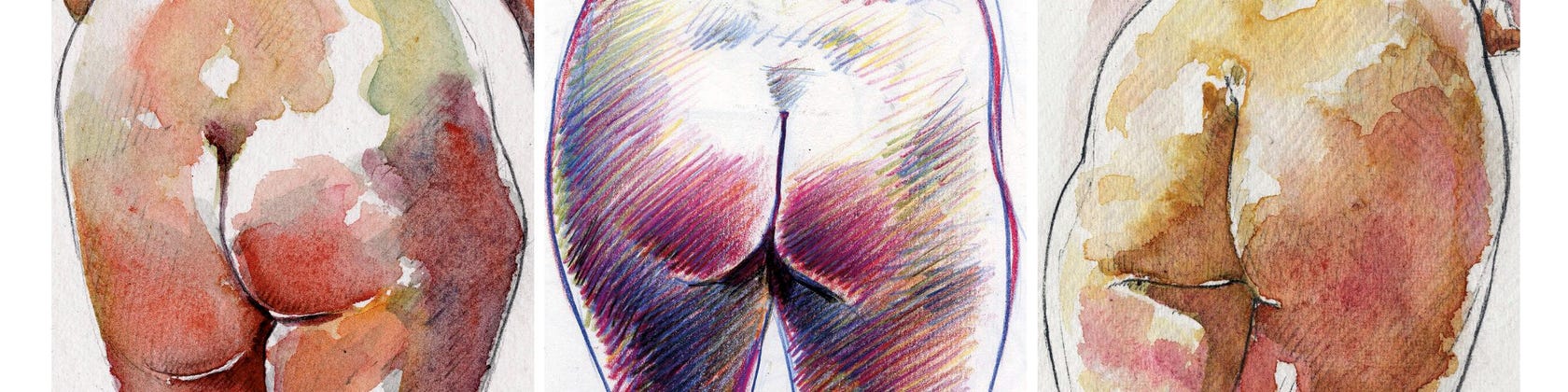
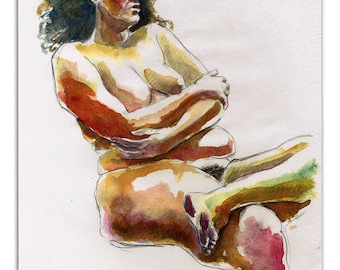
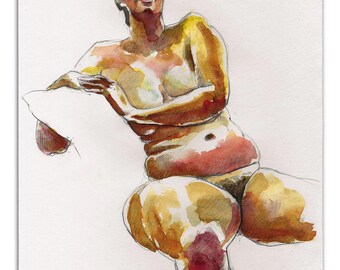
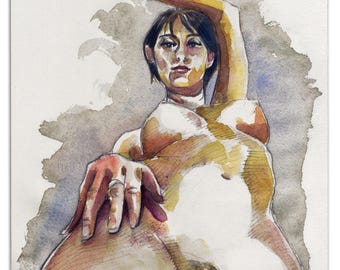
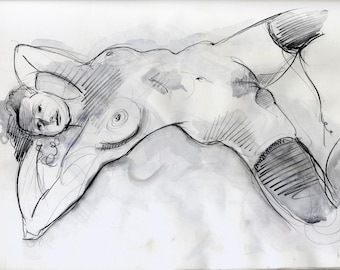
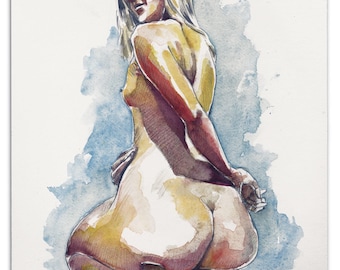
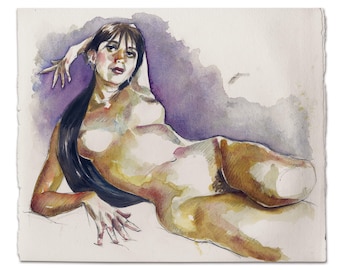
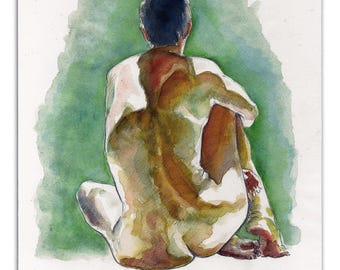
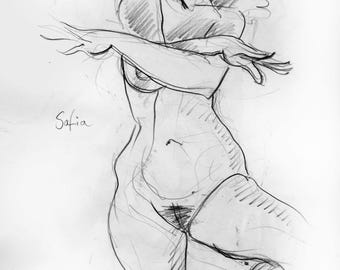
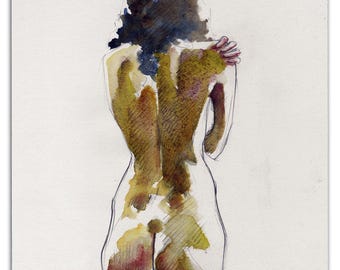
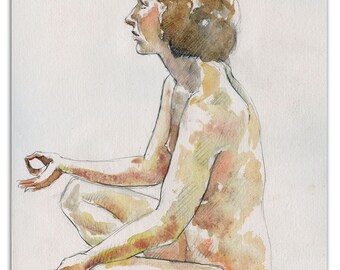
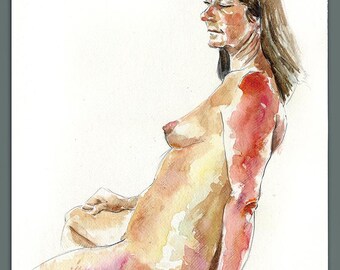
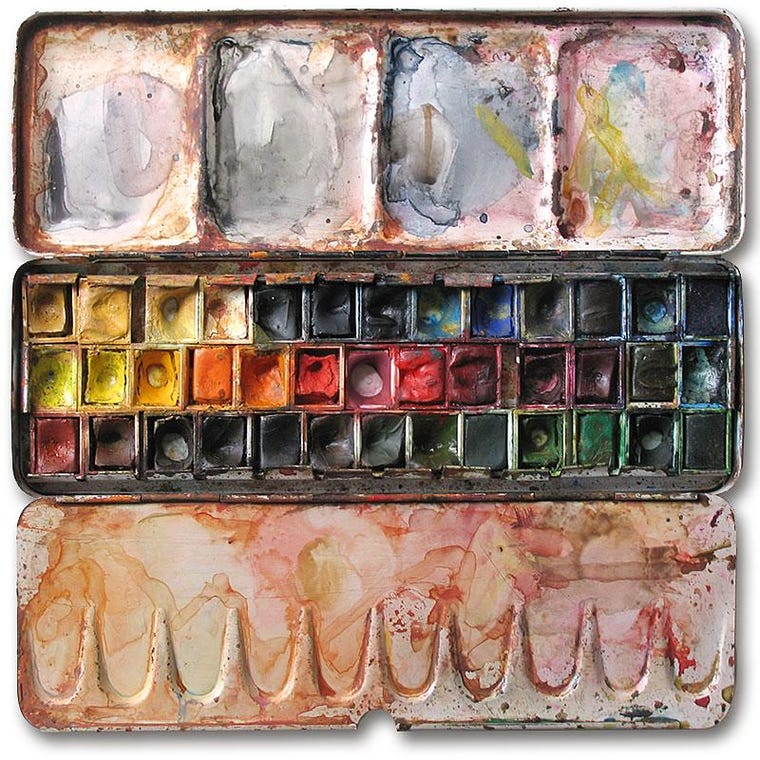
A word about the length of poses. The Thursday group I attended for so long had a set order of pose times — two five minute poses to warm up, followed by three 30 minute poses. I became used to this regime and tailored my style to suit, the short poses done vigorously in 8B water soluble graphite, blended with plain water, and the longer, tighter drawings in 3B water soluble pencil washed over with watercolours. When I started going to the Elysium sessions they offered 10 minute poses followed by 20 minute ones. Initially this threw me and I struggled to adjust my drawing style. It then occurred to me that I had time to introduce colour to the short poses. It was a revelation and I immediately began to loosen up my drawing and painting to fit the time available. This resulted in far more lively drawings, although the hit rate of successful ones was lower.
By now I was drawing twice a week for two to three hours and developing a style I was happy with that was adaptable to the length of pose. Then came the pandemic and, like much else, the classes were closed down.
Lockdown Diversity
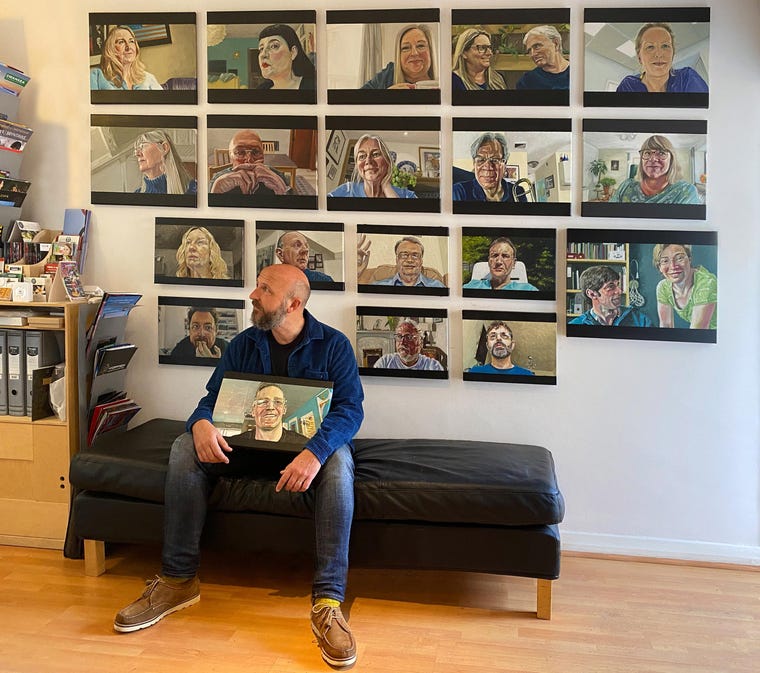
With no classes taking place, I went cold turkey for a week or so. My graphic design work was waning in the downturn and, although I was getting some new stuff in, I found myself with plenty of time on my hands. Now I am not very good at being idle, I get bored quickly and can feel the urge to be creative building up in me. I started hearing about the ways in which people were keeping in touch during lockdown, and downloaded Zoom to see what the fuss was about. It was an eye-opener. At first I persuaded my writing tutor that she could run her classes with this new software and it worked well, everyone quickly assimilated. During one of these classes it dawned on me that I was getting an unusual perspective of each speaker in turn, and I wondered what it would be like to draw someone’s (conventional) portrait via Zoom. So I asked for volunteers on Facebook and found it went extremely well, making three oil portraits in quick succession. This led me to develop a project to paint 19 portraits (Co-Vid 19) over the twelve weeks of lockdown.
While this was going on I still had time to do more, so I started looking at the online life drawing sessions that were springing up all over the place. These were sometimes run by groups that had previously run in-person classes, by enterprising individuals, or even by the models themselves, and could be based absolutely anywhere on the globe within reasonable timezone restrictions. The arrangements threw up some extraordinary combinations — a group organised in Scotland with the model in Mexico or a group in the Netherlands with the model in India for instance. I drew models in Australia, the USA, India, Colombia and Taiwan — all in a couple of weeks. I got chatting with other artists across the globe and found once again that many were like-minded people regardless of nationality. It was inspiring and I increased my drawing time to three to four three-hour sessions a week and filled sketchbook after sketchbook.
My style adapted again, as drawing from a flat screen a metre in front of you is totally different to being in a live class. But I quickly found that some things were actually better on Zoom. I didn’t have to go anywhere or carry my stuff with me, I could draw anytime that suited, and some of the camera angles and lens distortions that the models were exploiting made for some very interesting material. Some models became favourites — a girl posing from her flat every Monday morning in Amsterdam, an Italian actress living in Barcelona, an Australian woman whose sessions were at 9.00 am GMT where the other artists local to her were having an evening glass of wine while I had my breakfast coffee, and the wonderful, imaginative Olja, a Polish actor and dancer living in Belgium. Olja raised the bar, presenting challenging poses from whacky angles, often inspired by artists I’d never heard of whom she’d researched for poses (Dennis Sarahzin, Ferdinand Hodler, Malcolm Liepke).
I began experimenting with pastels and coloured pencils for the first time in years and fell in love with the process again. I still get the odd phase in which I struggle, sometimes due to the model, the length of poses or a poor quality picture, but mostly because I am not up to it all the time. It’s not a tap you can turn on and off, but the more you draw, the better you get and the fewer duff drawings you produce. Most of the time.
Naturism
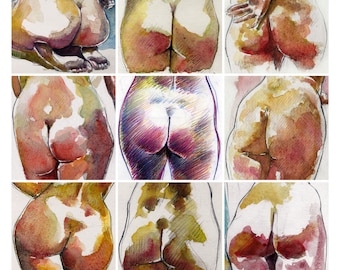
After all these years and thousands of drawings I had hardly ever sold any of my work — not that I had tried very hard. There was the commission in Manchester, I had sold one through a local gallery, a couple to a model and a handful via Instagram, but I could not see that there was much of a market for nudes. After a visit to a naturist beach in Greece in 2019 it dawned on me that I may have found a potential market. The idea stagnated until lockdown came along and I found the time to do something with it. I designed an advert to place in the British Naturism magazine in the hope that I could get some interest from its members in commissioning a nude portrait of themselves or partner. After three weeks I got an enquiry from a gentleman who, coincidentally, lived just down the road from me! This being during lockdown meant we still had to use Zoom however. The session went well though and I sold him a set of portraits. But then, nothing.
A couple of weeks later I got a phone call from the magazine to check if the advert had worked. When I said no, they suggested that I join as a member instead so that I could promote my work through the forums on their website. It worked and I soon had five or six commissions under my belt (yes, I was still wearing one — I needed somewhere to keep my pencils). I’ve since done commissions for naturists across the UK, in Portugal, Spain and in the US — that’s the beauty of doing it on Zoom, it doesn’t matter where the sitter is. They are also at ease, perhaps because they are used to being naked, but also because they are in their home environment.
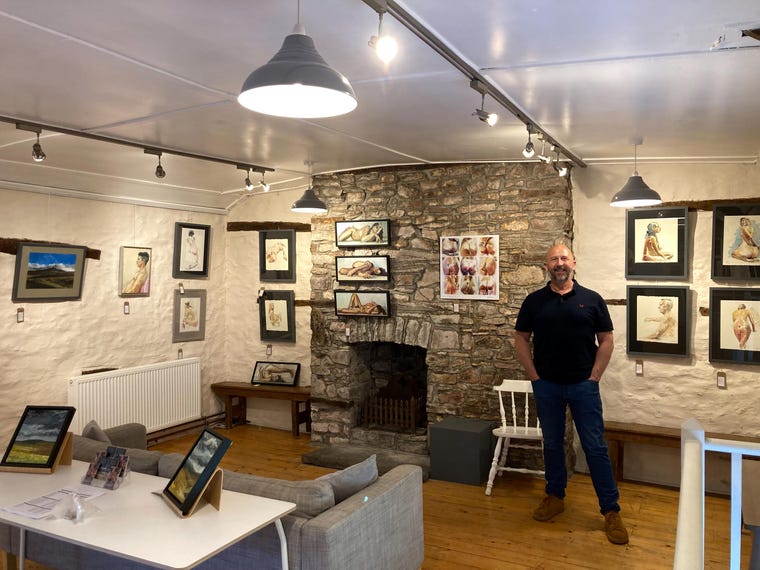
Then, earlier this year I got an enquiry to draw a couple on their fiftieth anniversary visit to a naturist resort in Wales. This was a bit different as I would be drawing them face to face. What made it much different was that I would have to be naked too! I didn’t know how to take this, but they offered a good sum for the work and the weather looked ok so, after consulting my ever tolerant wife, I said yes. I had no qualms about stripping off, I’d been to naturist beaches several times abroad, but that was always in hot sunny weather and, nice as west Wales is, it’s not often that warm. It was OK though, the sitters were very welcoming and soon put me at ease, taking me around the site for a look around, and tried to canvass some more work for me while I was there. So I sat there naked, drawing through a cool, light mist that everyone was doing their best to ignore. It was a challenge, not because I was naked, you soon get used to that, but it was the first time I’d drawn anyone that wasn’t on screen for a good year. They were happy with the work though and kindly made me lunch before I set off again.
What next?
So, apart from a bit of money, what do I get from drawing? I often ask myself. I find peace in it, is the short answer. I switch my brain off when I draw and let instinct and practice take over. Drawing in any form is a great discipline for a visual creative (I am a graphic designer by trade). It encompasses line, form, colour, composition, technique, and develops concentration and judgement. The time limitation imposed by the stamina of the model demands a need to work quickly, with a constant, on the fly, reassessing of line, value and comparative proportion. You gain an appreciation that small details can be the life force of a drawing, a flick here, a gestural mark there, even a drip or splatter can enliven a piece of work.
I recently started making timelapse movies as I worked, and the results were very interesting. I hadn’t realised that I approach each drawing so differently, sometimes sketching out the proportions lightly first, sometimes starting at the head, other times at the feet. It is an intellectual process of course but after all these years of experience I’m not actively thinking it through, I just respond to what I see. I am happy that it shows that even after all this time I am still learning from the process. It has been constantly fascinating to me for over forty years and I can’t see that ending any time soon.