
Runas antiguas. Mentalidad moderna. Vida legendaria.
Ancient runes. Modern mind. Legendary life.
No vine a las runas buscando magia. Vine buscando un sistema.
En los últimos diez años he sido lo que algunos llamarían un psiconauta. La mayor parte de ese tiempo la dediqué a la PNL, que enseña cómo se construye una identidad y cómo reescribirla. Funcionó en lo que hacía, pero nunca en lo que yo creía que valía. Así que busqué algo más antiguo que esa técnica.
Entonces escuché por primera vez los mitos nórdicos, y los nombres empezaron a sonarme familiares. Týr. Odín. Thor. Frigg. Los había estado pronunciando todas las semanas de mi vida sin siquiera haberlos escuchado: cuatro días de la semana llevan el nombre de esos mismos dioses. Nada sobrevive mil trescientos años por ser meramente decorativo. Había algo más allá de eso.
Descubrí que el Futhark antiguo nunca fue una baraja para adivinar el futuro. Era una forma de nombrar fuerzas, tanto en el mundo como en la persona que la portaba. Fehu no significa "el dinero va a llegar". Fehu es lo que estás dispuesto a recibir. Es una cuestión psicológica, y tiene respuesta.
Sentado con ellos, seguía reconociendo las mismas estructuras que la PNL me había enseñado, descritas mil años antes en otro idioma. Veinticuatro fuerzas. Veinticuatro puntos donde la vida se estanca.
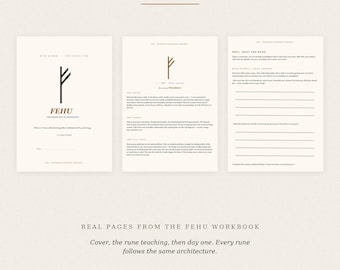
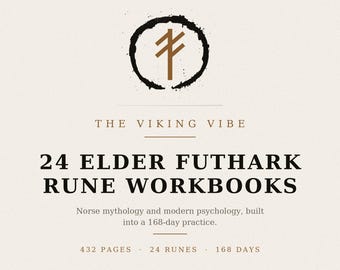
Así que construí lo que quería y no encontraba: un cuaderno de ejercicios por runa, siete días cada uno, mitología en un lado y psicología en el otro. Nada de cascos con cuernos.
Aquí me encargo de todo: la redacción, la investigación, el diseño.
Runas antiguas. Mentalidad moderna. Vida legendaria.
I didn't come to the runes looking for magic. I came looking for a system.
In the last ten years I've been what some would call a psychonaut. Most of that was spent inside NLP, which teaches you how an identity gets installed and how to rewrite it. It worked on what I did. It never touched what I thought I was worth. So I went looking for something older than the technique.
Then I heard the Norse myths for the first time, and the names started sounding familiar. Týr. Odin. Thor. Frigg. I'd been saying them every week of my life without once hearing them — four days of our week are named for those same gods. Nothing survives thirteen hundred years by being decorative. There was something underneath it.
What I found was that the Elder Futhark was never a fortune-telling deck. It was a way of naming forces — in the world, and in the person carrying it. Fehu isn't "money is coming". Fehu is what you're willing to receive. That is a psychological question, and it has an answer.
Sitting with them, I kept recognising the same structures NLP had taught me, described a thousand years earlier in a different language. Twenty-four forces. Twenty-four places a life gets stuck.
So I built the thing I wanted and couldn't find: one workbook per rune, seven days each, myth on one side and psychology on the other. No horned helmets.
I make everything here myself: the writing, the research, the design.
Ancient runes. Modern mind. Legendary life.
