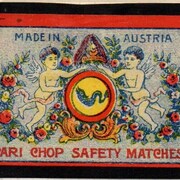
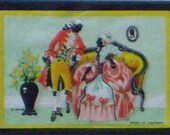
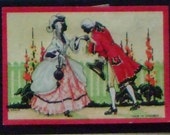
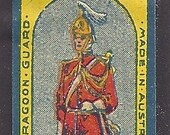
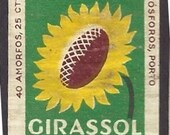
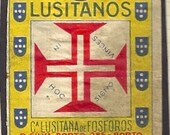
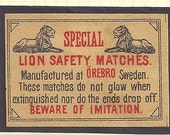
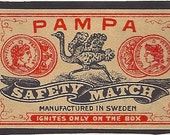
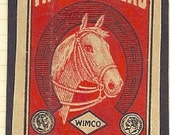
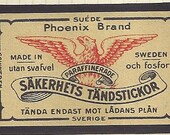
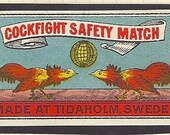
Matchbox labels are miniature works of art advertisements. Sometimes, especially in the mid 20th century, they were also used for propaganda.
The match box labels in this store belonged to my late father-in-law and were collected over a period of sixty years starting around 1940 when he was an aircraft mechanic in the desert of North Africa in WWII for the South African Air Force.
They have been carefully mounted in albums with stamp "hinges" so are easy to remove off the backing without damage. Every picture represents the actual condition of each label.
*****************
Collecting matchbox labels is called Phillumeny or Phillumenism.
When you go to a fancy restaurant or stay at a resort hotel, do you pick up a matchbook or box of matches and put it in your pocket to use later? Even people who don't smoke or use matches will often pick up a matchbook as a souvenir, especially if the matchbook has a lovely or intriguing cover or a logo of the place it came from. There are people who have huge, impressive collections of different items related to matches-matchbooks, matchbox covers, match strikers, individual matches, and so on. If you are one of the many people who enjoy collecting matchbook-related items, then you are a phillumenist.
People started collecting matchbooks when matches first were collected into matchbooks, but there was no specific name for the practice. Marjorie Evans, a British matchbook collector who was the president of the British Matchbox Label & Booklet Society, coined the word "phillumenist" in 1943. Some matchbook collections actually include chemical matches, which were produced much earlier than the modern friction matches we use today. After WWII, there were many match manufacturers who issued special sets of matchbook covers not intended for advertising, specifically geared toward phillumenists.
By the 1960s the hobby of phillumeny grew especially popular as society became more interested in visiting exotic places and finding new ways to advertise them. But in the 1980s, with the introduction of cardboard match boxes, the hobby began waning. Collectors were disappointed with the quality of the new style matchboxes because the images on them were not as distinct and colorful, the print was of poorer quality, and they were clearly designed for straightforward advertising without as much design and flair.
As matchbooks and matchboxes became more functional and less artistic, modern matches became less interesting to collect, but the hobby of phillumeny steadily became more appealing. The reason for the heightened interest is probably that the matchbook covers from decades ago were made a long time before computers and modern printing methods began churning out ordinary matchbooks. Before the cardboard boxes, advertisers went to elaborate lengths to describe their products artistically, and each tiny cover of a matchbook was a tiny piece of art. So collections grew to include not just modern specimens of match-related items, but also collections dating back to the 1820s, when modern matches were first introduced. Phillumenists in different countries tend to collect different types of items, and they also collect match holders and strikers that aristocrats carried matches in over a century ago. Some phillumenists specialize in a certain era or type of item, while others build more general collections.
Because all matchboxes are essentially the same, brand-centric advertising on the outsides of these containers has been an important part of the industry since its foundation in the mid-19th century. Designs ranged from generic labels such as the often-imitated ones produced by the Swedish Jönköping Match Factory to more specialized lines like the “Swan Vestas” made by Collard & Kendall in Great Britain.
Swedish brands such as Tiger, Vulcan, Telegraph, Palm Tree, Light Ship, Three Storks, and Locomotive dominated the market until the Great Depression. But it was the Mendelssohn Opera Company of New York City who's credited with adopting matchboxes for marketing purposes in 1892. That's when the company’s manager had the cast decorate matchbook covers by hand with details of the show’s opening and an image of the headlining stars. Thanks to the innovative tactic, the show’s opening night was supposedly packed.
A Diamond Match company salesman named Henry C. Traute heard this tale and recognized the potential of matchbox advertising: Traute had a Pabst beer advertisement printed at matchbook size, and took it to the company’s headquarters where he secured an order for 10 million matchbooks with printed covers.
Matchbox advertising quickly spread through every industry imaginable—from soap and shoelaces to fashion labels and fancy restaurants. The household commodity was also perfect for advertising public-health initiatives, sporting events, or political campaigns. However, in the mid-1970s, the introduction of disposable lighters devastated the industry.
Some of the most popular collectible matchbox labels were produced during the late 19th century in India and China, the Art Deco era in Japan, and the mid-century period in Russia and other Eastern-Bloc countries. Their small size and large production numbers make matchbox labels an affordable way to collect vintage advertising art.