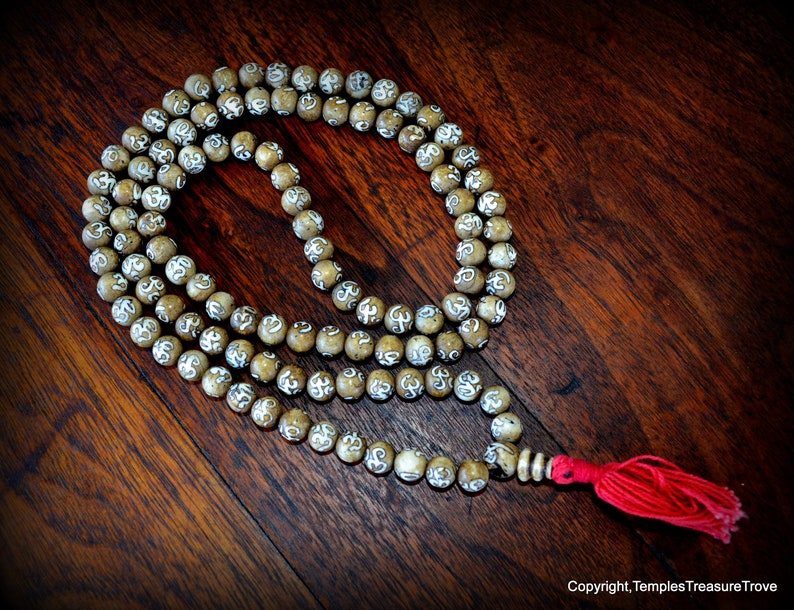
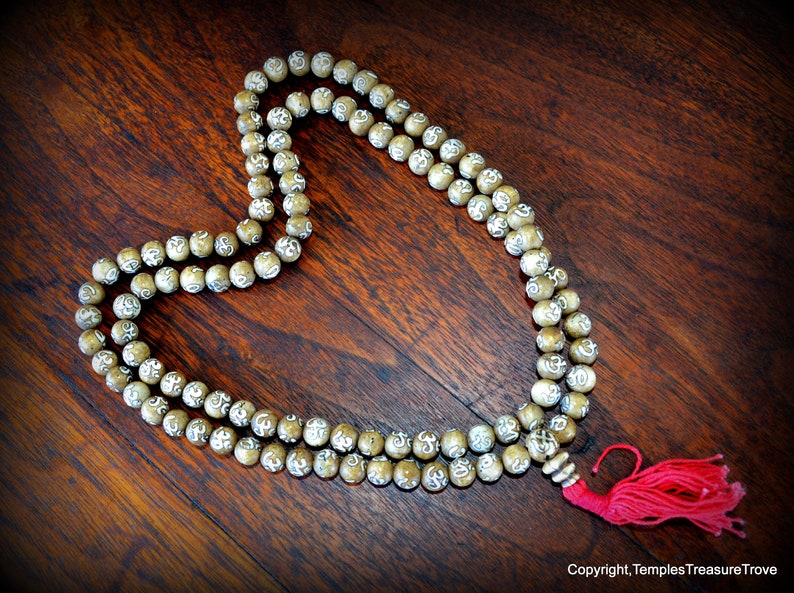


Om Inscribed Handcrafted Nepalese Buddhist Sacred Conch Shell Carved Om Mani Padmi Hum 108 Beads Prayer Mala Rosary Sourced from Kathmandu
Low in stock, only 2 left
Price:$249.95
Star Seller
Star Sellers have an outstanding track record for providing a great customer experience—they consistently earned 5-star reviews, shipped orders on time, and replied quickly to any messages they received.
Your order should arrive by this date if you buy today. To calculate an estimated delivery date you can count on, we look at things like the carrier's latest transit times, the seller's processing time and shipping history, and where the order is shipping to and from.
You can only make an offer when buying a single item
Star Seller. This seller consistently earned 5-star reviews, shipped on time, and replied quickly to any messages they received.
Highlights
Om Inscribed Handcrafted Nepalese Buddhist Sacred Conch Shell Carved Om Mani Padmi Hum 108 Beads Prayer Mala Rosary Sourced from Kathmandu
Proceeds from the sale of my imported items from the Kathmandu region will be reinvested with my on the ground suppliers who lost everything but their lives in the earthquakes that devastated so much of the region in May of 2015. These peace loving people have a long journey ahead of them,many are still without basic shelter,food,water and health services due to difficulties in accessing many of the remote villages.
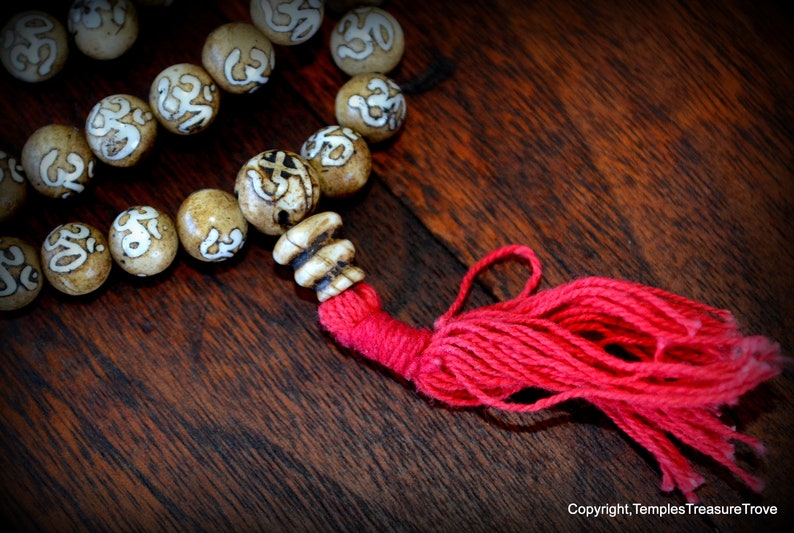
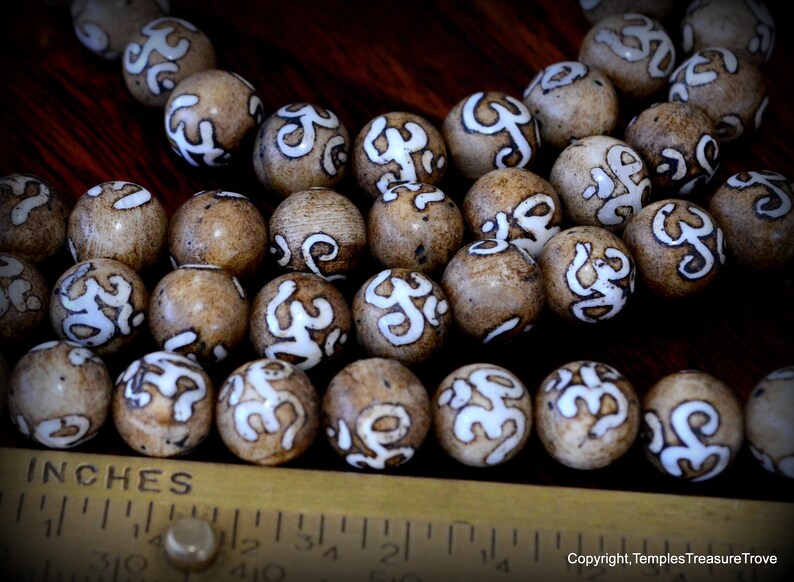
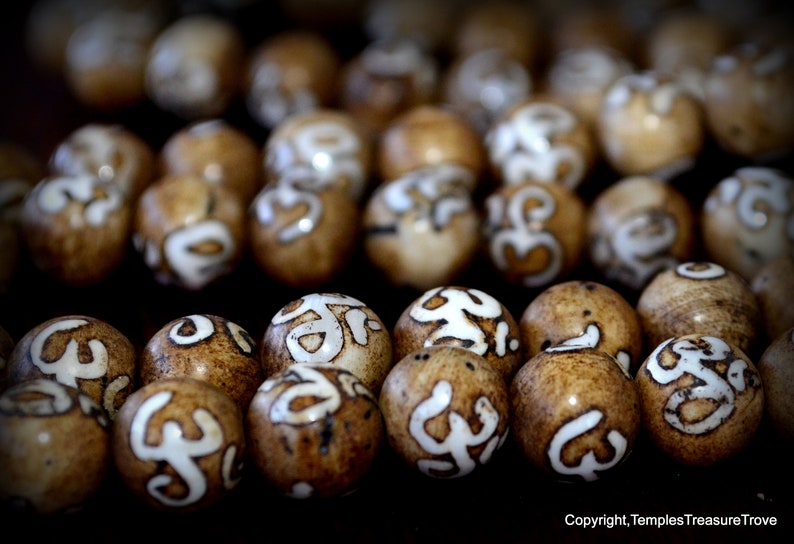
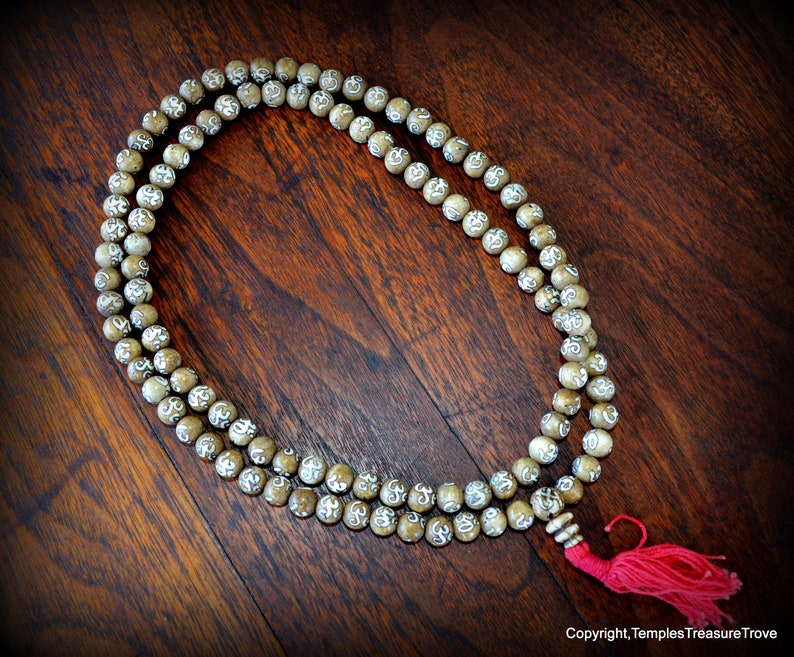
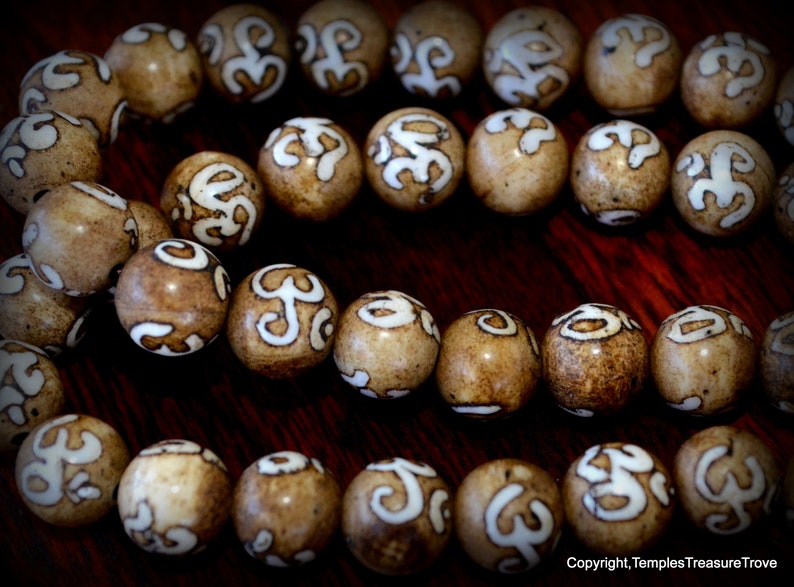
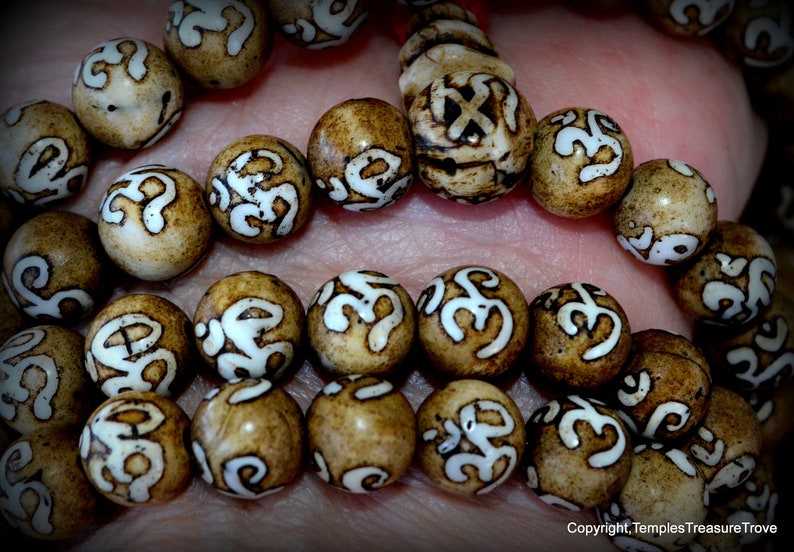
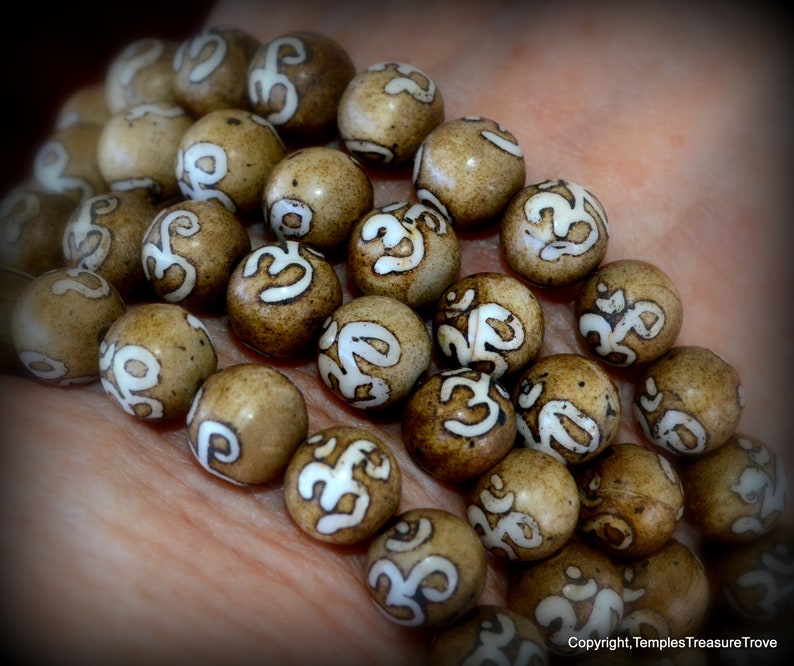
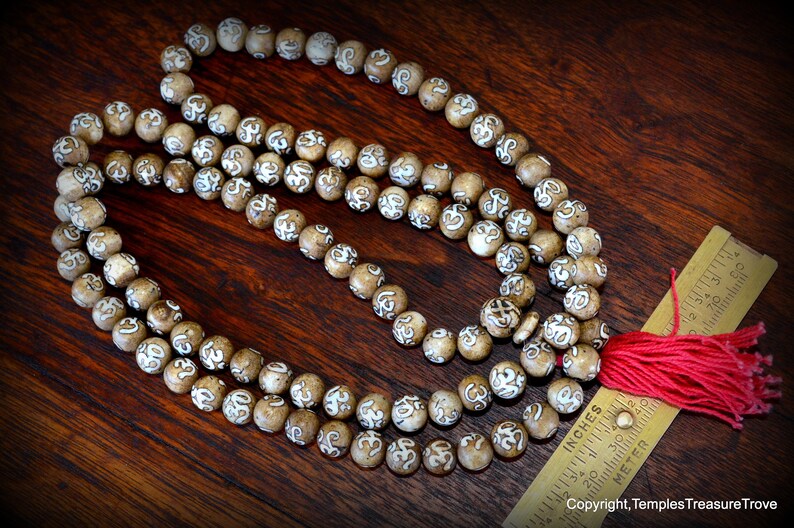
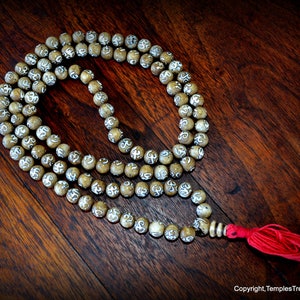
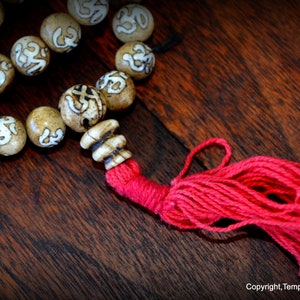
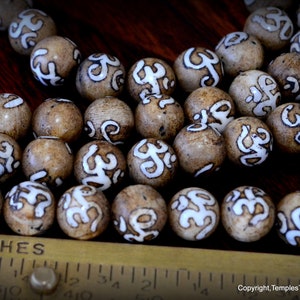
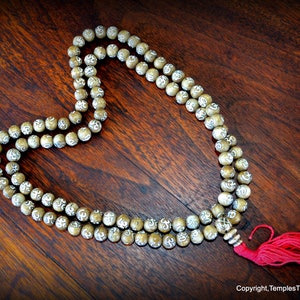
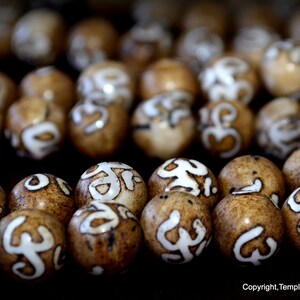
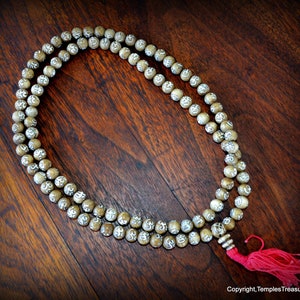
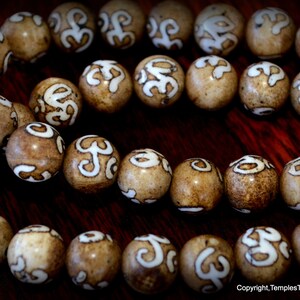
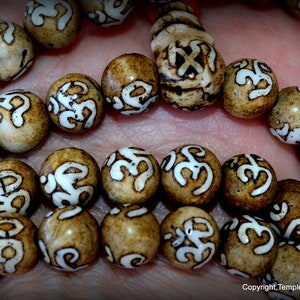
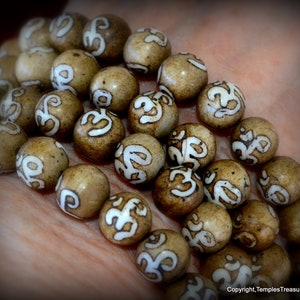
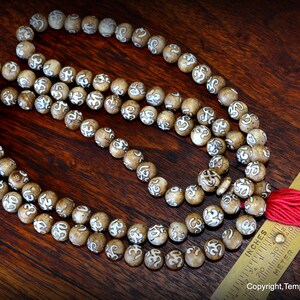
This beautifully handcrafted Buddhist prayer mala is acquired from Kathmandu, Nepal. Each Sacred Conch Shell bead is inscribed with the Om insignia. On very close inspection the beads appear to be pearls with the nacre carved away to show the brown layer beneath!! I can only imagine the countless HOURS it took to create these pieces!! The mala is strung tightly on a dark cord and finished with a lovely soft red tassel that feels like cotton.
Please refer to the photos as they are an important part of the description. All weights and measures are approximate. I've included a good deal of info regarding the Sacredness of the Conch Shell, if you're interested in info regarding the meaning and significance of the six syllable "Om Mani Padme Hum" symbols on the beads go to the link posted below:
-------------> https://en.wikipedia.org/wiki/Om_mani_padme_hum
Details:
Weight: Approximately 86 gms
Length: 34" with an added 2" of focal bead and tassel
Bead Size: 8mm x 8mm (main 108 beads)
Bead material: carved conch shell
Tassel bead: Barrel shaped and 10mm round + 11mm bead with 3 ribs
Stringing material: Natural fibers
Tassel: Red cotton
~*~*~*~*~*~*~*~*~*~*~*~*~*~*~*~*~*~*~*~*~*~*~*~*~*~*~*~*~*~*~*~*~*~*~*~*~*~*~*~
Conch shells have great spiritual significance in Tibet,Nepal,India and many of the neighboring countries.
The link http://www.agasthiar.org/a/conch.htm is absolutely OVERFLOWING with information on how revered and important these shells are in Buddhist/Hindu cultures. I posted just a few bits and pieces of info below from this link.
~*~*~*~*~*~*~*~*~*~*~*~*~*~*~*~*~*~*~*~*~*~*~*~*~*~*~*~*~*~*~*~*~*~*~*~*~*~*~*
..."Conch Shells - Truth, Bhakti and Selflessness (Tyaga)
Conch Shell = Satyavati, the Embodiment of TRUTH (Satya), said Sathguru Venkataraman. People with names such as Satya, Satyavati, Satyavalli, etc. must do puja with conch shells daily. 3
Amongst the spiritual aids that promote bhakti (devotion), conch shells are at the forefront, said the Sathguru. 3
Conch shells, both idam puri (left) and valam puri (right), are physical representations of life forms that attained high spiritual states by leading selfless lives. 3
Conch Shells - OM, Mantras and Spiritual Purification
Within conch shells, the divine Om sound and many other beejakshara mantra sounds are always present. 1
Conch shells attract and absorb the celestial Veda Mantra Sabda sounds and present them to us. 1
If conch shells are used in a house in the proper spiritual way, the entire environment of the house can be purified easily.................................................
Conches are spiritual aids that promote bhakti and spirituality. They are also spiritual solutions for removing many kinds of "doshas" (afflictions).
Placing vibhuti sacred ash and kumkuma vermilion in conch shells blesses the house with auspiciousness and gives longevity to the spouse. 5
Conches can give the blessing of truthfulness particularly to those in professions where lying is common, such as lawyers and judges. 5
Conch shells can reduce NEGATIVE VIBRATIONS in their vicinity and give steadiness of mind. 5
Sathguru Venkataraman said that a conch shell is Omkara Naadha Karuvoolam - a treasure chest of the original Omkara sound of the beginningless beginning. Thus blowing a conch shell even once can fill a place with Omkara Shakti - the power of OM, he said.
Blowing the conch shell is itself a good pranayama yoga practice, particularly if the special pranayama conch shell is used.
Regularly blowing the conch shell in worship can help one get rid of the urge to smoke.
The sound of OM can purify thoughts and it is this divine sound that fills a conch shell. Thus a conch shell helps purify one's thoughts, said Sathguru Venkataraman........."
~*~*~*~*~*~*~*~*~*~*~*~*~*~*~*~*~*~*~*~*~*~*~*~*~*~*~*~*~*~*~*~*~*~*~*~*~*~
Buddhist prayer beads are a traditional tool used to count the number of times a mantra is recited whilst meditating. They are similar to other forms of prayer beads used in various world religions; thus some call this tool the Buddhist rosary.
A Japa mala or mala (Sanskrit:माला; mālā, meaning garland[1]) (Tib. threngwa[2]) is a set of beads commonly used by Hindus and Buddhists. Malas are used for keeping count while reciting, chanting, or mentally repeating a mantra or the name or names of a deity. This practice is known in Sanskrit as japa. Malas are typically made with 16, 27, 54 or 108 beads.
In Tibetan Buddhism, traditionally malas of 108 beads are used. Some practitioners use malas of 21 or 28 beads for doing prostrations. Doing one 108-bead mala counts as 100 mantra recitations; the extra repetitions are done to amend any mistakes.
Malas are mainly used to count mantras. These mantras can be recited for different purposes linked to working with mind. The material used to make the beads can vary according to the purpose of the mantras used. Some beads can be used for all purposes and all kinds of mantras. These beads can be made from the wood of the Bodhi tree (ficus religiosa), or from 'Bodhi seeds,' which come from the Rudraksha (Elaeocarpus ganitrus) and not the Bodhi tree. Another general-purpose mala is made from another unknown seed, the beads themselves called 'Moon and Stars' by Tibetans, and variously called 'lotus root', 'lotus seed' and 'linden nut' by various retailers. The bead itself is very hard and dense, ivory coloured (which gradually turns a deep golden brown with long use), and has small holes (moons) and tiny black dots (stars) covering its surface.
Pacifying mantras should be recited using white colored malas. Materials such as crystal, pearl, shell/conch or mother of pearl are preferable. These can serve to purify the mind and clear away obstacles like illness, bad karma and mental disturbances. Using pearls is not practical however, as repeated use will destroy their iridescent layer. Most often pearl malas are used for showing off or 'Dharma jewelry'.
Increasing mantras should be recited using malas of gold, silver, copper and amber. The mantras counted on these can "serve to increase life span, knowledge and merit."[3]
Mantras for magnetizing should be recited using malas made of saffron, lotus seed, sandalwood, or other forms of wood including elm wood, peach wood, and rosewood. However, it is said the most effective is made of Mediterranean oxblood coral, which, due to a ban on harvesting, is now very rare and expensive.
Mantras to tame by forceful means should be recited using malas made of Rudraksha beads or bone. Reciting mantras with this kind of mala serves to tame others, but with the motivation to unselfishly to help other sentient beings.[3] To tame by forceful means, means to subdue harmful energies, such as "extremely malicious spirits, or general afflictions".[3] Malas for these mantras are made from Rudraksha seeds, or even human bones, with 108 beads on the string. Only a person that is motivated by great compassion for all beings, including those they try to tame, can do this.
The mala string should be composed of three, five or nine threads, symbolizing the Three Jewels (Buddha, Dharma, Sangha), the five Dhyani Buddhas (Vairocana, Akshobhya, Ratnasambhava, Amitabha, Amoghasiddhi) and their wisdoms or the nine yanas or Buddha Vajradhara and eight Bodhisattvas. The large main bead, called the Guru bead, symbolizes the Guru, from whom one has received the mantra one is reciting. It is usually recommended that there be three vertical beads in decreasing size at this point: one white (Nirmanakaya) one red (Sambhogakaya) and one blue (Dharmakaya), or enlightened body, speech and mind.
[edit]Usage
Mantras are typically repeated hundreds or even thousands of times. The mala is used so that one can focus on the meaning or sound of the mantra rather than counting its repetitions.[citation needed] One repetition is usually said for each bead while turning the thumb clockwise around each bead, though some traditions or practices may call for counterclockwise motion or specific hand and finger usage. When arriving at the Guru bead, both Hindus and Buddhists traditionally turn the mala around and then go back in the opposing direction. Within the Buddhist tradition, this reversing of the beads serves to remind practitioners of the teaching that it is possible to break the cycle of birth and death. If more than 108 repetitions are to be done, then sometimes in Tibetan traditions grains of rice are counted out before the chanting begins and one grain is placed in a bowl for each 108 repetitions.[citation needed] Each time a full mala of repetitions has been completed, one grain of rice is removed from the bowl. Many Tibetan Buddhists have bell and dorje counters (a short string of ten beads, usually silver, with a bell or dorje at the bottom), the dorje counter used to count each round of 100, and the bell counter to count 1,000 mantras per bead. These counters are placed at different points on the mala depending on tradition, sometimes at the 10th, 21st or 25th bead from the Guru bead. Traditionally, one begins the mala in the direction of the dorje (skillful means) proceeding on to the bell (wisdom) with each round. A 'bhum' counter, often a small brass or silver clasp in the shape of a jewel or wheel, is used to count 10,000 repetitions, and is moved forward between the main beads of the mala, starting at the Guru bead, with each accumulation of 10,000
[edit]Juzu
In Japanese Buddhism, they are known as "juzu" (数珠?, counting beads) or "nenju" (念珠?, thought beads), and both words are usually preceded by the honorific 'o-' (as in "o-juzin" (御数珠?)).
[edit]Shu zhu
In Chinese culture such beads are named shu zhu 数珠 ("counting beads"), Fo zhu 佛珠 ("Buddha beads"), or nian zhu 念珠 ("mindfulness beads").
Seik badi
Theravada Buddhists in Burma use prayer beads, called seik badi [seɪʔ bədí]), shortened to badi. 108 beads are strung on a garland, with the beads typically made of fragrant wood like sandalwood, and series of brightly coloured strings at the end of the garland.[4] It is commonly used in samatha meditation, to keep track of the number of mantras chanted during meditation.
There are numerous explanations why there are 108 beads, with the number 108 bearing special religious significance in a number of Hindu and Buddhist traditions.[5]
Ananda Coomaraswamy holds that the numerology of the decimal numeric system was key to its inception. 108 is therefore founded in Dharmic metaphysical numerology. One for bindu; zero for shunyata and eight for ananta.
In traditional Buddhist thought, people are said to have 108 afflictions or kleshas.[6] There are six senses (sight, sound, smell, taste, touch, and consciousness) multiplied by three reactions (positive, negative, or indifference) making 18 "feelings." Each of these feelings can be either "attached to pleasure or detached from pleasure" making 36 "passions", each of which may be manifested in the past, present, or future.[citation needed] All the combinations of all these things makes a total of 108, which are represented by the beads in the ojuzu.[7] This same number is also used in Japanese New Year services where a bell is rung 108 times.
In addition, practitioners of Vajrayana Buddhism, use the number 108 for a different purpose. After reciting 100 mantras, eight extra mantras are done to compensate for any errors.
~*~*~*~*~*~*~*~*~*~*~*~*~*~*~*~*~*~*~*~*~*~*~*~*~*~*~*~*~*~*~*~*~*~*~*~*~*~
If you need a good excuse to purchase this piece go to the link below ;)
https://www.etsy.com/shop/TemplesTreasureTrove/about/
For more world wide treasures: https://www.etsy.com/shop/TemplesTreasureTrove
Thanks so much for stopping by to view my Om Inscribed Handcrafted Nepalese Buddhist Sacred Conch Shell Carved Om Mani Padmi Hum 108 Beads Prayer Mala Rosary Sourced from Kathmandu
-
Order today to get by Oct 31-Nov 3
Your order should arrive by this date if you buy today. To calculate an estimated delivery date you can count on, we look at things like the carrier's latest transit times, the seller's processing time and shipping history, and where the order is shipping to and from.
-
Returns & exchanges not accepted
But please contact me if you have problems with your order
-
Free shipping
-
Ships from: Las Vegas, NV
There was a problem calculating your shipping. Please try again.
Etsy Purchase Protection
Shop confidently on Etsy knowing if something goes wrong with an order, we've got your back for all eligible purchases —
see program terms

Be the first to review this item


Smooth shipping Has a history of shipping on time with tracking.
Speedy replies Has a history of replying to messages quickly.
Rave reviews Average review rating is 4.8 or higher.
More from this shop
Visit shop-
Unisex Tibetan Prayer Mala~Vintage Tibetan Buddhist Yak Bone Brass Turquoise Coral Inlay 108 Bead Prayer Mala~Japa Mala~Buddhist Prayer Mala
$139.95
-
Vintage Tribal Tibetan Skull Necklace~Carved Bone Skulls and Shell Slice Necklace~Skull Necklace~Unisex Carved Skull & Conch Shell Necklace
$149.95
-

Antique Tested .925 Bedouin Afghani Ram's Heads Hollow Cuff Bracelet from a Museum Lot Sold off from a Serbian Museum circa "Desert Storm"
$259.95
-
Antique Afghani Lapis Coin Silver Granulation and Gold Gilding Evil Eye Protective Amulet Breast Plate Pendant Circa 1900 or Earlier
$595.00
-
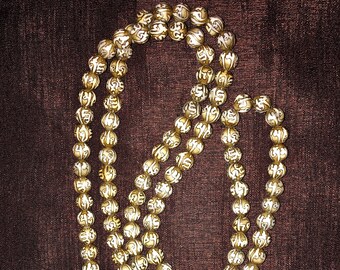
Conch Shell Japa Mala, Carved with Om Mani Padme Hum
$120.99
-
Sacred Ethically Sourced Buffalo Bone Mala Beads | Buddhist Prayer Beads for Meditation | Mindfulness, Spiritual Practice & Mantra Chanting
Sale Price $224.00
Original Price $280.00
-
Tibetan Bone Mala: 108 Custom Vintage Prayer Beads * Buddhist Skull and OM Guru Beads
$120.00
-

Tibetan Om Bone Mala Rosary Necklace - Vintage Nepal
$218.71
-
Handcrafted Yak Bone Mala –108 Beads, Six-Syllable Mantra Carved, Dzi Bead, Brass Guru Bead, Tibetan Buddhist Prayer Necklace, 9mm 28”(H1004
Sale Price $125.67
Original Price $193.34
-
Lotus seeds Mala-Prayer beads-108 Beads,japamala-Handmade in Nepal-Blessed by Monk-Mala for pray-Religious mala
$134.54
-
108 Vintage Handcrafted Tibetan Buddhist Mantra Inscribed Bone Beads,Restrung Tibetan Meditation Mala,Bone Necklace,Buddhist Prayer Beads
$132.45
-
Tibetan Bone Prayer Mala: Vintage Buddhist Meditation Beads
$140.00
-
108 TIBETAN Yak Bone Mala – Handcrafted Tibetan Meditation Necklace for Mindfulness & Spiritual Practice | Buddhist Prayer Beads
Sale Price $121.10
Original Price $173.00
-
Tulsi Radha Carved Bead Mala Necklace: Knotted Japa Prayer Beads
Sale Price $82.36
Original Price $109.81
-
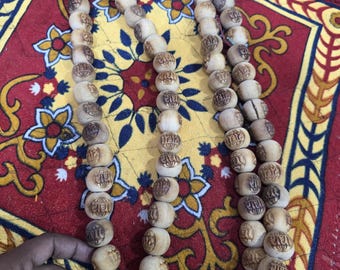
Radha Naam Kadamba Wood Mala 25mm | Hand Carved Radha Name 108+1 Japa Mala | Big Bead Devotional Mala from Vrindavan
Sale Price $127.12
Original Price $149.55
-
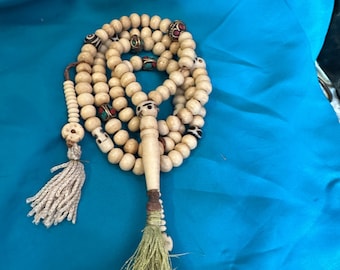
Tibetan Bone Prayer Mala: Vintage Buddhist Meditation Beads, Nepal
$120.00
Shoppers with similar taste loved these
-
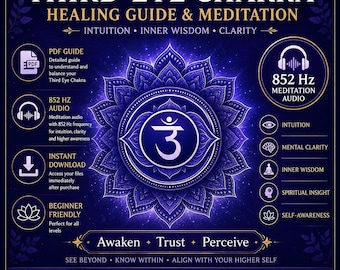
Digital download
Third Eye Chakra Healing Guide PDF & 852 Hz Meditation Audio (Digital Download)
$1.49
-

Digital download
Solar Plexus Chakra Healing Guide PDF with 528 Hz Meditation Audio (Digital Download)
$1.49
-
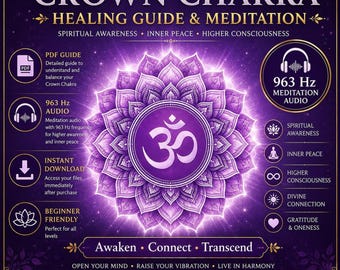
Digital download
Crown Chakra Healing Guide PDF & 963 Hz Meditation Audio (Digital Download)
$1.49
-
Digital download
Heart Chakra Healing Guide PDF with 639 Hz Meditation Audio (Digital Download)
$1.49
-
Digital download
Root Chakra Healing Guide PDF & 396 Hz Meditation Audio (Digital Download)
$1.49
-

Digital download
Sacral Chakra Healing Guide PDF with 417 Hz Meditation Audio (Digital Download)
$1.49
-
Digital download
Throat Chakra Healing Guide PDF & 741 Hz Meditation Audio (Digital Download)
$1.49
-
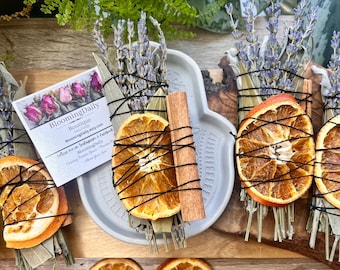
Prosperity Smoke Cleansing Wand: Cedar, Sage, Cinnamon & Citrus
$15.09
-
Lepidolite, Sage, Rosemary and Lavender Smudge Stick
$23.00
-

Happy Home Smoke Cleansing Bundle: Cedar, Oregano, Basil
$17.09
-

Cedar, Sage and Lavender Smoke Cleansing Stick with Rose and Carnation, Fairy Moon Charm
$16.09
-
California White Sage Smudge Stick Set – Choose Your Blend – White Sage, Dragon's Blood, Palo Santo, Lavender, Floral Sage – Cleansing Gift
Sale Price $6.61
Original Price $7.35
