



DSM-5-TR Differential Diagnosis Cheat Sheet | Decision Trees, Look-Alike Comparison Tables + Differential Pairs | Therapist PDF + Word
Star Seller
Star Sellers have an outstanding track record for providing a great customer experience—they consistently earned 5-star reviews, shipped orders on time, and replied quickly to any messages they received.
Item highlights
Seller's description
A client tells you she has mood swings that change in hours, with intense fears of abandonment and self-harm urges. The intake note your colleague wrote says 'bipolar II.' You think it might be borderline. You have 50 minutes and a treatment plan due. You need the side-by-side that tells you exactly what distinguishes BPD reactive mood lasting hours from bipolar II hypomanic episodes lasting days, and you need the ICD-10-CM codes for both so you can update the chart correctly the moment you decide.
This is the differential diagnosis cheat sheet I built after years of watching clinicians and exam candidates run into the same pairs over and over: BPD vs bipolar II, PTSD vs adjustment vs MDD, OCD vs OCPD, ASD vs social anxiety, ARFID vs anorexia, conversion vs factitious vs malingering. Every differential gets the criterion-level distinguishing feature, every disorder gets its ICD-10-CM code, and Section 13 holds the diagnostic hierarchy that resolves overlaps.
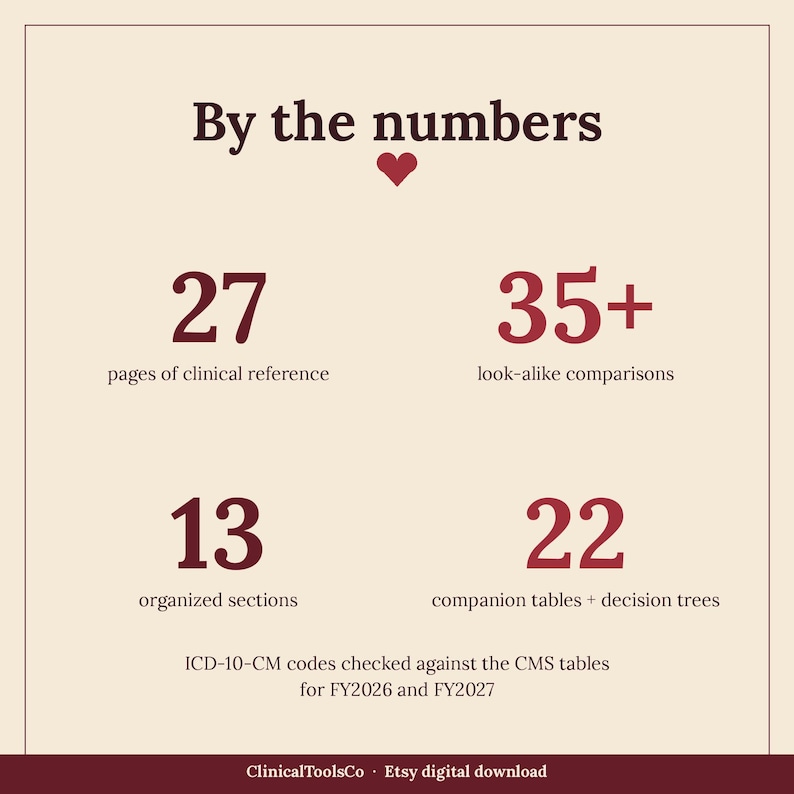
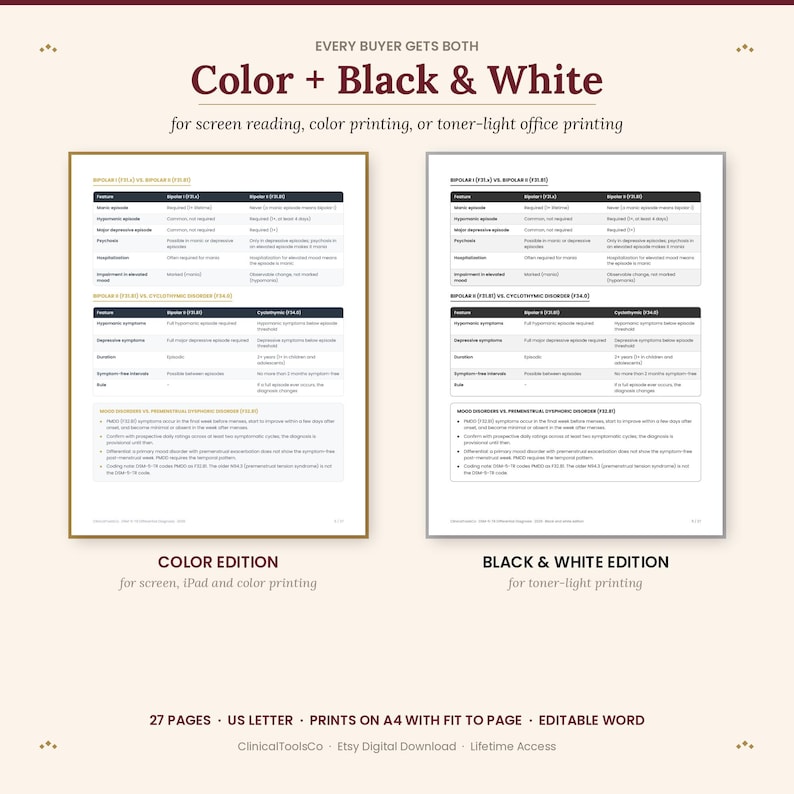
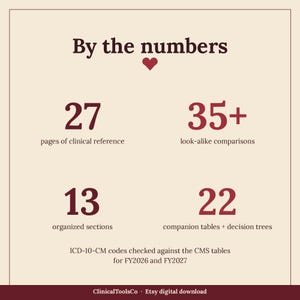
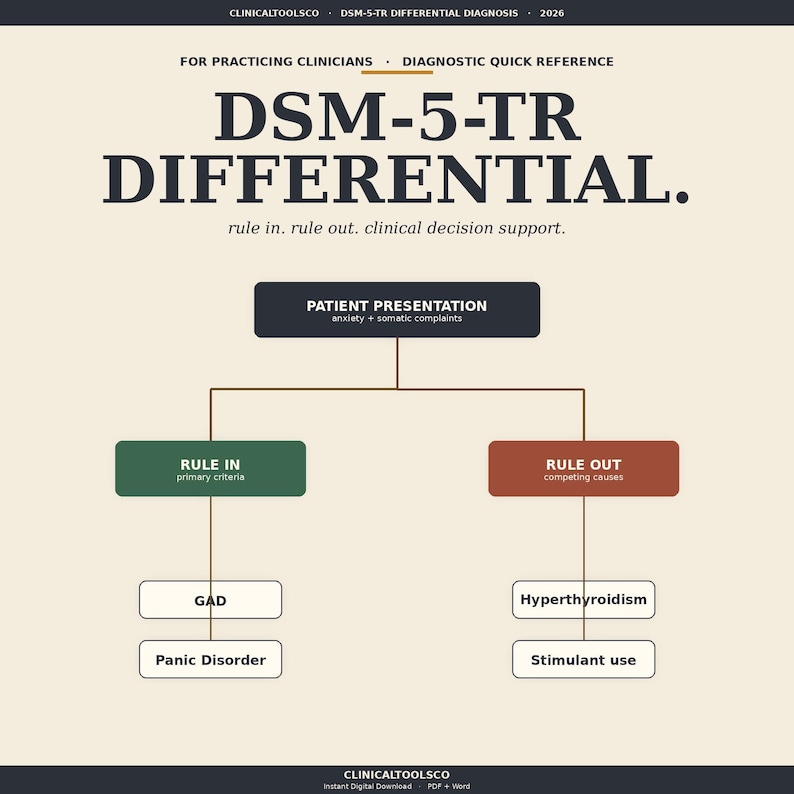
27 pages organized into 13 sections, in a color edition and a black and white print edition, plus a Differential Decision Tools companion with 14 look-alike comparison tables and 8 decision trees for the presentations clinicians most often confuse. Built by a practicing clinician. Designed for in-session reference and EPPP, LCSW, LPC, NCMHCE, ASWB exam preparation.
━━━━━━━━━━━━━━━━━━━━━
𝐖𝐇𝐀𝐓 𝐈𝐒 𝐈𝐍 𝐓𝐇𝐄 𝐑𝐄𝐅𝐄𝐑𝐄𝐍𝐂𝐄
━━━━━━━━━━━━━━━━━━━━━
✔ How to use the guide: the four-step differential process (cluster, generate, distinguish, hierarchy), the four common errors (premature closure, confirmation bias, hierarchy errors, frequency illusion), and how to read full codes vs code families
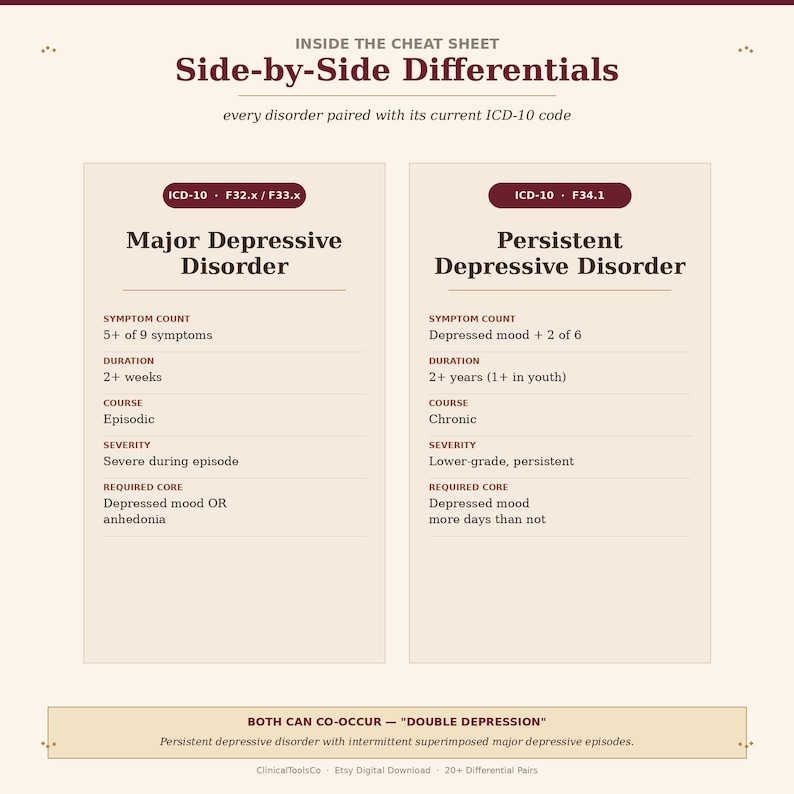
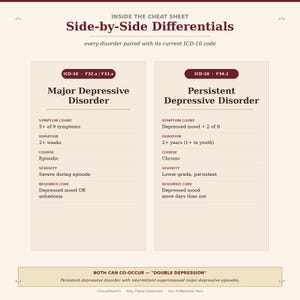
✔ Mood spectrum differentials: MDD (F32.x/F33.x), persistent depressive (F34.1), bipolar I (F31.x), bipolar II (F31.81), cyclothymic (F34.0), PMDD (F32.81), DMDD (F34.81), with double depression and DMDD exclusion rules
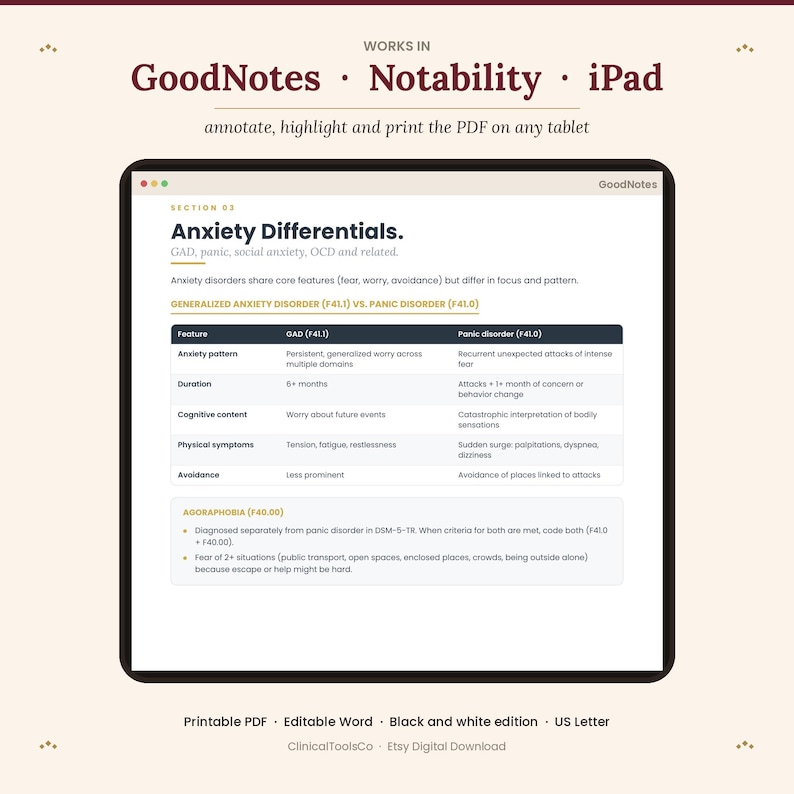
✔ Anxiety differentials: GAD (F41.1), panic (F41.0), agoraphobia (F40.00), social anxiety (F40.10) vs avoidant PD (F60.6), OCD (F42.2) vs GAD, OCD vs OCPD (F60.5), body dysmorphic (F45.22) vs anorexia (F50.01x/F50.02x)
✔ Trauma and stressor differentials: PTSD (F43.10), acute stress disorder (F43.0), the six adjustment disorder codes (F43.20 through F43.25), PTSD vs MDD overlap, prolonged grief disorder (F43.81), and complex PTSD (ICD-11) and how it differs from the DSM-5-TR dissociative subtype
✔ Psychotic spectrum: brief psychotic (F23), schizophreniform (F20.81), schizophrenia (F20.9), delusional (F22), schizoaffective bipolar and depressive types (F25.0, F25.1), mood with psychotic features (F32.3, F33.3, F31.2, F31.5), substance-induced psychotic disorder by substance and use disorder severity (F1x.159, F1x.259, F1x.959)
✔ Personality disorder grid: 10 commonly-confused PD pairs with the distinguishing feature for each (BPD vs bipolar II, BPD vs CPTSD, schizotypal vs ASD, AvPD vs social anxiety, DPD vs BPD, OCPD vs OCD, ASPD vs NPD, histrionic vs BPD, schizoid vs avoidant, paranoid vs delusional)
✔ Neurodevelopmental differentials: ASD (F84.0) vs social anxiety, ADHD (F90.0/F90.1/F90.2) vs mood disorders, intellectual disability (F70 through F73) vs specific learning disorder (F81.0/F81.2/F81.81)
✔ Substance vs primary disorder: hierarchy rule plus decision criteria (predate substance use, persist past expected effects, in excess of substance, family history, abstinence with recurrence) plus intoxication and withdrawal patterns by substance with ICD-10-CM categories
✔ Eating disorder grid: anorexia (F50.01x restricting, F50.02x binge-eating/purging) vs bulimia (F50.2x) vs BED (F50.81x) vs ARFID (F50.82), the full severity and remission code list in use since October 2024 (F50.010 through F50.819), DSM-5-TR severity anchors, and ARFID vs anorexia by body image motivation
✔ Somatic and dissociative differentials: conversion subtypes (F44.4 through F44.7) vs factitious (F68.10) vs malingering (Z76.5), somatic symptom (F45.1) vs illness anxiety (F45.21), DID (F44.81) vs other dissociative disorders
✔ Specifier reference: mood disorder specifiers (anxious distress, mixed features, melancholic, atypical, psychotic, catatonia, peripartum, seasonal), PTSD dissociative and delayed-expression specifiers, OCD insight and tic-related specifiers, substance use severity and remission coding (mild F1x.10, moderate-severe F1x.20, in remission F1x.11 and F1x.21)
✔ ICD-10-CM quick reference: every disorder in the document with its code, organized by category (mood, anxiety/OCD/related, trauma, psychotic, personality, neurodevelopmental, substance, eating, somatic/dissociative, sleep-wake, sexual/gender, disruptive and impulse-control, neurocognitive)
✔ Decision rules: the DSM hierarchy (substance/medication-induced, due to another medical condition, primary mental disorder, then the more pervasive disorder among primaries) with common exclusion rules per diagnosis and the 60-second pre-exam refresher
━━━━━━━━━━━━━━━━━━━━━
𝐖𝐇𝐘 𝐓𝐇𝐈𝐒 𝐈𝐒 𝐃𝐈𝐅𝐅𝐄𝐑𝐄𝐍𝐓
━━━━━━━━━━━━━━━━━━━━━
Most DSM differential references are 600-page textbooks. They are exhaustive and unusable when you have 50 minutes between sessions. This reference is structured for desk-side use during clinical work and for high-yield review before exams.
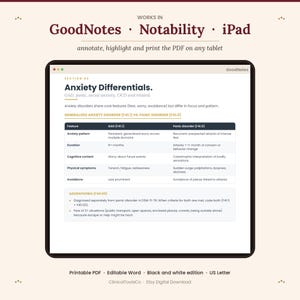
The pair-by-pair structure matters because that is how differentials actually present in practice and on exams. The included sections give you the side-by-side feature comparison (BPD vs bipolar II by mood duration, OCD vs OCPD by ego-syntonicity, ASD vs social anxiety by sensory features) rather than a paragraph that names both disorders and leaves you to extract the distinguishing variable yourself.
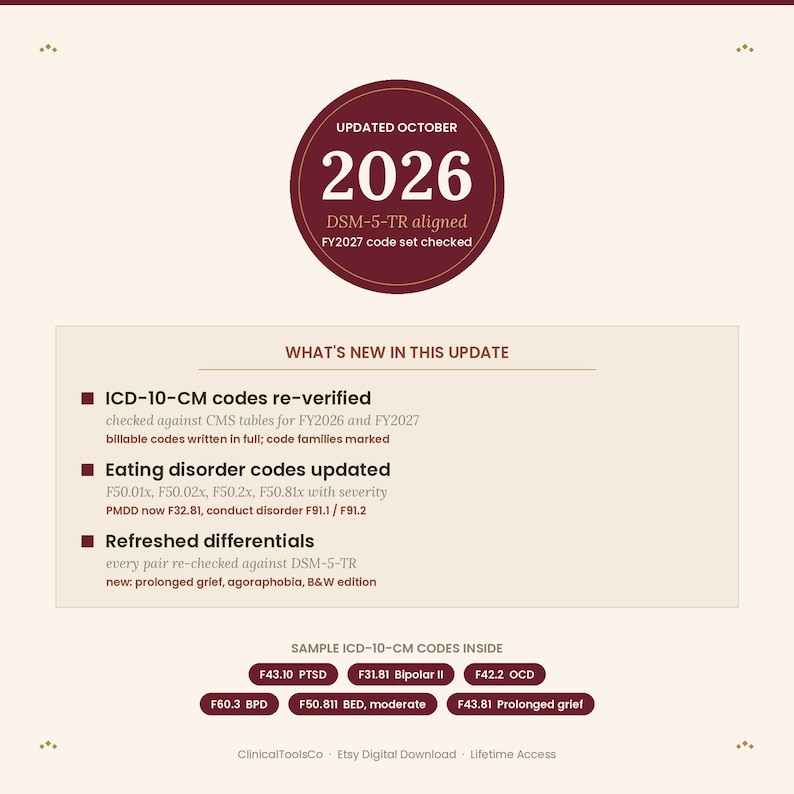
The ICD-10-CM coding integration matters because differential diagnosis and billing live on the same document in the real chart. Every code was checked against the CMS ICD-10-CM code tables for FY2026 and FY2027. Billable codes are written in full; where a code needs another character for episode, severity or remission, it is marked as a family and the full codes are listed in Section 12. That includes the six adjustment disorder codes, the bipolar I episode-state and remission codes (F31.0 through F31.76), and the Z code Z76.5 for malingering. Section 12 holds the full quick reference organized by clinical category for chart review and claim documentation. The substance-induced psychotic codes are broken out by substance and use disorder severity in Section 5.
The decision rules section matters because clinical and exam questions both hinge on the diagnostic hierarchy. The included Section 13 walks through the four-tier hierarchy (substance, another medical condition, primary disorders, then the more pervasive disorder) plus the common exclusion rules per diagnosis (DMDD cannot coexist with bipolar disorder, ODD, or IED; any manic episode rules out bipolar II; schizoaffective requires psychosis without a mood episode for 2 weeks plus mood episodes for the majority of the illness) and includes the 60-second pre-exam refresher.
The personality disorder pair grid matters because PD differentials are the most-missed items on EPPP, LCSW, and NCMHCE exams and the most-confused diagnoses in clinical work. The included grid covers the 10 PD pairs that come up most often, each with the single distinguishing feature.
The specifier reference matters because specifiers change the code (F32.3 single episode severe with psychotic features versus F32.x for the base diagnosis) and are heavily tested. The included Section 11 covers mood specifiers, PTSD dissociative subtype, OCD insight specifiers, and substance use severity and remission coding.
━━━━━━━━━━━━━━━━━━━━━
𝐖𝐇𝐎 𝐈𝐓 𝐈𝐒 𝐅𝐎𝐑
━━━━━━━━━━━━━━━━━━━━━
• Clinical social workers (LCSW, LMSW) and clinical mental health counselors (LPC, LMHC, LPCC, LCPC)
• Marriage and family therapists (LMFT)
• Psychologists and psychological associates
• Psychiatric nurse practitioners and physician associates in psychiatry
• EPPP candidates preparing for the doctoral licensure exam
• ASWB LCSW and LMSW exam candidates
• NCMHCE candidates preparing for the clinical mental health counseling exam
• LPC and LMHC state exam candidates
• Graduate students in clinical psychology, social work, and counseling
• Pre-licensed associates and trainees in any clinical mental health field
• Supervisors providing diagnostic supervision
━━━━━━━━━━━━━━━━━━━━━
𝐅𝐎𝐑𝐌𝐀𝐓
━━━━━━━━━━━━━━━━━━━━━
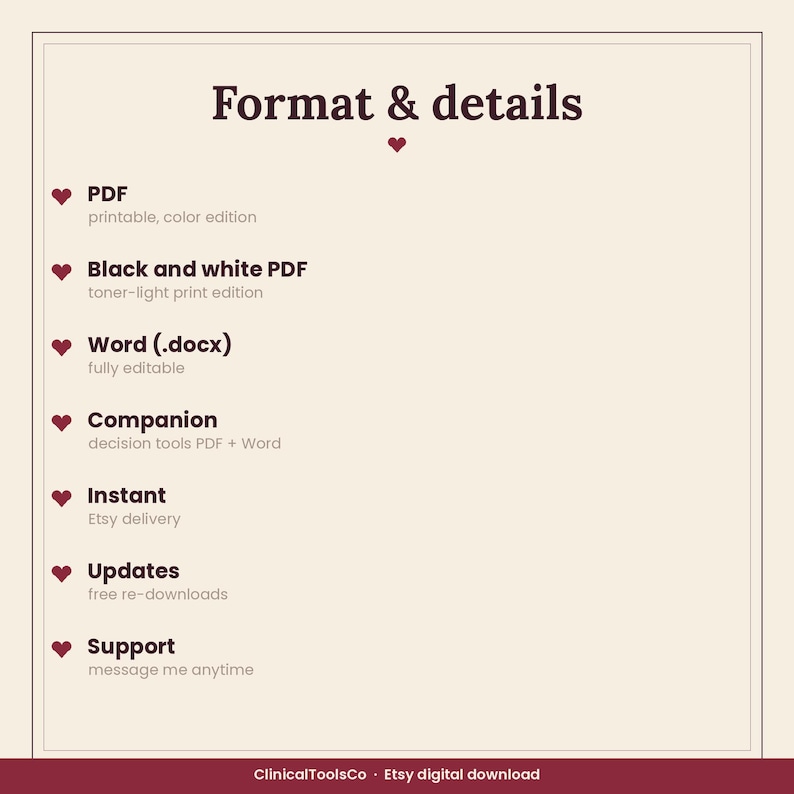
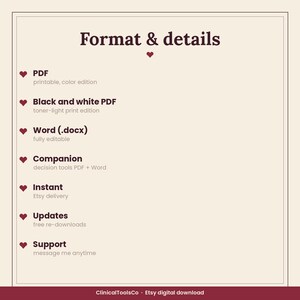
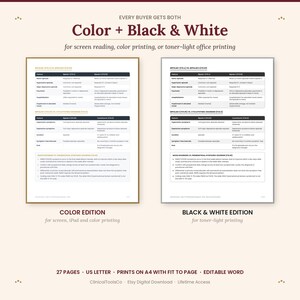
• Printable PDF, color edition
• Printable PDF, black and white edition for toner-light printing
• Editable Microsoft Word (.docx)
• Differential Decision Tools companion (PDF + Word)
• Designed for in-session reference; print pages 4 to 5 (mood spectrum), 8 (trauma vs depression), and 11 (personality disorder grid) for desk access
• US Letter (8.5 x 11); prints on A4 with fit to page
• Works on Mac, Windows, iPad, GoodNotes, Notability
• Print at home or office, or reference on screen
• Lifetime access, unlimited prints
━━━━━━━━━━━━━━━━━━━━━
𝐔𝐏𝐃𝐀𝐓𝐄𝐃 𝐎𝐂𝐓𝐎𝐁𝐄𝐑 𝟐𝟎𝟐𝟔
━━━━━━━━━━━━━━━━━━━━━
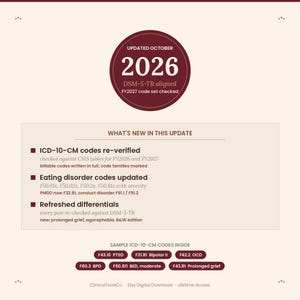
DSM-5-TR criteria current across all chapters. Every ICD-10-CM code checked against the CMS code tables for FY2026 (October 1, 2025 to September 30, 2026) and FY2027 (effective October 1, 2026). Anorexia, bulimia and binge-eating disorder codes carry the severity or remission character required since October 1, 2024 (F50.01x, F50.02x, F50.2x, F50.81x). PMDD coded F32.81, the DSM-5-TR code. Conduct disorder onset codes F91.1 and F91.2. Adjustment disorder codes F43.20 through F43.25. Bipolar I episode-state and remission codes F31.0 through F31.76. Substance-induced psychotic codes by substance and use disorder severity (alcohol F10.159/F10.259/F10.959, and the same pattern for cannabis F12, sedatives F13, cocaine F14, stimulants F15, hallucinogens F16, inhalants F18). Malingering correctly coded as Z76.5 (Z code, not a mental disorder). Prolonged grief disorder (F43.81) added. ICD-11 complex PTSD note included for cross-reference with DSM-5-TR PTSD.
━━━━━━━━━━━━━━━━━━━━━
𝐇𝐎𝐖 𝐓𝐎 𝐔𝐒𝐄 𝐈𝐓
━━━━━━━━━━━━━━━━━━━━━
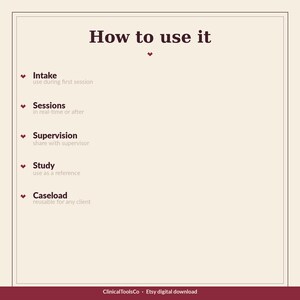
For clinical use: keep the document open during intake and assessment sessions. When a presentation could be either of two diagnoses, jump to that pair in the section table of contents and read the criterion-level differentiator first. Pull the ICD-10-CM codes from Section 12 when updating the chart. Apply Section 13 hierarchy rules when symptoms could be explained by substance use or a medical condition.
For exam preparation: read Sections 2 through 10 in order to build the pair-by-pair pattern library. Memorize the Section 11 specifier reference (high-yield exam content). Use Section 12 to drill ICD-10-CM code recall. Run the Section 13 60-second pre-exam refresher the morning of the exam.
For supervision: use the pair grid sections to anchor differential supervision discussions. Print the personality disorder grid (Section 6) and the mood spectrum grid (Section 2) and bring them to supervision sessions.
━━━━━━━━━━━━━━━━━━━━━
𝐀 𝐍𝐎𝐓𝐄 𝐅𝐑𝐎𝐌 𝐓𝐇𝐄 𝐃𝐄𝐒𝐈𝐆𝐍𝐄𝐑
━━━━━━━━━━━━━━━━━━━━━
I am a practicing clinician. I built this reference after watching the same five or six pairs trip up clinicians and exam candidates over and over: BPD vs bipolar II, OCD vs OCPD, ASD vs social anxiety, PTSD vs adjustment, conversion vs factitious vs malingering. The personality disorder grid in Section 6 is the one I drew on the whiteboard during supervision until I got tired of redrawing it. The ICD-10-CM quick reference in Section 12 is the one I pull up during chart documentation. The 60-second pre-exam refresher in Section 13 is the one I read the morning I took the EPPP.
Differential diagnosis is pattern recognition built on criterion knowledge. The reference helps you see the patterns faster.
Digital download. No physical product ships. Reach out via Etsy messages if anything does not work or if you have questions.
Item review
All reviews are from verified buyers. This review is shown automatically based on factors like recency, whether it includes comments, your chosen language, and whether the rating reflects the typical experience with the shop.
“Love well designed forms. These are great.”

Amber
12 days ago
7 views in the last 24 hours
NowPrice:$22.49
Original Price: $29.99
25% off
Sale ends on November 11
You can only make an offer when buying a single item
Delivery
Instant download
Your files will be available to download once payment is confirmed. Here's how.
Instant download items don't accept returns, exchanges or cancellations. Please contact the seller about any problems with your order.
Reviews for this item
Love well designed forms. These are great.
Great resource for mental health professionals.
great for studying mental health diagnosis & disorder

So much clearer than my grad school textbook. Wish I had this years ago. This has been so useful for EPPP prep. Super clear and easy to follow.
Seller's description
Specifications
A client tells you she has mood swings that change in hours, with intense fears of abandonment and self-harm urges. The intake note your colleague wrote says 'bipolar II.' You think it might be borderline. You have 50 minutes and a treatment plan due. You need the side-by-side that tells you exactly what distinguishes BPD reactive mood lasting hours from bipolar II hypomanic episodes lasting days, and you need the ICD-10-CM codes for both so you can update the chart correctly the moment you decide.
This is the differential diagnosis cheat sheet I built after years of watching clinicians and exam candidates run into the same pairs over and over: BPD vs bipolar II, PTSD vs adjustment vs MDD, OCD vs OCPD, ASD vs social anxiety, ARFID vs anorexia, conversion vs factitious vs malingering. Every differential gets the criterion-level distinguishing feature, every disorder gets its ICD-10-CM code, and Section 13 holds the diagnostic hierarchy that resolves overlaps.
27 pages organized into 13 sections, in a color edition and a black and white print edition, plus a Differential Decision Tools companion with 14 look-alike comparison tables and 8 decision trees for the presentations clinicians most often confuse. Built by a practicing clinician. Designed for in-session reference and EPPP, LCSW, LPC, NCMHCE, ASWB exam preparation.
━━━━━━━━━━━━━━━━━━━━━
𝐖𝐇𝐀𝐓 𝐈𝐒 𝐈𝐍 𝐓𝐇𝐄 𝐑𝐄𝐅𝐄𝐑𝐄𝐍𝐂𝐄
━━━━━━━━━━━━━━━━━━━━━
✔ How to use the guide: the four-step differential process (cluster, generate, distinguish, hierarchy), the four common errors (premature closure, confirmation bias, hierarchy errors, frequency illusion), and how to read full codes vs code families
✔ Mood spectrum differentials: MDD (F32.x/F33.x), persistent depressive (F34.1), bipolar I (F31.x), bipolar II (F31.81), cyclothymic (F34.0), PMDD (F32.81), DMDD (F34.81), with double depression and DMDD exclusion rules
✔ Anxiety differentials: GAD (F41.1), panic (F41.0), agoraphobia (F40.00), social anxiety (F40.10) vs avoidant PD (F60.6), OCD (F42.2) vs GAD, OCD vs OCPD (F60.5), body dysmorphic (F45.22) vs anorexia (F50.01x/F50.02x)
✔ Trauma and stressor differentials: PTSD (F43.10), acute stress disorder (F43.0), the six adjustment disorder codes (F43.20 through F43.25), PTSD vs MDD overlap, prolonged grief disorder (F43.81), and complex PTSD (ICD-11) and how it differs from the DSM-5-TR dissociative subtype
✔ Psychotic spectrum: brief psychotic (F23), schizophreniform (F20.81), schizophrenia (F20.9), delusional (F22), schizoaffective bipolar and depressive types (F25.0, F25.1), mood with psychotic features (F32.3, F33.3, F31.2, F31.5), substance-induced psychotic disorder by substance and use disorder severity (F1x.159, F1x.259, F1x.959)
✔ Personality disorder grid: 10 commonly-confused PD pairs with the distinguishing feature for each (BPD vs bipolar II, BPD vs CPTSD, schizotypal vs ASD, AvPD vs social anxiety, DPD vs BPD, OCPD vs OCD, ASPD vs NPD, histrionic vs BPD, schizoid vs avoidant, paranoid vs delusional)
✔ Neurodevelopmental differentials: ASD (F84.0) vs social anxiety, ADHD (F90.0/F90.1/F90.2) vs mood disorders, intellectual disability (F70 through F73) vs specific learning disorder (F81.0/F81.2/F81.81)
✔ Substance vs primary disorder: hierarchy rule plus decision criteria (predate substance use, persist past expected effects, in excess of substance, family history, abstinence with recurrence) plus intoxication and withdrawal patterns by substance with ICD-10-CM categories
✔ Eating disorder grid: anorexia (F50.01x restricting, F50.02x binge-eating/purging) vs bulimia (F50.2x) vs BED (F50.81x) vs ARFID (F50.82), the full severity and remission code list in use since October 2024 (F50.010 through F50.819), DSM-5-TR severity anchors, and ARFID vs anorexia by body image motivation
✔ Somatic and dissociative differentials: conversion subtypes (F44.4 through F44.7) vs factitious (F68.10) vs malingering (Z76.5), somatic symptom (F45.1) vs illness anxiety (F45.21), DID (F44.81) vs other dissociative disorders
✔ Specifier reference: mood disorder specifiers (anxious distress, mixed features, melancholic, atypical, psychotic, catatonia, peripartum, seasonal), PTSD dissociative and delayed-expression specifiers, OCD insight and tic-related specifiers, substance use severity and remission coding (mild F1x.10, moderate-severe F1x.20, in remission F1x.11 and F1x.21)
✔ ICD-10-CM quick reference: every disorder in the document with its code, organized by category (mood, anxiety/OCD/related, trauma, psychotic, personality, neurodevelopmental, substance, eating, somatic/dissociative, sleep-wake, sexual/gender, disruptive and impulse-control, neurocognitive)
✔ Decision rules: the DSM hierarchy (substance/medication-induced, due to another medical condition, primary mental disorder, then the more pervasive disorder among primaries) with common exclusion rules per diagnosis and the 60-second pre-exam refresher
━━━━━━━━━━━━━━━━━━━━━
𝐖𝐇𝐘 𝐓𝐇𝐈𝐒 𝐈𝐒 𝐃𝐈𝐅𝐅𝐄𝐑𝐄𝐍𝐓
━━━━━━━━━━━━━━━━━━━━━
Most DSM differential references are 600-page textbooks. They are exhaustive and unusable when you have 50 minutes between sessions. This reference is structured for desk-side use during clinical work and for high-yield review before exams.
The pair-by-pair structure matters because that is how differentials actually present in practice and on exams. The included sections give you the side-by-side feature comparison (BPD vs bipolar II by mood duration, OCD vs OCPD by ego-syntonicity, ASD vs social anxiety by sensory features) rather than a paragraph that names both disorders and leaves you to extract the distinguishing variable yourself.
The ICD-10-CM coding integration matters because differential diagnosis and billing live on the same document in the real chart. Every code was checked against the CMS ICD-10-CM code tables for FY2026 and FY2027. Billable codes are written in full; where a code needs another character for episode, severity or remission, it is marked as a family and the full codes are listed in Section 12. That includes the six adjustment disorder codes, the bipolar I episode-state and remission codes (F31.0 through F31.76), and the Z code Z76.5 for malingering. Section 12 holds the full quick reference organized by clinical category for chart review and claim documentation. The substance-induced psychotic codes are broken out by substance and use disorder severity in Section 5.
The decision rules section matters because clinical and exam questions both hinge on the diagnostic hierarchy. The included Section 13 walks through the four-tier hierarchy (substance, another medical condition, primary disorders, then the more pervasive disorder) plus the common exclusion rules per diagnosis (DMDD cannot coexist with bipolar disorder, ODD, or IED; any manic episode rules out bipolar II; schizoaffective requires psychosis without a mood episode for 2 weeks plus mood episodes for the majority of the illness) and includes the 60-second pre-exam refresher.
The personality disorder pair grid matters because PD differentials are the most-missed items on EPPP, LCSW, and NCMHCE exams and the most-confused diagnoses in clinical work. The included grid covers the 10 PD pairs that come up most often, each with the single distinguishing feature.
The specifier reference matters because specifiers change the code (F32.3 single episode severe with psychotic features versus F32.x for the base diagnosis) and are heavily tested. The included Section 11 covers mood specifiers, PTSD dissociative subtype, OCD insight specifiers, and substance use severity and remission coding.
━━━━━━━━━━━━━━━━━━━━━
𝐖𝐇𝐎 𝐈𝐓 𝐈𝐒 𝐅𝐎𝐑
━━━━━━━━━━━━━━━━━━━━━
• Clinical social workers (LCSW, LMSW) and clinical mental health counselors (LPC, LMHC, LPCC, LCPC)
• Marriage and family therapists (LMFT)
• Psychologists and psychological associates
• Psychiatric nurse practitioners and physician associates in psychiatry
• EPPP candidates preparing for the doctoral licensure exam
• ASWB LCSW and LMSW exam candidates
• NCMHCE candidates preparing for the clinical mental health counseling exam
• LPC and LMHC state exam candidates
• Graduate students in clinical psychology, social work, and counseling
• Pre-licensed associates and trainees in any clinical mental health field
• Supervisors providing diagnostic supervision
━━━━━━━━━━━━━━━━━━━━━
𝐅𝐎𝐑𝐌𝐀𝐓
━━━━━━━━━━━━━━━━━━━━━
• Printable PDF, color edition
• Printable PDF, black and white edition for toner-light printing
• Editable Microsoft Word (.docx)
• Differential Decision Tools companion (PDF + Word)
• Designed for in-session reference; print pages 4 to 5 (mood spectrum), 8 (trauma vs depression), and 11 (personality disorder grid) for desk access
• US Letter (8.5 x 11); prints on A4 with fit to page
• Works on Mac, Windows, iPad, GoodNotes, Notability
• Print at home or office, or reference on screen
• Lifetime access, unlimited prints
━━━━━━━━━━━━━━━━━━━━━
𝐔𝐏𝐃𝐀𝐓𝐄𝐃 𝐎𝐂𝐓𝐎𝐁𝐄𝐑 𝟐𝟎𝟐𝟔
━━━━━━━━━━━━━━━━━━━━━
DSM-5-TR criteria current across all chapters. Every ICD-10-CM code checked against the CMS code tables for FY2026 (October 1, 2025 to September 30, 2026) and FY2027 (effective October 1, 2026). Anorexia, bulimia and binge-eating disorder codes carry the severity or remission character required since October 1, 2024 (F50.01x, F50.02x, F50.2x, F50.81x). PMDD coded F32.81, the DSM-5-TR code. Conduct disorder onset codes F91.1 and F91.2. Adjustment disorder codes F43.20 through F43.25. Bipolar I episode-state and remission codes F31.0 through F31.76. Substance-induced psychotic codes by substance and use disorder severity (alcohol F10.159/F10.259/F10.959, and the same pattern for cannabis F12, sedatives F13, cocaine F14, stimulants F15, hallucinogens F16, inhalants F18). Malingering correctly coded as Z76.5 (Z code, not a mental disorder). Prolonged grief disorder (F43.81) added. ICD-11 complex PTSD note included for cross-reference with DSM-5-TR PTSD.
━━━━━━━━━━━━━━━━━━━━━
𝐇𝐎𝐖 𝐓𝐎 𝐔𝐒𝐄 𝐈𝐓
━━━━━━━━━━━━━━━━━━━━━
For clinical use: keep the document open during intake and assessment sessions. When a presentation could be either of two diagnoses, jump to that pair in the section table of contents and read the criterion-level differentiator first. Pull the ICD-10-CM codes from Section 12 when updating the chart. Apply Section 13 hierarchy rules when symptoms could be explained by substance use or a medical condition.
For exam preparation: read Sections 2 through 10 in order to build the pair-by-pair pattern library. Memorize the Section 11 specifier reference (high-yield exam content). Use Section 12 to drill ICD-10-CM code recall. Run the Section 13 60-second pre-exam refresher the morning of the exam.
For supervision: use the pair grid sections to anchor differential supervision discussions. Print the personality disorder grid (Section 6) and the mood spectrum grid (Section 2) and bring them to supervision sessions.
━━━━━━━━━━━━━━━━━━━━━
𝐀 𝐍𝐎𝐓𝐄 𝐅𝐑𝐎𝐌 𝐓𝐇𝐄 𝐃𝐄𝐒𝐈𝐆𝐍𝐄𝐑
━━━━━━━━━━━━━━━━━━━━━
I am a practicing clinician. I built this reference after watching the same five or six pairs trip up clinicians and exam candidates over and over: BPD vs bipolar II, OCD vs OCPD, ASD vs social anxiety, PTSD vs adjustment, conversion vs factitious vs malingering. The personality disorder grid in Section 6 is the one I drew on the whiteboard during supervision until I got tired of redrawing it. The ICD-10-CM quick reference in Section 12 is the one I pull up during chart documentation. The 60-second pre-exam refresher in Section 13 is the one I read the morning I took the EPPP.
Differential diagnosis is pattern recognition built on criterion knowledge. The reference helps you see the patterns faster.
Digital download. No physical product ships. Reach out via Etsy messages if anything does not work or if you have questions.
-
Designed by
-
Item typeDigital download
-
Digital file type(s)3 PDF, 2 other files
This seller consistently earned 5-star reviews, shipped orders on time, and replied quickly to messages.
If something goes wrong with an order, we've got your back on all eligible purchases. View program terms
Meet your seller

Usually responds in a few hours
Speedy replies Has a history of replying to messages quickly.
Rave reviews Average review rating is 4.8 or higher.
More from this shop
-

Digital download
Neurodivergent Affirming Therapy Toolkit | Autism, ADHD and AuDHD Clinician Guide, Client Handouts and Session Language | PDF
Sale Price $9.74
Original Price $12.99
-

Digital download
Psychopharmacology Guide for Therapists | Psychiatric Medication Reference by Class, Side Effects and Client Talking Points | Word
Sale Price $18.74
Original Price $24.99
-
Digital download
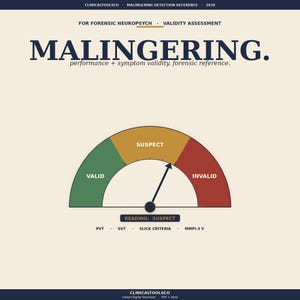
Malingering and Symptom Validity Reference for Psychologists | PVT and SVT Cutoffs, Slick Criteria, Base Rates, Report Language
Sale Price $7.49
Original Price $9.99
-

Digital download
Multicultural Counseling Case Vignettes | 22 Cases with ADDRESSING Framework, Cultural Formulation for Therapists | Printable PDF
Sale Price $8.24
Original Price $10.99
-
Digital download
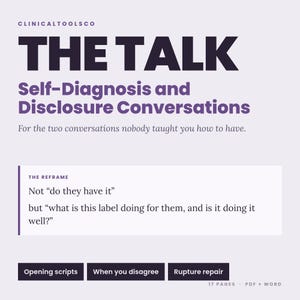
When a Client Self Diagnoses | Therapist Scripts for Autism, ADHD and Borderline Disclosures, Rupture Repair | Printable Guide
Sale Price $7.49
Original Price $9.99
-
Digital download
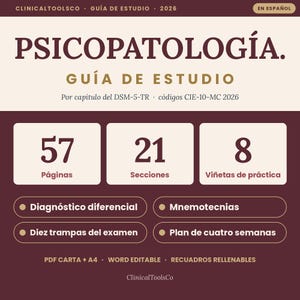
Spanish Psychopathology Study Guide | Guía de Psicopatología en Español | Disorders by DSM-5-TR Chapter, Vignettes | PDF + Word
Sale Price $6.74
Original Price $8.99
-

Digital download
DSM-5-TR Differential Diagnosis Bundle | Social Work & Counseling Study Guide | Clinical Quick Reference
$10.00
-

Digital download
DSM-5-TR Cheat Sheet, ICD 10 Therapist Mental Health Guide (Digital Download)
Sale Price $5.00
Original Price $20.00
-

Digital download
DSM-5 Diagnostic Criteria Cheat Sheet | DSM-5 TR Study Guide | Mental Health Reference Guide | Therapist Resource | Instant Download
Sale Price $3.75
Original Price $12.49
-

Digital download
DSM-5-TR Cheat Sheet for Therapists | Differential Diagnosis Quick Reference Guide | Clickable Diagnostics (Clickable PDF)
Sale Price $5.56
Original Price $6.95
-

Digital download
DSM-5 Diagnostic Criteria Cheat Sheet, Therapist Quick Guide (Digital Download)
Sale Price $3.00
Original Price $12.00
-

Digital download
Mental Health Diagnostic Criteria Cheat Sheet: Clinical Reference Guide for Social Workers & Therapists (PDF)
Sale Price $15.84
Original Price $48.00
-

Digital download
DSM-5-TR Mental Health Diagnoses Guide, Cheat Sheets (PDF)
Sale Price $9.01
Original Price $36.06
-

Digital download
DSM5 Cheat Sheets: Mental Disorder Diagnostic Criteria, DSM5-Tr Easily Diagnose Disorders Reference Tool (PDF)
Sale Price $3.97
Original Price $15.90
-

Digital download
DSM5 Cheat Sheet - 100+ Mental Disorders DSM5-Tr Diagnostic Criteria, Psychiatrist Diagnosing Tool (PDF Download)
Sale Price $7.96
Original Price $9.95
-

Digital download
Mental Health Codes - Diagnosis Cheat Sheet - Therapist Billing - Therapist Guide - DSM 5 - ICD - DSM 5 tr - dsm 5 guide - Therapy Guides
$11.99
-

Digital download
DSM5 Cheat Sheets: Mental Disorder Diagnostic Criteria, DSM5-Tr Easily Diagnose Disorders Reference Tool (PDF)
Sale Price $4.76
Original Price $5.95
-

Digital download
DSM 5 CHEAT SHEETS
$10.00
Shoppers with similar taste loved these
-

Digital download
Watercolor Medical Clipart: Nurse & Doctor Illustrations PNG Digital Download
Sale Price $3.75
Original Price $5.00
-

Digital download
Medical Elements Clipart, Healthcare Projects Digital planner, medical clipart, nurse clipart, medicine clipart, Watercolor Medical Clipart.
Sale Price $1.21
Original Price $2.20
-

Digital download
Watercolor Medical Clipart: Doctor, Nurse, Hospital Illustrations (Instant Download)
$2.98
-

Digital download
Medical Clipart PNG Bundle,Pink Healthcare Elements PNG,Doctor and Nurse Clipart,Medical Instrument PNG Clipart Bundle, Hospital,healthcare
Sale Price $1.62
Original Price $4.91
-

Digital download
Medical Clipart Bundle, Healthcare PNG, Doctor Nurse Elements
Sale Price $3.07
Original Price $4.72
-

Digital download
Medical Clipart, Doctor Clipart PNG Bundle, 735 PNG Medical Clipart Bundle, Instant Digital Download, Commercial Use
Sale Price $1.62
Original Price $4.91
-

Digital download
Watercolor Medical Clipart Bundle: Healthcare Graphics, Nurse & Doctor PNGs (Digital Download)
Sale Price $2.09
Original Price $2.99
-

Digital download
Medical Equipment Clipart, Medical Clipart PNG Bundle,Medical Instrument PNG Clipart Bundle,Hospital, nurse, healthcare, doctor images,nurse
Sale Price $1.62
Original Price $4.91
-

Digital download
Medical Clipart Bundle Watercolor Medical Clipart Doctor Nurse Clipart Hospital Clipart Healthcare Clipart Anatomy PNG
$4.20
-

Digital download
Clinical Hours Tracker Spreadsheet, Clinical Hours Log, Residency Hours Sheet, Nursing School, Social Work, Therapist Time, Internship Hours
$2.90
-

Digital download
Clinical Hours Tracker Spreadsheet, Supervision Log Template Google Sheets, Nursing School Planner, Therapy Counseling Placement Log Excel
Sale Price $3.14
Original Price $6.27
-

Digital download
Clinical hours tracker spreadsheet, Excel licensure hour log, social work, counseling, therapy daily practicum, indirect and supervised hour
Sale Price $5.59
Original Price $6.99


