















Multi-Agent Context Handoff: Orchestration Patterns Guide for AI Systems
What to know
Digital download
Digital file type(s)
1 PDF
You're scaling AI agents across your workflows. Each one needs data to function. But passing context between them without bloating payloads, creating security holes, or losing track of what's happening is hard.
This guide solves the multi-agent context handoff problem head-on.
The Core Problem
When you orchestrate multiple AI agents in production, context becomes your biggest bottleneck. Pass too much, and your system slows down, costs spike, and sensitive data leaks across boundaries you didn't know existed. Pass too little, and agents hallucinate or produce garbage because they lack critical information. Scale to three, five, ten agents working in sequence or parallel, and the chaos multiplies.
Most teams discover this the hard way: a production agent chain that worked fine with one handoff breaks spectacularly when you add a second agent. Tokens bloat. Memory fills. Security audits fail. You rebuild from scratch.
What's Inside
This guide walks you through battle-tested patterns for passing context between AI agents without the chaos:
- The Context Chaos Wall: Why multi-agent systems break. Diagnose where your setup will fail before it does in production.
- Subagent Context Scoping: Learn exactly what each agent in your chain actually needs-and nothing more. Cut unnecessary data at every handoff.
- Structured Handoff Schemas: Build JSON contracts between agents. Define what fields are required, what's optional, and what triggers validation failures.
- Shared Memory Architectures: Choose between in-memory stores for speed and persistent architectures for reliability. Know the trade-offs that matter at your scale.
- The Broker Skeleton Pattern: A minimal orchestration framework you can implement in hours, not weeks. Start with one schema, validate at a single boundary, add tracing, then scale.
Who This Is For
You build systems with multiple AI agents working together. You use Claude, GPT, or other LLMs in production. You care about reliability, cost, and security. You're tired of guessing why your agent chains break when you add the second or third agent.
The Outcome
After reading, you'll understand:
- How to design context that flows cleanly between agents without bloat.
- The patterns that prevent security leaks and data chaos in multi-agent systems.
- A concrete implementation approach you can start this week on your highest-risk pipeline.
- How to add observability so you see exactly what each agent receives and what it sends.
Delivery
You get a PDF guide with patterns, code examples, architecture diagrams, and a step-by-step implementation roadmap. No fluff, no filler. Pure applied knowledge for teams building production multi-agent systems.
Start with your highest-risk pipeline. Write one JSON handoff schema. Validate it at a single agent boundary. Add tracing. Then add the second agent. This guide gives you the map; you provide the execution.
About this product
NeuraGrowth is an AI-assisted, human-curated digital studio made in Poland. Concept, structure, and final pass on every product are human-directed. Drafting, layout, illustration, and image rendering use generative AI tools (Claude by Anthropic, Stability AI, Ideogram, DALL-E, Gemini, and FLUX), selected per task for the best output. We don't auto-publish. Every file passes hands-on review before it goes live.
NowPrice:$4.89
Original Price: $6.99
30% off
Sale ends in 3 days
Instant download
Your files will be available to download once payment is confirmed. Here's how.
Instant download items don't accept returns, exchanges or cancellations. Please contact the seller about any problems with your order.
If something goes wrong with an order, we've got your back for all eligible purchases. View program terms
Be the first to review this item
Meet your seller
Usually responds in a few hours
More from this shop
-

Digital download
Claude MCP Obsidian Setup Guide | Connect Desktop to Vault
Sale Price $3.49
Original Price $4.99
-

Digital download
SaaS Security Audit Guide for AI-Built Apps | Pre-Launch Checklist
Sale Price $4.89
Original Price $6.99
-
Digital download
Agentic Engineering Transition Playbook: Coder to Orchestrator Bundle
Sale Price $6.99
Original Price $9.99
-
Digital download
Claude MCP Setup Guide: No Terminal Required
Sale Price $4.89
Original Price $6.99
-
Digital download
Supabase MCP Field Guide: Claude, Cursor & RLS Security
Sale Price $4.89
Original Price $6.99
-
Digital download
n8n MCP Integration Handbook Part 2: Claude + Production Use Cases
Sale Price $4.89
Original Price $6.99
-
Digital download
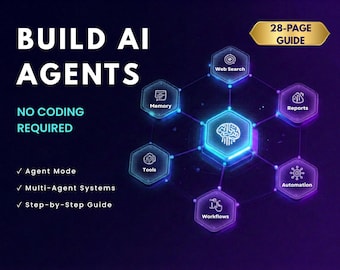
AI Agents Toolkit | Build ChatGPT Agents, Workflows & Multi-Agent Systems
$16.99
-
Digital download
No-Code AI Agent Guide: Automate Business Tasks (Digital Download)
$5.54
-

Digital download
Ultimate n8n Automation Guide 2025 | AI Agents Masterclass (Digital Download)
$1.10
-
Digital download
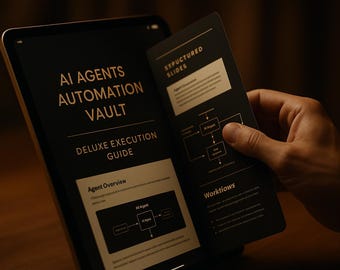
AI Agents Automation Vault – Deluxe Guide to Build & Scale GPT Systems (No Code)
$41.66
-

Digital download
AI Agents - How to create on Google Gemini - A multimedia guide
$20.84
-

Digital download
Ai agents - How to create them in the N8n platform! A Multimedia Guide
$6.95
-

Digital download
The Agent Next Door: Your Guide to Human-AI Teamwork in the Modern Office
$20.00
-
Digital download
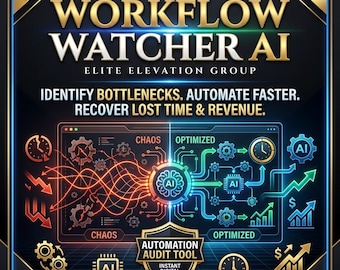
Workflow Watcher AI | Automation Audit Assistant for Small Business | Custom GPT Digital Download | No-Code Workflow & Systems Strategy
$97.00
-
Digital download
AI Agents Ebook: Automate Your Online Business in 30 Days
Sale Price $0.95
Original Price $3.81
-
Digital download
AI Personal Assistant Guide: Productivity & Automation (Digital Download)
$3.06
-
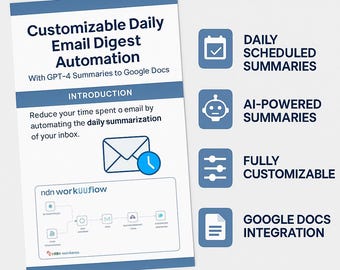
Digital download
AI Email Digest Automation | GPT-4 Summaries to Google Docs (PDF Guide)
$6.93
-
Digital download
High Level AI Agent Setup | Agent Reviews | Agent Workflows | Inbound Agent | Outbound Agent | AI Assistant| Agent Design
$397.00


