














NowPrice:$4.89
Original Price: $6.99
30% off
Sale ends in 2 days
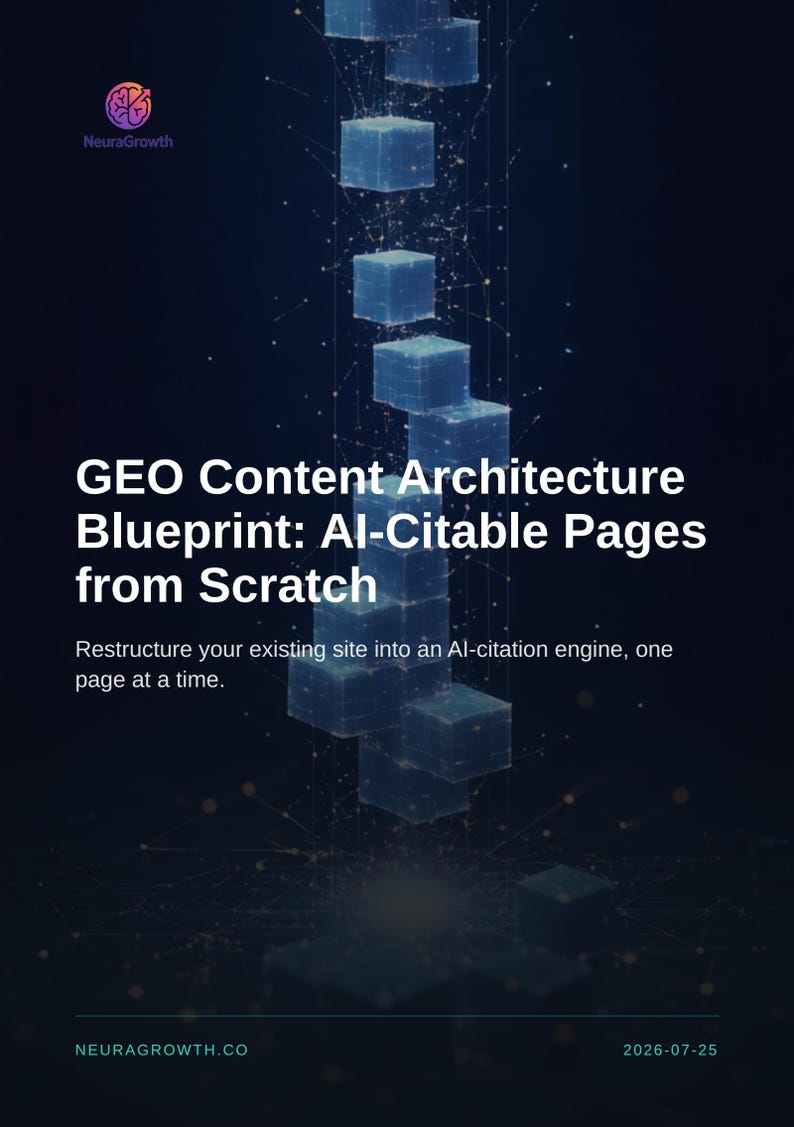
Content Architecture for AI Citations: Make Your Pages Citable
You can only make an offer when buying a single item
Highlights
You've built great content. LLMs ignore most of it.
While some websites appear constantly in AI model outputs, most disappear into the void. The difference isn't luck or traffic volume. It's structure.
Large language models cite specific page types and formats. They extract from definition blocks, comparison tables, step-by-step breakdowns, and data-rich sections. A homepage About section written in flowing prose? Invisible to citation engines. That same content reorganised into the four citable block types? Now LLMs pull it verbatim.
This guide shows you exactly what LLMs look for, why they ignore conventional web copy, and how to restructure your existing site one page at a time to become a citation source.
What's Inside:
- The neuroscience of why language models cite some pages and skip others, and the specific formatting cues that trigger citations
- The four block types that models extract word-for-word: definition blocks, comparison matrices, procedural sequences, and data clusters
- Before-and-after rewrites of real pages: homepage About sections, service pages, product descriptions, and resource hubs
- A 30-day sprint framework to audit your site, prioritise high-authority pages, and convert them into AI-citable content
- Specific formatting rules that work across ChatGPT, Claude, Gemini, and open-source models
- How to verify your changes in real model outputs without waiting for organic discovery
You Don't Need to Rebuild From Scratch
This is not about migrating to a new platform, hiring developers, or starting a fresh website. You work with what you have. The method here treats your existing content as raw material. A single hour of restructuring can make a page that was previously invisible to AI models become a cited source.
After This Guide:
Your homepage About section will include at least one definition block that models recognise. Your service pages will use comparison formats that trigger citations. Your resource pages will use data clusters instead of paragraph walls. Within 30 days, you'll have restructured your highest-authority pages. Within 60 days, you'll start seeing your content appear in AI model outputs.
Delivery:
You receive a PDF guide (approximately 35-40 pages) with screenshots, templates, and a step-by-step checklist. Download immediately after purchase. No email delays, no video courses, no upsells. One PDF, complete, ready to use on your website today.
About this product
NeuraGrowth is an AI-assisted, human-curated digital studio made in Poland. Concept, structure, and final pass on every product are human-directed. Drafting, layout, illustration, and image rendering use generative AI tools (Claude by Anthropic, Stability AI, Ideogram, DALL-E, Gemini, and FLUX), selected per task for the best output. We don't auto-publish. Every file passes hands-on review before it goes live.
Instant Download
Your files will be available to download once payment is confirmed. Here's how.
Instant download items don’t accept returns, exchanges or cancellations. Please contact the seller about any problems with your order.
Etsy Purchase Protection
Shop confidently on Etsy knowing if something goes wrong with an order, we've got your back for all eligible purchases —
see program terms

Be the first to review this item
More from this shop
Visit shop-

Digital download
Claude MCP Obsidian Setup Guide | Connect Desktop to Vault
Sale Price $3.49
Original Price $4.99
-

Digital download
SaaS Security Audit Guide for AI-Built Apps | Pre-Launch Checklist
Sale Price $4.89
Original Price $6.99
-

Digital download
Agentic Engineering Transition Playbook: Coder to Orchestrator Bundle
Sale Price $6.99
Original Price $9.99
-
Digital download
Claude MCP Setup Guide: No Terminal Required
Sale Price $4.89
Original Price $6.99


