

Subscription Audit Printable | Cancel Checklist by Last Used | Recurring Payment Tracker Undated Sheet
Price:$5.85
Here's what's eligible:
- Your order doesn't match the item description or photos
- Your item arrived damaged
- Your item arrived after the estimated arrival window
- Your item didn't arrive or was lost in the mail
You can only make an offer when buying a single item
Highlights
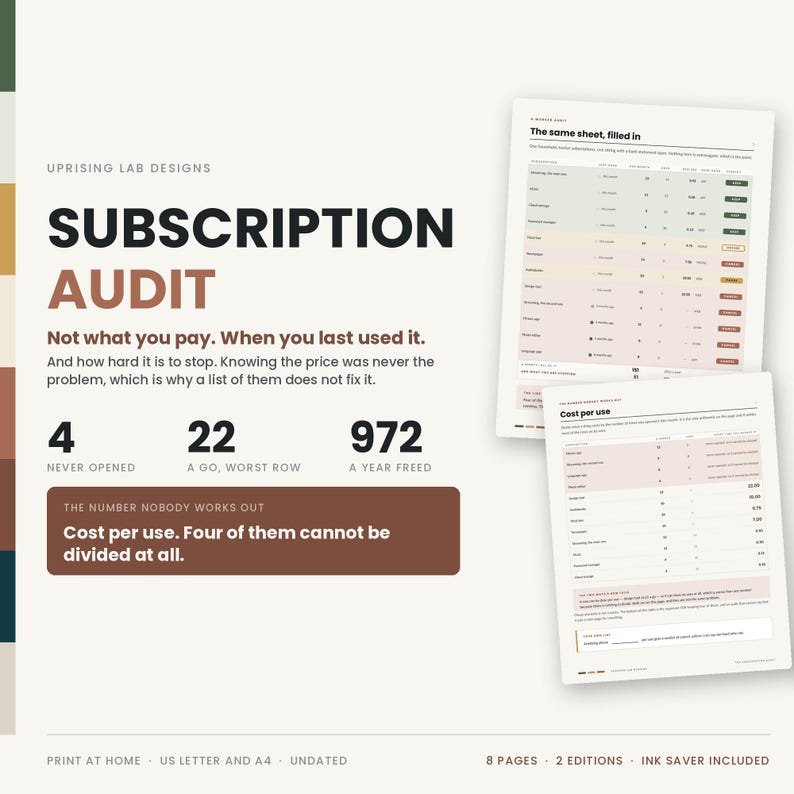
You are not unaware of your subscriptions. You could list most of them right now. Knowing was never the problem.
The problem is deciding, and then actually cancelling — and a list of prices does neither. That is why almost everyone who buys a subscription tracker fills it in once, feels briefly organised, and cancels nothing.
This one is built around the two things that stand between you and the money.
IT LEADS WITH LAST USED, NOT PRICE
The decisive column is not what a thing costs. It is when you last opened it. Something cheap and daily is fine; something dear and untouched since spring is not. So the sheet asks for last-used first, and the price second — which is the reverse of the obvious layout, and it is deliberate. Filling in the money first quietly decides the answers, because a small number looks harmless and a large one looks unavoidable.
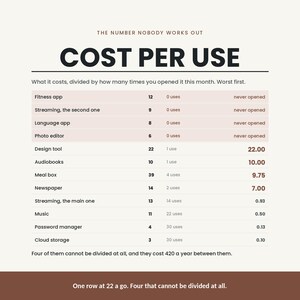
COST PER USE
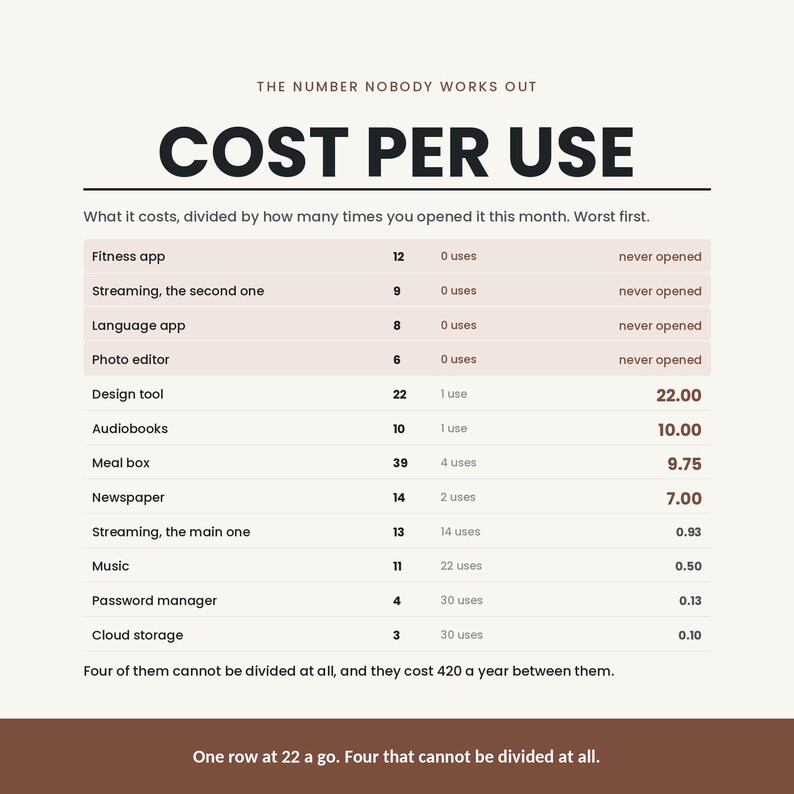
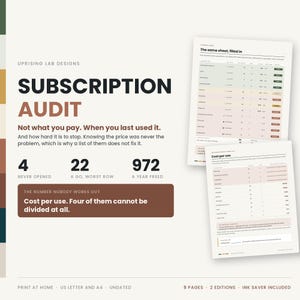
The number nobody works out and everybody understands the moment they see it. Divide what a thing costs by the number of times you opened it this month. In the worked example on page five, one row comes out at 22 a go. Four more were never opened at all, which cannot be divided — and that is the loudest answer on the page, because there is nothing to weigh it against.
The bottom of that table is the argument for keeping four of them. An audit that cannot say that is just a sales page for cancelling.
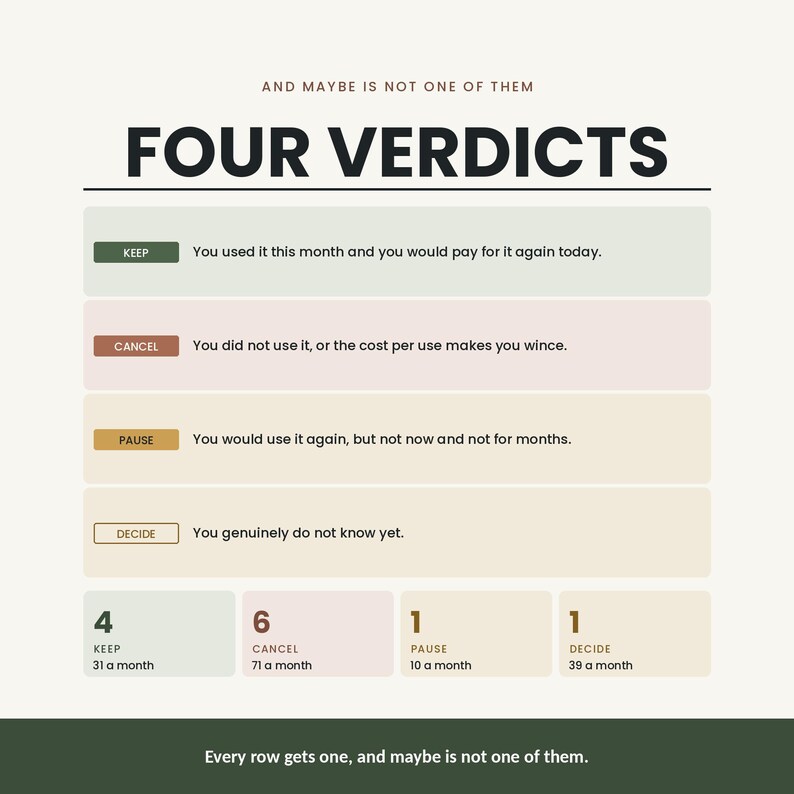
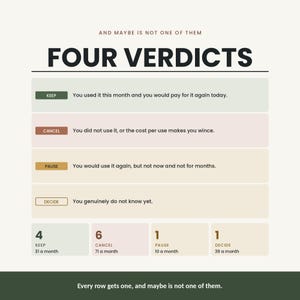
FOUR VERDICTS, AND MAYBE IS NOT ONE OF THEM
Keep, Cancel, Pause, Decide. Pause is the honest version of "I might use it again" — cancel it and write the month you will look again. Decide is allowed exactly once per audit, and only with a date beside it; without a date it is not a verdict, it is a shrug. Every row gets one, and a row without one is a row you will feel exactly the same way about in six months.
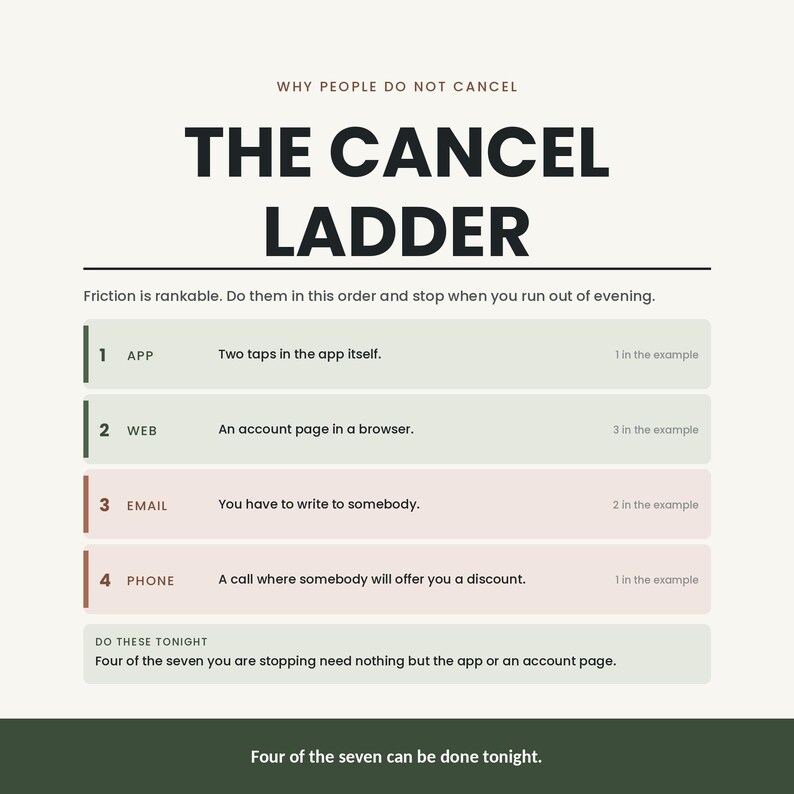
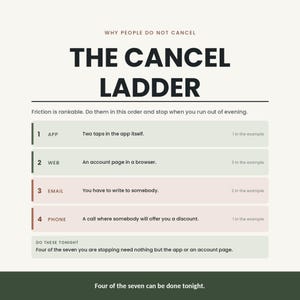
THE CANCEL LADDER
The reason people do not cancel is friction, and friction is rankable: two taps in an app, an account page, an email you have to write, a phone call somebody will argue with. Do them in that order. In the example, four of the seven can be done tonight without opening a laptop. Starting with the phone call means starting with the one you will put off — and then none of the others happen either.
Plus the exact sentence to send for the ones that need an email, and the four things worth knowing before you send it, including why you check the bank in two months rather than one.
SIX TRAPS
The annual one bought in a sale. The family plan where you are the payer. The one kept for a single feature. The trial that converted while you were not looking. The one that is cheaper than cancelling feels. And the one you are embarrassed to admit you do not use. Not one of these is about not knowing the price — every one is a decision that never got made.
AND THE PAGE MOST AUDITS SKIP
Money you stop spending does not arrive anywhere. It is absorbed, quietly and completely, unless you move it on the day the first cancellation lands. The last page is about that, and about diarising the next audit for six months rather than one, because nothing changes in a month and an audit you run too often is one you stop running.
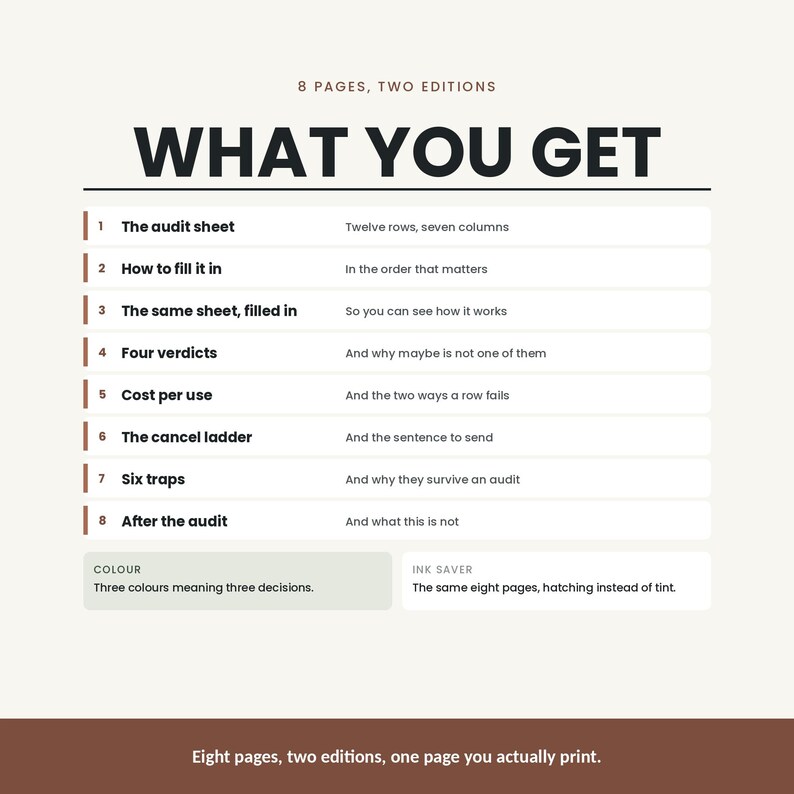
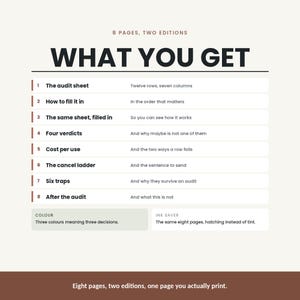
WHAT YOU GET
Eight pages, twice — a color edition and an ink-saver edition with the tints replaced by hatching for a mono printer. Both carry exactly the same words; only the ink changes.
The audit sheet — twelve rows, seven columns
How to fill it in, in the order that matters
The same sheet filled in, so you can see how
The four verdicts, and why maybe is not one
Cost per use, and the two ways a row fails
The cancel ladder, and the sentence to send
Six traps, and why they survive an audit
After the audit, and what this is not
NO RED. A traffic light is the obvious code for keep, think and cancel — so this one runs sage, brass and clay instead. A row you are cancelling is not a mistake you made, it is a decision you are finally getting to make.
WHAT IT DELIBERATELY IS NOT
No budget: it never asks what you earn or what you should spend. No recommendations — nothing here says which services are worth it, because that is not a thing a page can know about you. No app, no account, no login: one page you print, one pen, and a bank statement you already have. And no dates and no year, so it is right whenever you run it.
If the surprise is not what you subscribe to but when it all leaves, that is a timing problem rather than a subscription one, and the Bill Calendar is the page for it.
DETAILS
Topic: Subscriptions, recurring payments, free trials, cancelling, cost per use, money decluttering
Target audience: Anyone with more than about six recurring payments who suspects at least two of them are dead — and anyone who has filled in a subscription tracker before and cancelled nothing
Product type: Printable PDF, two editions
Format: PDF
Activity: About twenty minutes with a bank statement open, then one cancellation a month, then again in six months
Theme: Three colours meaning three decisions, not three quantities: sage for keep, brass for hold, clay for stop. Staleness is kept in grey on purpose so a fact about time can never be mistaken for a decision about money. Undated — no dates and no year in either file
Language: English (international spelling)
Usage rights: Personal use, and use with your own clients if you work with people. Print it as many times as you like. Not for resale, redistribution, sharing or repackaging, and not to be sold as a template, a bonus, a lead magnet or part of a course
Page count: 8 pages, in two editions
Dimensions: 8.5 × 11 in US Letter portrait. Prints on A4 with margins to spare — choose Fit to page rather than Actual size
Included items: 1. The Subscription Audit (8-page PDF) 2. The Subscription Audit, ink-saver edition (8-page PDF) 3. A read-me
Colour scheme: Sage
#4E644A for keep, brass
#CBA054 for hold, clay
#A76A53 for stop, on warm paper
#F8F6F1
Software required: Any PDF reader. Nothing to install, no account, no subscription — which would be a poor look on this one
Required materials: A printer and a pen, and a bank statement
Author credentials: Written and drawn from a blank file by Uprising Lab Designs — nothing resold, no PLR, no stock assets, and the typefaces are under the SIL Open Font License. A 122-check audit verifies that every figure on the pages is recomputed from the worked example rather than asserted, that the example is internally consistent, that every cost-per-use figure matches its own division, and that the colour and ink-saver editions carry identical text. Both editions were checked for text overlap, margin bleed, glyph coverage, rules crossing type and page overrun, then rendered and read twice. AI assisted drafting and layout; the editorial and design judgement are the studio's own
Instant download. No physical item ships. Because files deliver immediately, all sales are final — but message me before leaving a review and it is almost always fixed the same day.
This is not financial advice, and nothing here recommends or criticises any particular service.
If you experience any issues with your purchase or have questions about your files, please contact us. We are happy to help!
Instant Download
Your files will be available to download once payment is confirmed. Here's how.
Instant download items don’t accept returns, exchanges or cancellations. Please contact the seller about any problems with your order.
Etsy Purchase Protection
Shop confidently on Etsy knowing if something goes wrong with an order, we've got your back for all eligible purchases —
see program terms


More from this shop
Visit shop-
Digital download
Interview Prep Workbook Printable, 80 Questions Answer Strategy, STAR Method Worksheets, Job Planner (PDF)
Sale Price $9.37
Original Price $18.76
-
Digital download
Strength Training Planner for GoodNotes, Undated 12 Week Workout Log
Sale Price $9.44
Original Price $26.97
-
Digital download
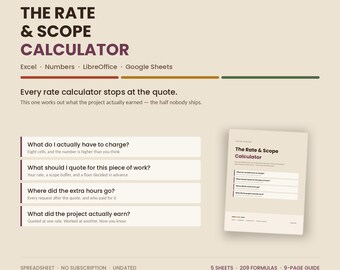
Freelance Hourly Rate Calculator Excel Google Sheets | Project Pricing Scope Creep Tracker
Sale Price $8.20
Original Price $16.41
-
Digital download
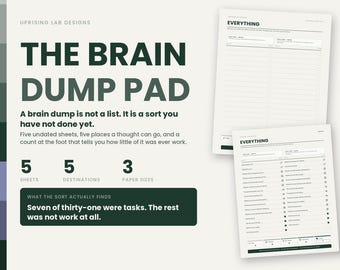
Brain Dump Printable, Undated Sheets That Sort Thoughts Into Five Places, A5 A4 Letter
$4.68
Be the first to leave a review
-

Digital download
Comprehensive Subscription & Membership Tracker: Never pay for Unused Services Again!
$6.67
-
Digital download
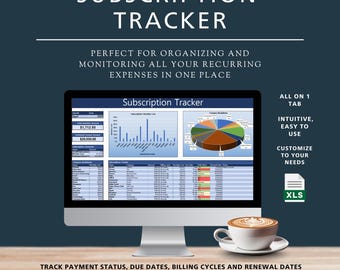
Subscription Tracker Excel, Monthly Subscription Tracker Template, Simple Subscription Tracker Spreadsheet, Subscription Membership Tracker
Sale Price $4.17
Original Price $6.95
-
Digital download
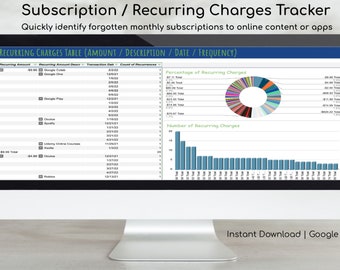
Subscription / Recurring Charges Tracker
$5.95
-
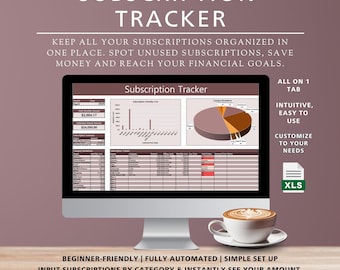
Digital download
Subscription Tracker Excel Template: Monthly Bill Organizer (Digital Download)
Sale Price $4.17
Original Price $6.95
-
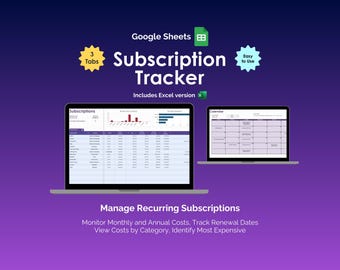
Digital download
Subscription Tracker Google Sheets Template Monthly Expense Budget Planner Recurring Payment Organizer Finance Membership Renewal Tool
Sale Price $3.97
Original Price $7.95
-
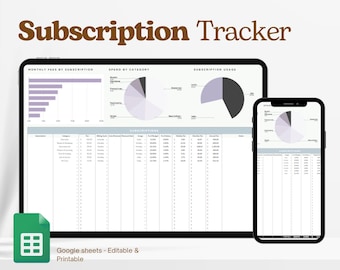
Digital download
Subscription Tracker Google Sheets Template | Monthly Bills & Subscriptions Organizer | Recurring Payments Log | Budget Expense Spreadsheet
Sale Price $3.41
Original Price $7.11
-

Digital download
Printable Subscription Tracker: Recurring Payments, Bills, Canva Template (PDF Download A4/A5/US Letter)
Sale Price $3.51
Original Price $5.40
-
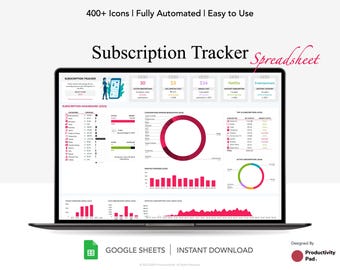
Digital download
Subscription Tracker Google Spreadsheet, Subscription Calendar, Membership Tracker, Financial Planner
$6.62
-
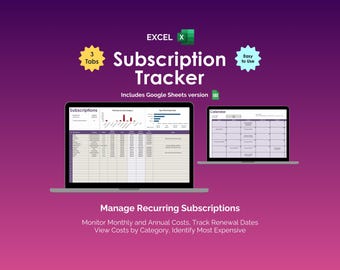
Digital download
Subscription Tracker Excel Spreadsheet Template Recurring Expense Tracker Bill Payment Calendar Streaming Subscription Membership Renewal
Sale Price $3.97
Original Price $7.95
-
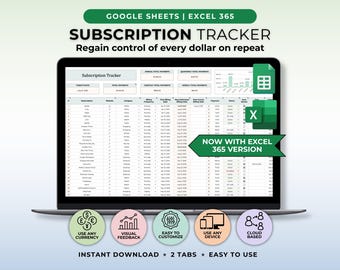
Digital download
Subscription Tracker Google Sheet Template Recurring Bills Tracker Subscription Savings Tracker Password Tracker Manage Subscription Log
Sale Price $2.41
Original Price $5.35
-

Digital download
Subscription Tracker: Manage Recurring Costs and safe money; Your online digital subscription spreadsheet (Excel & Google Sheets)
Sale Price $3.60
Original Price $4.81
-

Digital download
Subscription Tracker Membership Tracker Easy Budgeting Subscription Track Subscription Excel Subscription Membership Tracker Subscription
$10.00
Shoppers with similar taste loved these
-

Digital download
Printable Bank Account Information Tracker, Bank Details, Business Planner, Account Inserts, Bank Account Log, Finance Tracker, Card Details
$1.12
-

Accounts Log / Password Insert for Filofax, Kikki K, etc. - A5 and Personal Size Inserts
$4.75
-

Digital download
Bank & Credit Card Tracker Printable, Finance Planner (Fillable PDF)
$2.11
-
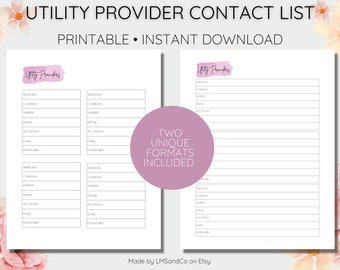
Digital download
Utility Provider Contact List: Home Planner Printable (PDF)
$1.75
-

Digital download
ADHD Productivity Planner Bundle Canva, Ultimate Adult Life Organizer, Goal Tracker PDF A4 A5
Sale Price $9.85
Original Price $32.84
-
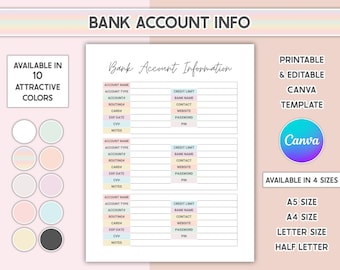
Digital download
Bank Account Info Printable Bank Tracker Canva Editable Accounts Log Finance Template Details Information
$2.69
-
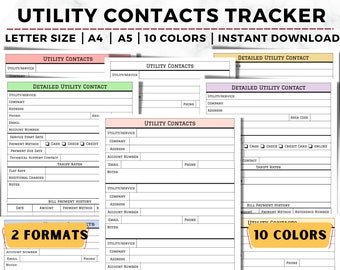
Digital download
Printable Utility Contacts Tracker, Household Organizer (Digital Download)
Sale Price $1.87
Original Price $3.11
-
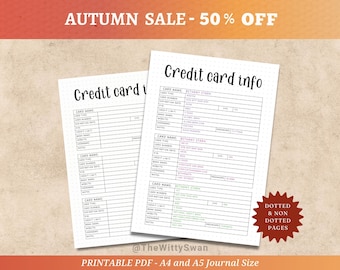
Digital download
Credit card info tracker printable Journal page Personal finance tracker Bank account info Bujo printable Password log A5 inserts
Sale Price $1.15
Original Price $2.30
-
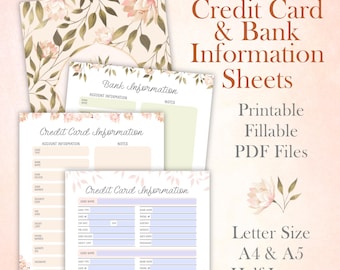
Digital download
Printable Credit Card & Bank Account Tracker | Finance Planning | Budget Plan
Sale Price $2.24
Original Price $2.99
-

Digital download
Editable Pastel Bow Binder Covers & Spines: Teacher Planner (Digital Download)
$5.50
-

Digital download
Utility Contacts Template Printable, Utility Service Address Book, Utility Information Tracker, Service Provider Contact List, Home Binder
Sale Price $0.96
Original Price $3.84
-

Digital download
Bank Account Information - Fillable - Printable PDF - Finance Planner - Business Planner - Instant Download
$3.20


