


Debt vs Invest Calculator Excel | Pay Off Debt or Invest Decision Tool | 5-Year Net Worth Comparison Spreadsheet with Break-Even Rate
Item highlights
Seller's description
The Kollaz Debt vs Invest Calculator is an Excel workbook that settles whether your extra dollars should kill debt or go into investments, comparing both options over 5 years of net worth. Enter your debt balance, APR, expected return, and monthly extra, and get a plain-English verdict plus your break-even debt APR: the exact rate where investing starts to win.
This is for someone torn between paying off debt and investing who needs the break-even math for their specific debts and expected returns.
Should your extra dollars kill your debt first, or go straight into investments? Get the answer in 60 seconds.
Enter 4 numbers (your debt balance, your debt APR, the investment return you expect, and your extra dollars per month), and this Excel workbook gives you a plain-English verdict: "Pay the debt first", "Invest the difference", or "It's close: either is fine."
What's inside (3 tabs)
- Cover: how it works + every assumption stated openly (see below)
- Inputs: 4 simple cells; everything recalculates instantly
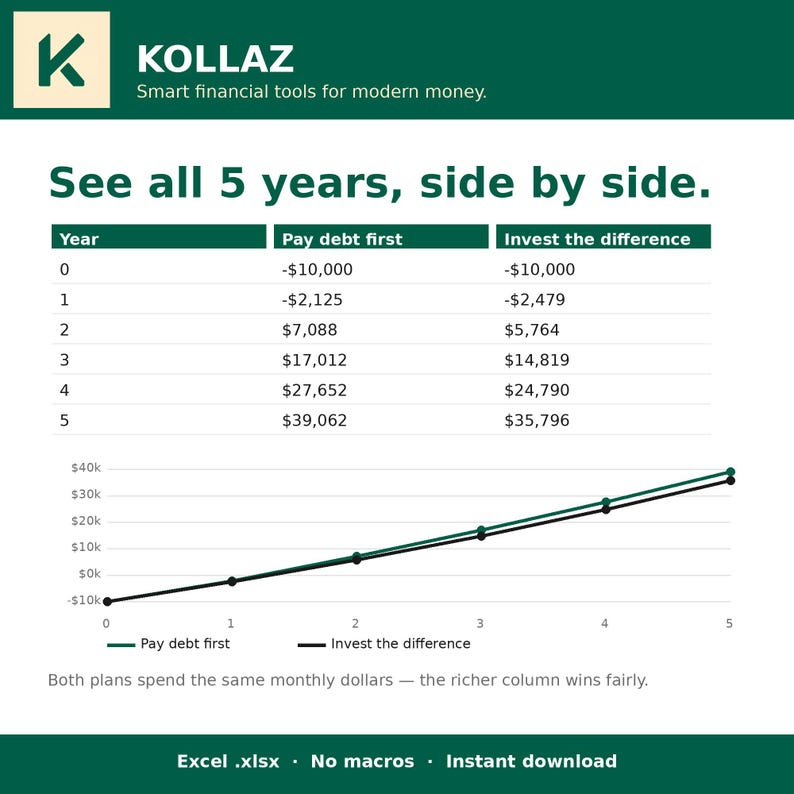
- Verdict Dashboard: your verdict, debt-free month, 5-year net worth for both plans, the dollar advantage, your break-even debt APR, a 5-year side-by-side projection table, and a net-worth comparison chart
Why the break-even rate matters
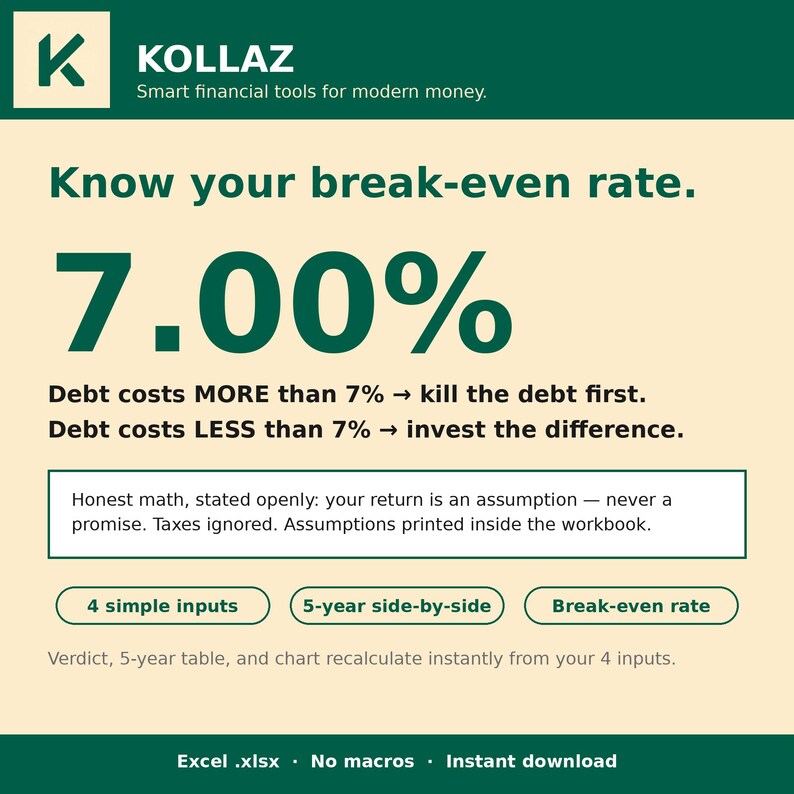
Above your break-even rate, killing the debt wins. Below it, investing wins. The workbook shows you exactly where your line is. For the sample scenario ($10,000 at 19% APR, 7% expected return, $500/mo), the answer is "Pay the debt first," $3,266 ahead after 5 years.
Honest math: assumptions stated openly
- Your expected return is YOUR assumption: returns are never guaranteed, and this workbook never promises investment outcomes.
- Taxes are ignored (no interest deduction, no tax on gains): a simplified, apples-to-apples comparison.
- Your regular budget is assumed to already cover minimum debt payments; the workbook compares what to do with the EXTRA dollars on top.
- The debt-first plan assumes you keep investing the freed-up payments once the debt is gone (instead of spending them).
- "It's close" means the 5-year gap is under $250 or 5%: either choice is fine.
- Educational tool only: not financial, tax, or investment advice.
Compatibility
Excel .xlsx, no macros. Tested working in Microsoft Excel (desktop + web) and Google Sheets. No macros, no add-ins, nothing to install.
Try the live demo (view-only sample): https://drive.google.com/file/d/1dWlHvVzFxqEgV0yNG5dFAFqI0XCo-m3z/view?usp=sharing
What you get
Instant download: the Debt vs Invest Decision Calculator workbook (.xlsx). Created with AI assistance. From Kollaz: smart financial tools for modern money.
Should I pay off debt or invest my extra money?
Enter 4 numbers (debt balance, debt APR, expected investment return, and extra dollars per month), and the workbook gives you a plain-English verdict in 60 seconds: "Pay the debt first", "Invest the difference", or "It's close: either is fine."
What is a break-even debt APR?
It's the exact interest rate where killing the debt and investing come out equal. Above your break-even rate, paying the debt wins; below it, investing wins. The workbook shows you exactly where your line is.
How long does the comparison cover?
A full 5-year side-by-side projection: net worth under both plans, the dollar advantage, your debt-free month, and a net-worth comparison chart.
Is the math honest about what it assumes?
Yes: every assumption is stated openly on the Cover tab. Your expected return is YOUR assumption (never guaranteed), taxes are ignored for an apples-to-apples comparison, and minimum payments are assumed covered by your regular budget.
Q: What does "It's close" mean?
A: The 5-year gap is under $250 or 5%: either choice is fine.
Q: Does it promise investment returns?
A: No: the workbook never promises investment outcomes. Your expected return is your own assumption; returns are never guaranteed.
Q: What if I have taxes on my investments or deductible interest?
A: Taxes are ignored in both plans (a simplified apples-to-apples comparison). It's an educational tool, not financial, tax, or investment advice.
Q: Why does the debt-first plan assume I keep investing later?
A: Because the fair comparison keeps investing the freed-up payments once the debt is gone, instead of spending them.
Format: Excel .xlsx workbook (no macros, no add-ins, nothing to install)
Tabs: 3: Cover (how it works + all assumptions), Inputs (4 cells), Verdict Dashboard (verdict, debt-free month, 5-year net worth both plans, dollar advantage, break-even APR, 5-year projection table, net-worth chart)
Inputs: debt balance, debt APR, expected investment return, extra dollars per month
Compatibility: Microsoft Excel (desktop + web) and Google Sheets
Maker: Kollaz: Smart financial tools for modern money
Delivery: instant digital download
If something goes wrong with an order, we've got your back for all eligible purchases. View program terms
NowPrice:$7.21
Original Price: $14.42
50% off
Sale ends on December 6
You can only make an offer when buying a single item
Delivery
Instant download
Your files will be available to download once payment is confirmed. Here's how.
Instant download items don't accept returns, exchanges or cancellations. Please contact the seller about any problems with your order.
Seller's description
Specifications
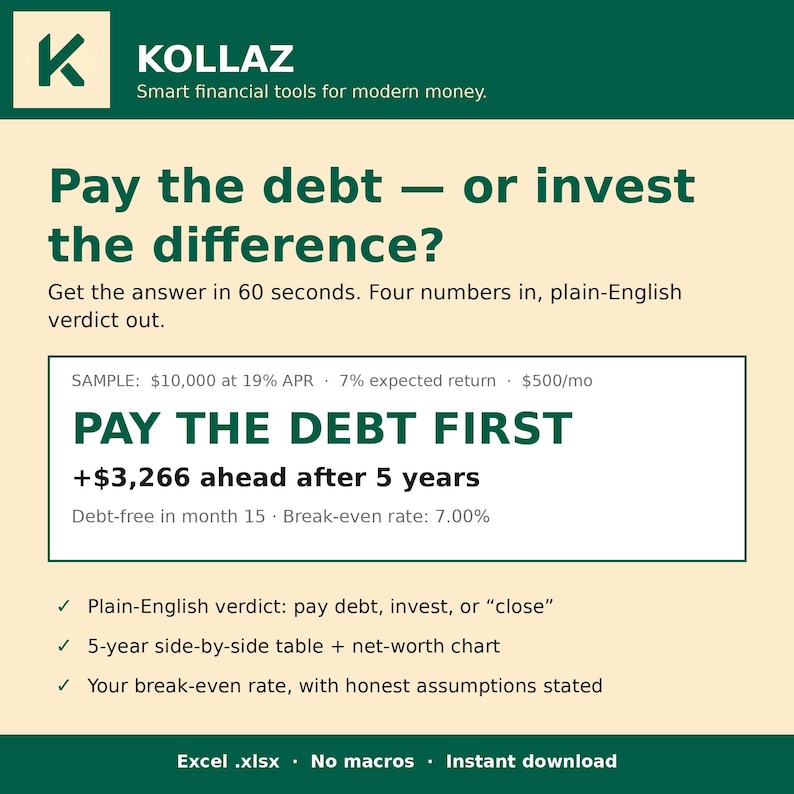
The Kollaz Debt vs Invest Calculator is an Excel workbook that settles whether your extra dollars should kill debt or go into investments, comparing both options over 5 years of net worth. Enter your debt balance, APR, expected return, and monthly extra, and get a plain-English verdict plus your break-even debt APR: the exact rate where investing starts to win.
This is for someone torn between paying off debt and investing who needs the break-even math for their specific debts and expected returns.
Should your extra dollars kill your debt first, or go straight into investments? Get the answer in 60 seconds.
Enter 4 numbers (your debt balance, your debt APR, the investment return you expect, and your extra dollars per month), and this Excel workbook gives you a plain-English verdict: "Pay the debt first", "Invest the difference", or "It's close: either is fine."
What's inside (3 tabs)
- Cover: how it works + every assumption stated openly (see below)
- Inputs: 4 simple cells; everything recalculates instantly
- Verdict Dashboard: your verdict, debt-free month, 5-year net worth for both plans, the dollar advantage, your break-even debt APR, a 5-year side-by-side projection table, and a net-worth comparison chart
Why the break-even rate matters
Above your break-even rate, killing the debt wins. Below it, investing wins. The workbook shows you exactly where your line is. For the sample scenario ($10,000 at 19% APR, 7% expected return, $500/mo), the answer is "Pay the debt first," $3,266 ahead after 5 years.
Honest math: assumptions stated openly
- Your expected return is YOUR assumption: returns are never guaranteed, and this workbook never promises investment outcomes.
- Taxes are ignored (no interest deduction, no tax on gains): a simplified, apples-to-apples comparison.
- Your regular budget is assumed to already cover minimum debt payments; the workbook compares what to do with the EXTRA dollars on top.
- The debt-first plan assumes you keep investing the freed-up payments once the debt is gone (instead of spending them).
- "It's close" means the 5-year gap is under $250 or 5%: either choice is fine.
- Educational tool only: not financial, tax, or investment advice.
Compatibility
Excel .xlsx, no macros. Tested working in Microsoft Excel (desktop + web) and Google Sheets. No macros, no add-ins, nothing to install.
Try the live demo (view-only sample): https://drive.google.com/file/d/1dWlHvVzFxqEgV0yNG5dFAFqI0XCo-m3z/view?usp=sharing
What you get
Instant download: the Debt vs Invest Decision Calculator workbook (.xlsx). Created with AI assistance. From Kollaz: smart financial tools for modern money.
Should I pay off debt or invest my extra money?
Enter 4 numbers (debt balance, debt APR, expected investment return, and extra dollars per month), and the workbook gives you a plain-English verdict in 60 seconds: "Pay the debt first", "Invest the difference", or "It's close: either is fine."
What is a break-even debt APR?
It's the exact interest rate where killing the debt and investing come out equal. Above your break-even rate, paying the debt wins; below it, investing wins. The workbook shows you exactly where your line is.
How long does the comparison cover?
A full 5-year side-by-side projection: net worth under both plans, the dollar advantage, your debt-free month, and a net-worth comparison chart.
Is the math honest about what it assumes?
Yes: every assumption is stated openly on the Cover tab. Your expected return is YOUR assumption (never guaranteed), taxes are ignored for an apples-to-apples comparison, and minimum payments are assumed covered by your regular budget.
Q: What does "It's close" mean?
A: The 5-year gap is under $250 or 5%: either choice is fine.
Q: Does it promise investment returns?
A: No: the workbook never promises investment outcomes. Your expected return is your own assumption; returns are never guaranteed.
Q: What if I have taxes on my investments or deductible interest?
A: Taxes are ignored in both plans (a simplified apples-to-apples comparison). It's an educational tool, not financial, tax, or investment advice.
Q: Why does the debt-first plan assume I keep investing later?
A: Because the fair comparison keeps investing the freed-up payments once the debt is gone, instead of spending them.
Format: Excel .xlsx workbook (no macros, no add-ins, nothing to install)
Tabs: 3: Cover (how it works + all assumptions), Inputs (4 cells), Verdict Dashboard (verdict, debt-free month, 5-year net worth both plans, dollar advantage, break-even APR, 5-year projection table, net-worth chart)
Inputs: debt balance, debt APR, expected investment return, extra dollars per month
Compatibility: Microsoft Excel (desktop + web) and Google Sheets
Maker: Kollaz: Smart financial tools for modern money
Delivery: instant digital download
-
Designed by
-
Item typeDigital download
-
Digital file type(s)1 File
If something goes wrong with an order, we've got your back on all eligible purchases. View program terms
Meet your seller
More from this shop
-

Digital download
Debt Payoff Spreadsheet | Snowball, Avalanche, Windfall Simulator | Excel + Google Sheets
Sale Price $20.61
Original Price $41.22
-

Digital download
Student Loan Repayment Plan Comparison Spreadsheet 2026: RAP vs IBR vs Standard, Amortization & Forgiveness Tax Calculator
Sale Price $17.66
Original Price $35.33
-

Digital download
Divorce Financial Organizer Spreadsheet: Asset, Debt & Document Checklist + Post-Split Budget Planner
Sale Price $13.25
Original Price $26.49
-

Digital download
FIRE Calculator Spreadsheet — Financial Independence Retire Early Planner, 4% Rule Withdrawal & Savings Rate Planner, Excel Download
Sale Price $20.61
Original Price $41.22
-
Digital download
2026 Self-Employed Tax Filing Planner (U.S. Edition) | Schedule C Deduction Finder, Quarterly Planner & CPA Handoff Packet
Sale Price $20.61
Original Price $41.22
-

Digital download
Inventory Tracker & Bookkeeping Spreadsheet for Small Business Bookkeeping | Inventory Spreadsheet, COGS and Expense Tracker, Sheets Excel
Sale Price $36.08
Original Price $72.16
-
Digital download
Debt Pay-Off Calculator Sheet – Excel & Google Sheets Template for Debt Management – 50% Off
Sale Price $5.81
Original Price $11.61
-
Digital download
Debt Reduction Calculator: Credit Card Tracker Spreadsheet (Digital Download)
$11.15
-
Digital download
Debt Snowball and Avalanche Calculator Spreadsheet for Microsoft Excel
$11.61
-

Digital download
Debt Payoff Calculator: Excel Template, Payment Plan (Digital Download)
$11.15
-
Digital download
Easy Debt Payoff Spreadsheet | Simple Monthly Credit Card & Loan Tracker | Excel | User Friendly | No Frills
$13.99
-
Digital download
Debt Payoff Excel Spreadsheet, Credit Card & Loan Tracker (Digital Download)
Sale Price $11.61
Original Price $13.66
-

Digital download
Ultimate Debt Method Debt Payoff Tracker Snowball Excel Debt Free Template Avalanche Calculator Spreadsheet Payoff Spreadsheet Quick
$15.14
-
Digital download
Debt Payoff Calculator Excel Spreadsheet, Snowball Avalanche Planner, 80 Account Credit Card Repayment Template
$14.99
-

Digital download
Debt Payoff Plan Template - Debt Tracker Sheet for Excel & Google Sheets - Personal Finance Management Tool
Sale Price $5.81
Original Price $11.61
-
Digital download
Debt Payoff Calculator Excel Spreadsheet, Snowball Avalanche Planner, 40 Account Credit Card Repayment Template
$10.99
-
Digital download
Simplest Way to Increase Your Credit Score & Pay Off Debt | SnoValanche™ Spreadsheet | Credit Card Tracker | Instant Download
$19.99
-

Digital download
Debt Payoff Tracker Debt Snowball Spreadsheet Debt Snowball Method Calculator Avalanche Method Debt for Organized Couple Gift 2026
$15.14
Shoppers with similar taste loved these
-
Digital download
Ultimate Monthly Budget Spreadsheet Google Sheets Excel Template Digital Financial Planner Debt Snowball Sinking Fund Subscription Tracker
Sale Price $10.53
Original Price $21.06
-

Digital download
AI Notion Template For Freelancers, Social Media Managers, Digital Marketing
$7.50
-
Digital download
2025 Budget Spreadsheet: Monthly & Annual Planner (Google Sheets, Digital Download)
$16.95
-
Digital download
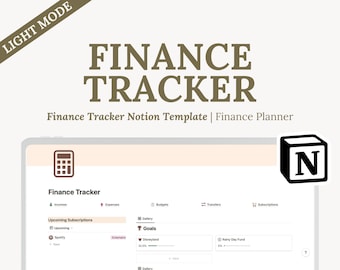
Notion Finance Tracker Template, Budget Tracker, Financial Planner, Income and Expense Tracker, Paycheck Budget and Money Management Tool
$6.00
-

Digital download
The Ultimate Notion Personal Finance Template | All-in-One Dashboard | Budget Manager, Finance Tracker, Expenses & More
$25.00
-
Digital download
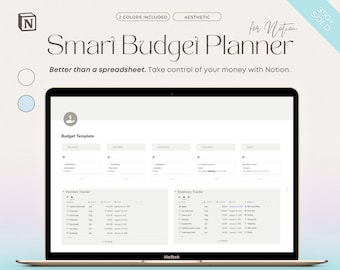
Notion Budget Template, Budget Spreadsheet, Notion Template Finance, Monthly Budget Planner Notion, Expenses Tracker, Personal Finance
$12.26
-

Digital download
Beginner Monthly Yearly Budget Spreadsheet | Google Sheets Budget Template | Simple Monthly Budget Tracker Financial Planner | Light Mode
Sale Price $13.40
Original Price $22.33
-

Digital download
Notion Financial Planner Template: Monthly Budget Tracker (Digital Download)
Sale Price $8.61
Original Price $9.79
-
Digital download
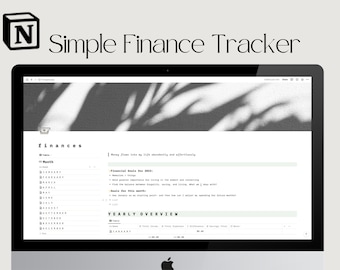
Simple Notion Finance Tracker | Notion Budget Template | Simple Aesthetic Budget Tracker
$5.00
-

Digital download
Notion Ultimate Finance Tracker Template | Finance Dashboard | Expenses Tracker | Notion Finance Planner | Notion Template
$14.99
-

Digital download
Budget and Finance Tracker Notion Template | Monthly Expense Tracker | Notion Budget Template | Notion Finances Template
$9.99
-

Digital download
Monthly Financial Review, Financial Reflection, Budgeting Evaluation, Finance Summary, Printable Insert Template, A4/A5/Letter/Half Size
$1.72


