



Resin Pricing Calculator Spreadsheet, Resin Art Cost Calculator, Epoxy Resin Business, Excel and Google Sheets
Item highlights
If something goes wrong with an order, we've got your back for all eligible purchases. View program terms
Price:$13.49
You can only make an offer when buying a single item
Delivery
Instant download
Your files will be available to download once payment is confirmed. Here's how.
Instant download items don't accept returns, exchanges or cancellations. Please contact the seller about any problems with your order.
Seller's description
Specifications
Know what to charge for every piece of resin art and what you keep after Etsy fees. Type your epoxy kit at the price you paid, the ml you mix for a pour session, your molds, pigments and inclusions and your minutes, and the sheet shows your retail price, wholesale price, profit after fees and profit per hour at the top, in Microsoft Excel or Google Sheets.
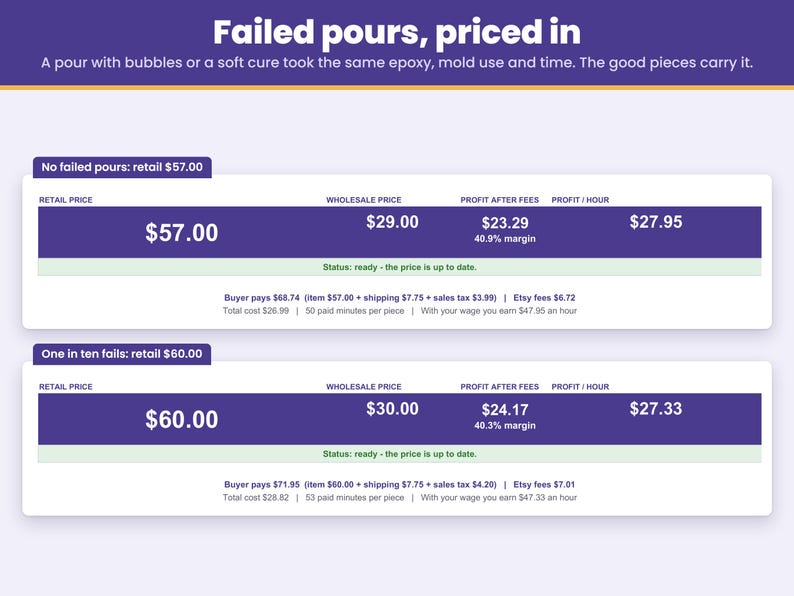
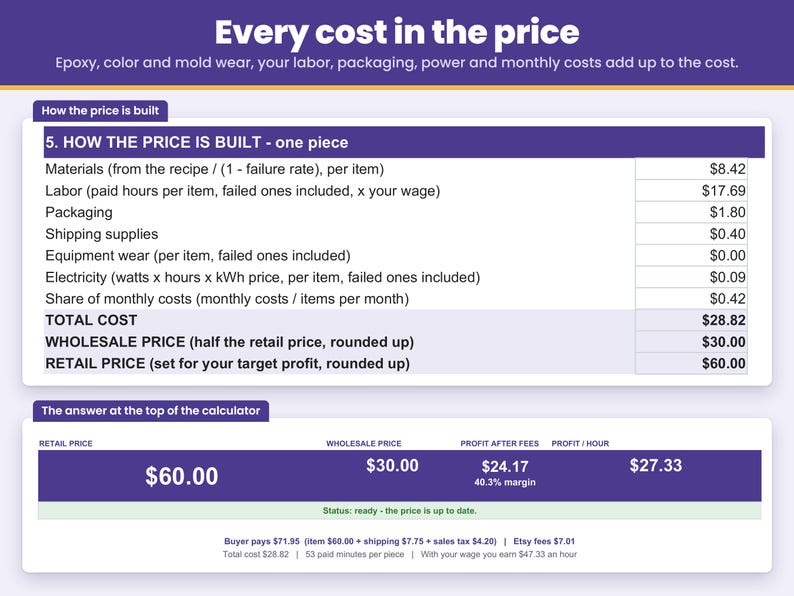
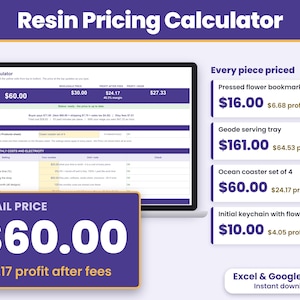
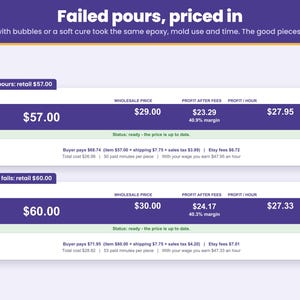
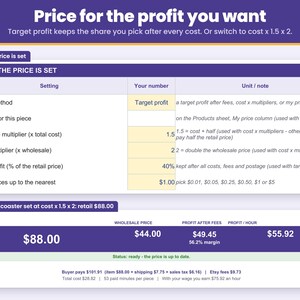
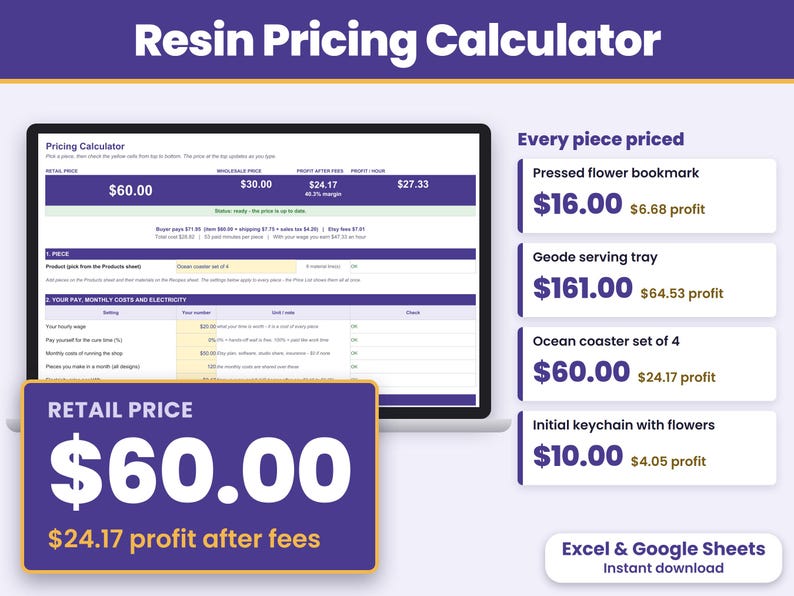
The filled-in example: a set of 4 ocean coasters, poured two sets to a session, costs $28.82, including 53 paid minutes at $20 an hour, mold wear, heat mat power and one pour in ten failing. It sells for $60.00 retail or $30.00 wholesale (half the retail price, about what shops pay) and keeps $24.17 after Etsy fees and postage. Change any number and the price updates as you type.
Made for resin artists in the US who sell on Etsy, at craft fairs or wholesale to shops. Instant download for Excel and Google Sheets on a computer.
WHAT YOU CAN DO
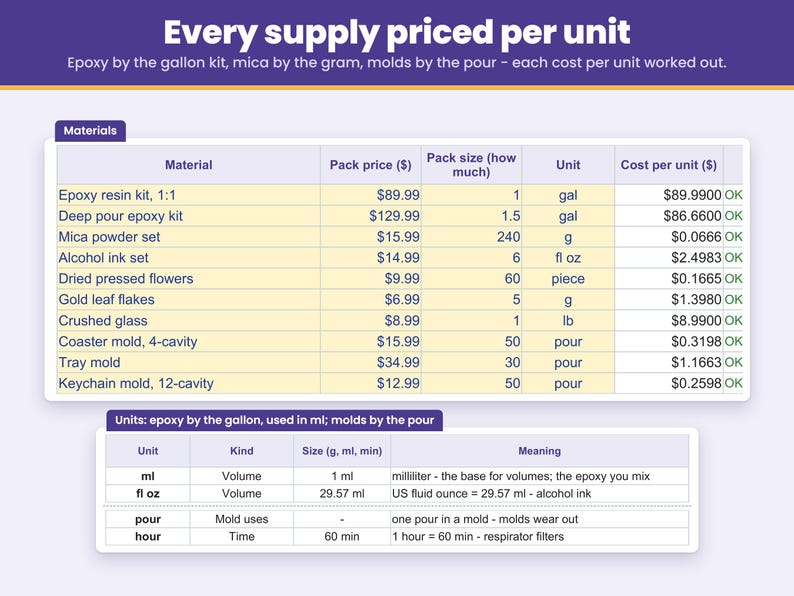
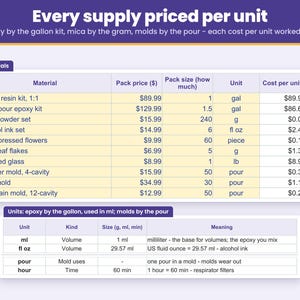
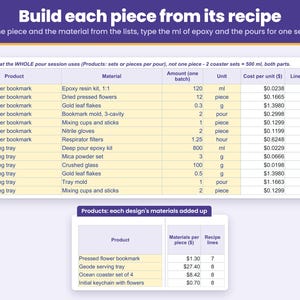
- Price from your real supply costs: type the pack price, how much is in the pack and the unit. A $89.99 gallon kit of 1:1 epoxy (both parts together) becomes $0.024 an ml, so a recipe can use the ml on your mixing cup. Epoxy sold by weight goes in by the kg and is used in grams. Mica powder by the g, alcohol ink by the fl oz, crushed glass by the lb, pressed flowers, cork pads and keychain hardware by the piece.
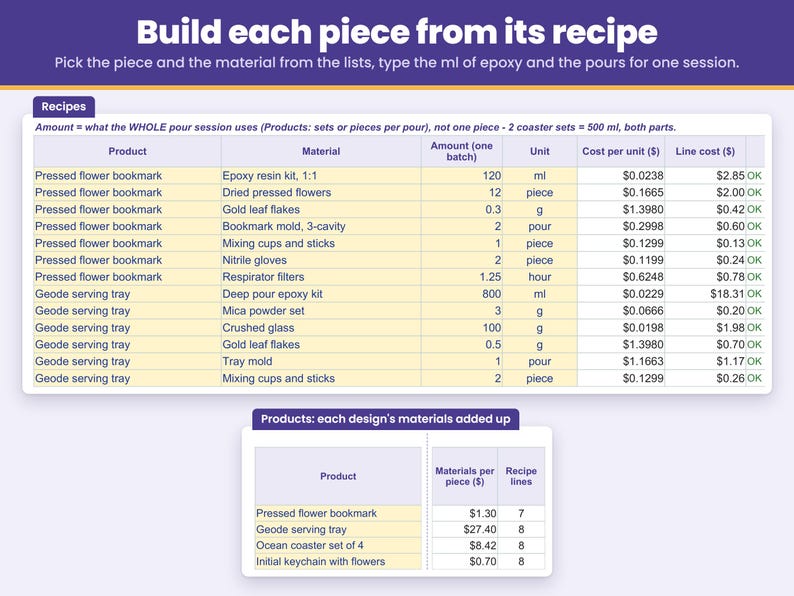
- Count the epoxy left in the cup: type the amount you mix, not only what ends up in the mold - what stays in the cup and on the stick is paid for too.
- Count mold wear: add each mold by the pours it lasts - a $15.99 coaster mold that lasts about 50 pours is $0.32 a pour - and put the pours of each session on the recipe.
- Add pigments and inclusions: mica, alcohol ink, pressed flowers, gold leaf and crushed glass, each at its own cost per unit.
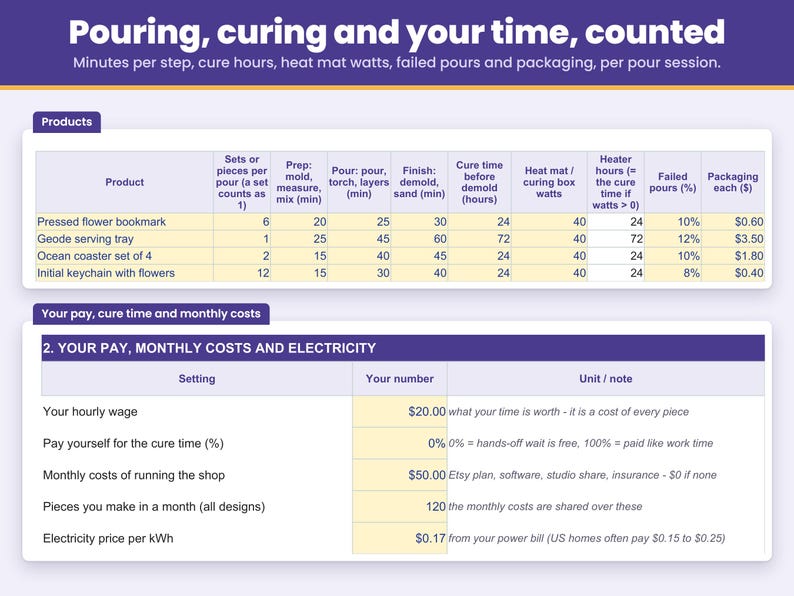
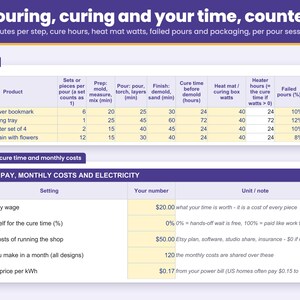
- Price by the pour session: type how many sets or pieces you pour in one session (a set of 4 coasters counts as 1), then the minutes, the cure hours and the amounts for the whole session. Every cost comes out per piece, so 12 keychains poured together share one session.
- Time in three steps: prep (prepare the mold, measure, mix), pour (pour, torch, layers) and finish (demold, sand, polish), in minutes.
- Decide whether cure time is paid: a pour cures for a day or more before you demold it, while you do other things. Pay yourself 0% of that wait, 100% or anything between - the price shows the difference straight away.
- Count a heat mat or curing box: type its watts and your price per kWh. It runs for the cure time and its power is shared over the pieces of the session; type 0 watts if you cure at room temperature.
- Price in the pours that fail: type the share you lose (10% = one in ten) - bubbles, a soft cure, a crack, a piece that breaks when you demold it. The epoxy, mold use, prep and pour time and the heat mat power of the failed pours are carried by the good ones - cost / (1 - failure rate). Finishing (demold, sand, polish) and parts such as cork pads and keychain hardware go on the good pieces only, so they are not divided.
- Pay yourself: your time x your hourly wage is part of the cost, so any profit is on top of your pay.
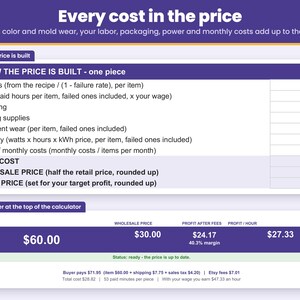
- Count every cost: packaging, shipping supplies, equipment wear per piece and a share of your monthly costs (shop fees, software, insurance) spread over the pieces you make in a month.
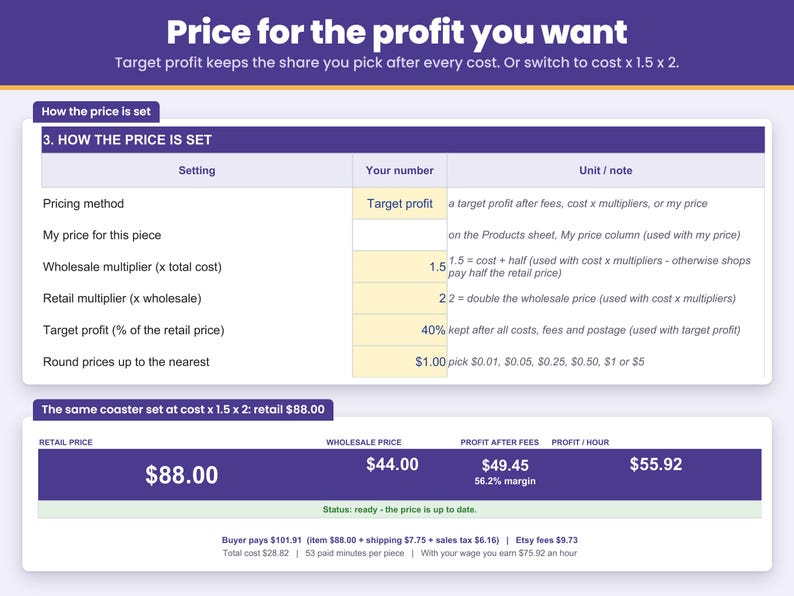
- Price three ways: for a target profit (the share of the price you want to keep, 40% to start), with cost x multipliers (cost x 1.5 = wholesale, wholesale x 2 = retail to start, both yours to change), or check the price you charge now with "My price". With a target profit or My price, the wholesale price is half the retail price - about what shops pay - and a note shows when selling to shops at that price would lose money.
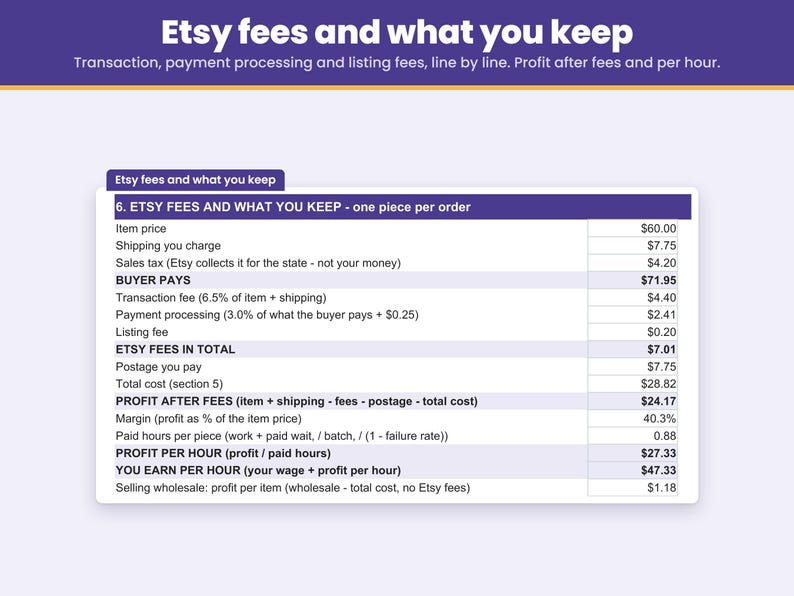
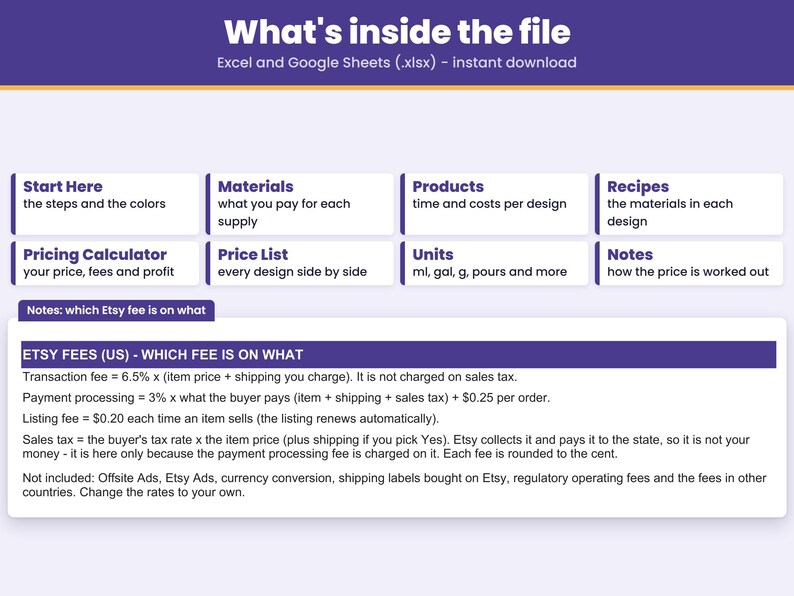
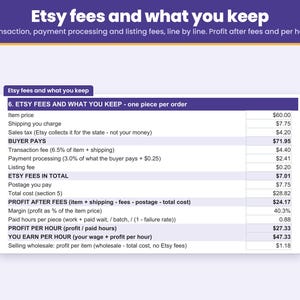
- See your Etsy fees line by line: transaction fee 6.5% of the item and the shipping you charge, payment processing 3% of what the buyer pays (including sales tax) + $0.25, and the $0.20 listing fee. Every rate is yours to change.
- Know your profit and your hourly earnings: profit after fees, profit as a % of the price, profit per hour, what you earn per hour with your wage, and your profit per piece when you sell wholesale.
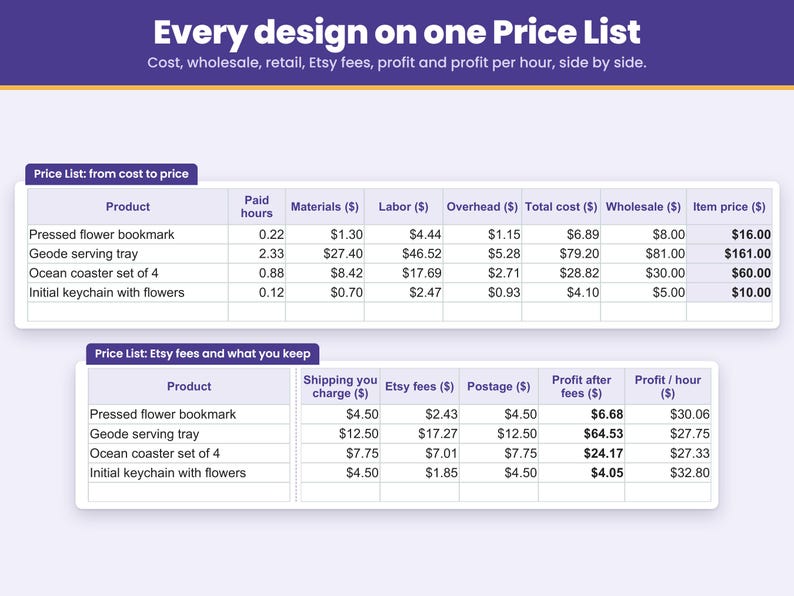
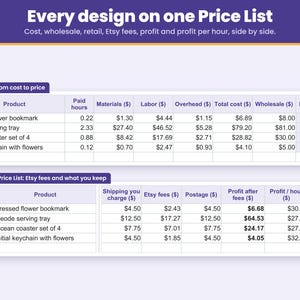
- See every design on one Price List: cost, wholesale, retail, Etsy fees, postage, profit and profit per hour, side by side.
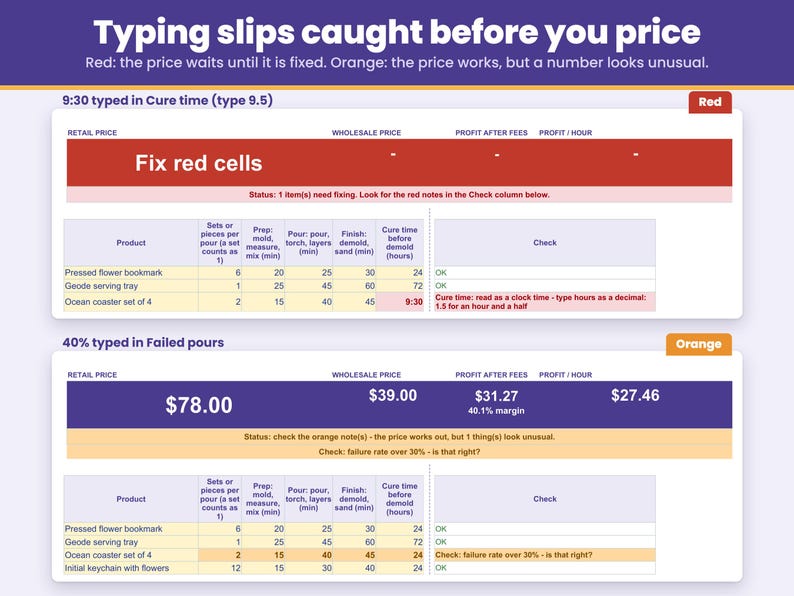
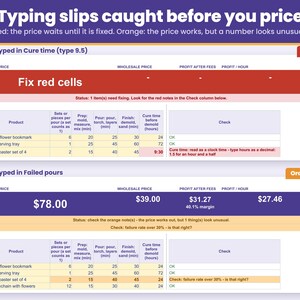
- Catch typing slips before you price: a missing number, text in a number cell, a zero pack size or amount, a number far too large, an hourly wage under $1 or heat mat watts typed in kW (0.04 instead of 40) turns red, and the price stays hidden until it is fixed. A fraction typed as 1/2 or a time typed as 1:30 turns red and asks for a decimal (0.5, 1.5). These turn orange so you can double-check: over 40 hours of work for one piece, a cure time over 168 hours, paying yourself over 25% of the cure time, a failure rate over 30%, heat mat watts over 1,500, an epoxy kit under $25 a gallon or $6.50 a liter (one part's price, or the wrong pack size), a mold over $6 a pour (the pours it lasts left out), one piece using more than a quarter of a pack (by weight or volume) or over 3,785 ml (a gallon) or 4.5 kg of one supply, over 20 g in one piece of a supply named mica, pigment, powder, glitter, leaf or flake (oz picked instead of g), an item price over $2,000, and a piece that loses money after fees.
- See what each material costs in one piece: the Pricing Calculator lists the biggest material lines of the design, biggest cost first, with the amount in one piece, its cost and its share, next to the recipe line and the pack as you typed them - so a wrong unit or a batch amount typed for one piece stands out. A short note above the Materials and Recipes tables and a tip on the pack price, pack size and amount cells say what to type: the whole pack, and the whole pour session. With an epoxy kit in the list, the note under it asks if the kit's pack price and size are for part A + B together.
WHAT'S INCLUDED
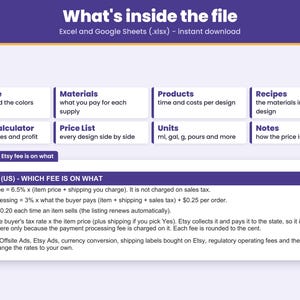
- One spreadsheet file (.xlsx) for Excel, plus a PDF with your link to make your own copy in Google Sheets. Tabs: Start Here, Materials, Products, Recipes, Pricing Calculator, Price List, Units, Notes.
- Finished examples already filled in: a set of 4 ocean coasters ($60.00 retail, $30.00 wholesale, $24.17 profit after Etsy fees), a geode serving tray in deep pour epoxy ($161.00 retail, $64.53 profit), pressed flower bookmarks poured six at a time ($16.00 retail, $6.68 profit) and initial keychains with flowers poured 12 at a time ($10.00 retail, $4.05 profit). Replace the example prices with your own.
- Room for 50 materials, 25 designs and 200 recipe lines, with 13 units to pick from (ml, fl oz, l, gal, g, oz, lb, kg, piece, dozen, pour, hour, min).
- Yellow cells are the only cells you fill in. In Excel, formula cells are locked to keep them safe from accidental edits; in your Google Sheets copy, typing over a formula shows a warning first.
HOW TO USE IT
1. Materials: type each supply once - the pack price, how much is in the pack and the unit. Molds go in by the pours they last.
2. Products and Recipes: on Products, one row per design with the sets or pieces per pour session, the minutes of each step, the cure time, the heat mat watts, the share of pours that fail, packaging and postage. On Recipes, the ml of epoxy you mix, the pigments, inclusions and mold pours for the whole session.
3. Pricing Calculator: pick a design and set your hourly wage, how much of the cure time you are paid for, monthly costs, electricity price, pricing method and Etsy fees. The retail price, wholesale price, profit after fees and profit per hour show at the top.
FAQ
How much should I charge for resin art?
Add up the epoxy, pigments, inclusions, mold wear, your time at an hourly wage, the pours that fail, packaging, a share of your monthly costs and the Etsy fees, then set the price for the profit you want. In the example, a set of 4 ocean coasters costs $28.82 (53 paid minutes at $20 an hour and one pour in ten failing included) and sells for $60.00 retail, priced for a 40% profit after Etsy fees and rounded up to the next dollar: $24.17 per set.
How do I calculate the epoxy cost of a piece?
Type the kit once ($89.99 for a gallon of 1:1 epoxy, both parts together) and the ml you mix for the session. A gallon is 3,785 ml, so it is $0.024 an ml. In the example, 500 ml mixed for two coaster sets is $11.89, or $5.94 a set - $6.60 with one pour in ten failing. To find how much a mold takes, fill it with water and pour that into a measuring cup.
How do I include mold wear in my price?
Add the mold as a material by the pour: what it cost and about how many pours it lasts. A $15.99 coaster mold that lasts about 50 pours is $0.32 a pour. In the example, each set of coasters carries $0.36 of mold wear with the failed pours included.
Should I charge for cure time?
That is your choice, and the calculator shows both. With the cure time at 0%, only your hands-on time is paid: the coaster set is $60.00. Paying yourself 10% of its 24-hour cure, shared over the two sets of the session, gives $113.00.
How do I price in failed pours?
Type the share you lose on the Products sheet. A failed pour took the same epoxy, mold use, prep and pour time and heat mat power, so the good pieces carry it: cost / (1 - failure rate). Finishing and parts such as cork pads and keychain hardware go on the good pieces only, so they are not divided. In the example, the coaster set is $57.00 when nothing fails and $60.00 when one pour in ten fails.
How much electricity does a heat mat use?
Multiply its watts by the cure hours and your price per kWh, then share it over the pieces of the session. In the example, a 40 W heat mat for a 24-hour cure at $0.17 per kWh is $0.16 a session - $0.09 per coaster set with the failed pours carried. Type 0 watts if you cure at room temperature.
How do I price a large piece like a serving tray?
Add the deep pour epoxy, the inclusions and the tray mold, and type the cure time and the minutes for one tray. In the example, a geode serving tray with 800 ml of deep pour epoxy, crushed glass, gold leaf and a 72-hour cure costs $79.20 and sells for $161.00 retail or $81.00 wholesale, with $64.53 profit after Etsy fees.
How do I price small pieces poured many at a time?
Type the number of pieces in the session and the minutes and amounts for the whole session. In the example, 12 initial keychains with flowers share one session: $4.10 total cost each, $10.00 retail and $4.05 profit after Etsy fees. Pressed flower bookmarks poured six at a time sell for $16.00 with $6.68 profit.
What should I charge wholesale for resin art?
Shops usually pay about half the retail price, so with a target profit or My price the wholesale price is half the retail price. For the example coaster set, $30.00 wholesale leaves $1.18 over all your costs and your wage when a shop buys it - thin for a big order. If you sell a lot to shops, pick "Cost x multipliers": cost x 1.5 = $44.00 wholesale and wholesale x 2 = $88.00 retail, which leaves $15.18 a set sold wholesale and $49.45 after Etsy fees sold on Etsy. Both multipliers are yours to change.
How much profit do I make after Etsy fees?
The calculator works out each fee on what it is charged on. For the example coaster set at $60.00 with $7.75 shipping and 7% sales tax, Etsy fees come to $7.01 and the profit after fees, postage and all costs is $24.17 - $27.33 for each hour of work on top of your $20 wage.
Is the price I charge now high enough?
Type it in the My price column on the Products sheet and pick "My price". You see the profit after fees, the margin and what you earn per hour at that price, and the status line at the top turns orange if the price is below your cost or loses money after fees.
Can I offer free shipping?
Yes. Type $0 for the shipping you charge. The postage you pay stays a cost, and the transaction fee is then only on the item price.
Does it work in Google Sheets?
Yes. Your download includes a PDF with a link: click it and Google Sheets makes your own copy, no upload needed. In my checks, with the same numbers typed in, every price and check gave the same result in Google Sheets as in Excel, and the dropdown lists and the red and orange checks carry over. In Google Sheets, fill only the yellow cells and type decimals such as 0.5, not fractions such as 1/2.
HOW TO DOWNLOAD
After you buy, open etsy.com in a web browser (computer recommended), go to Purchases and reviews, and click Download Files. Digital files cannot be downloaded in the Etsy app.
- Microsoft Excel: open the .xlsx file in Excel on a computer.
- Google Sheets: open the PDF in your download, click Make my copy in Google Sheets, then click Make a copy. The copy is saved in your Google Drive. A free Google account is enough. (You can also upload the .xlsx at drive.google.com: New > File upload, then right-click it > Open with > Google Sheets.)
LIMITATIONS
- Instant digital download. Nothing is shipped. No molds, resin or patterns are included - this is a pricing spreadsheet.
- Needs Microsoft Excel or Google Sheets on a computer.
- Made in Microsoft Excel and checked in Google Sheets.
- Not tested in Excel on the web, Excel for Mac, Numbers or the Google Sheets phone app.
- In Google Sheets, formula cells are not locked as they are in Excel. The copy from your link warns you before you type over a formula; an uploaded .xlsx does not, so fill only the yellow cells.
- US dollars. Units convert within the same kind (weight, volume, count, time); a weight can't be turned into a volume, so epoxy bought by the kg is used in grams and epoxy bought by the gallon in ml or fl oz.
- It does not work out mix ratios or how much epoxy a mold holds: type the amount you mix for the session (the Start Here sheet shows how to measure a mold with water).
- The heat mat's power is worked out from its watts x the cure hours, as if it runs the whole time. A plug-in meter gives the real number.
- Prices assume one piece per order; with several pieces in one order, the shipping, the $0.25 fixed fee and the postage are shared, so each piece keeps a little more.
- Room for 50 materials, 25 designs and 200 recipe lines.
- It is a pricing tool, not an inventory, supply stock or bookkeeping file.
- Etsy fees and the sales tax rate in the file are examples (Etsy US fees as published in Oct 2026; Offsite Ads, Etsy Ads, currency conversion, shipping labels and fees in other countries not included). Check your own shop and your local sales tax rate.
- Example supply prices, mold lifetimes, times, cure hours, watts, failure rates and costs are examples. Replace them with your own.
- For use in your own business. Please do not resell or share the file.
- Because this is a digital download, returns and exchanges are not accepted.
Something not working, or a question? Send me a message on Etsy anytime - I'm happy to help.
This spreadsheet was designed by CraftCostSheets and built with the help of AI tools, then checked in Microsoft Excel and Google Sheets.
-
Made by
-
Item typeDigital download
-
Digital file type(s)1 PDF, 1 other file
If something goes wrong with an order, we've got your back on all eligible purchases. View program terms
Meet your seller
More from this shop
-
Digital download
Jewelry Pricing Calculator Spreadsheet, Jewelry Price Sheet, Wholesale Retail Price, Etsy Fees, Excel and Google Sheets
$12.49
-
Digital download
3D Print Pricing Calculator Spreadsheet, Filament Cost Calculator, 3D Printing Business, Excel and Google Sheets
$11.99
-
Digital download
Pottery Pricing Calculator Spreadsheet, Kiln Firing and Glaze Cost, Ceramics Business, Excel and Google Sheets
$15.99
-
Digital download
Tumbler Pricing Calculator Spreadsheet, Sublimation Epoxy Vinyl Tumbler Price Sheet, Excel and Google Sheets
$13.99
-
Digital download
Handmade Pricing Calculator Spreadsheet, Product Cost and Profit Margin, Wholesale Retail Pricing, Excel and Google Sheets
$11.99
-
Digital download
Machine Embroidery Pricing Calculator, Price by Stitch Count, Embroidery Business Spreadsheet, Excel and Google Sheets
$15.99