

Python Data Structures Cheat Sheet, Lists, Tuples, Dictionaries and Sets, Visual Coding Study Guide
Item highlights
Seller's description
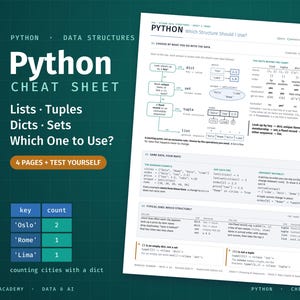
A Python data structures cheat sheet that shows when to use a list, tuple, dictionary or set, with a decision chart and every result drawn.
THIS IS A DIGITAL DOWNLOAD. NO PHYSICAL ITEM WILL BE SHIPPED.
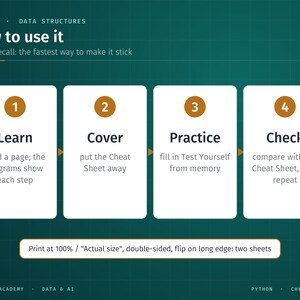
You will receive printable PDF files in one ZIP file. No printed or laminated sheets are included. The photos show how they look once printed.
LIST, TUPLE, DICT OR SET? KNOW WHICH ONE TO USE, AND WHY
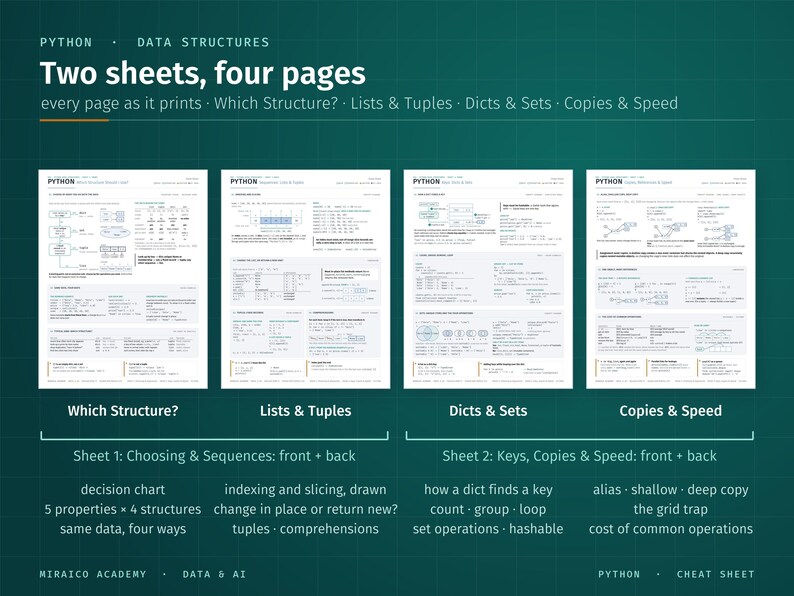
A visual study guide to Python's four built-in data structures on two sheets, printed on both sides. It starts with a decision chart (which structure fits what you do with the data?), then shows how each one behaves, drawn on the same small data set: four cities, an order record and a price list. Every code example is short and shows its real result.
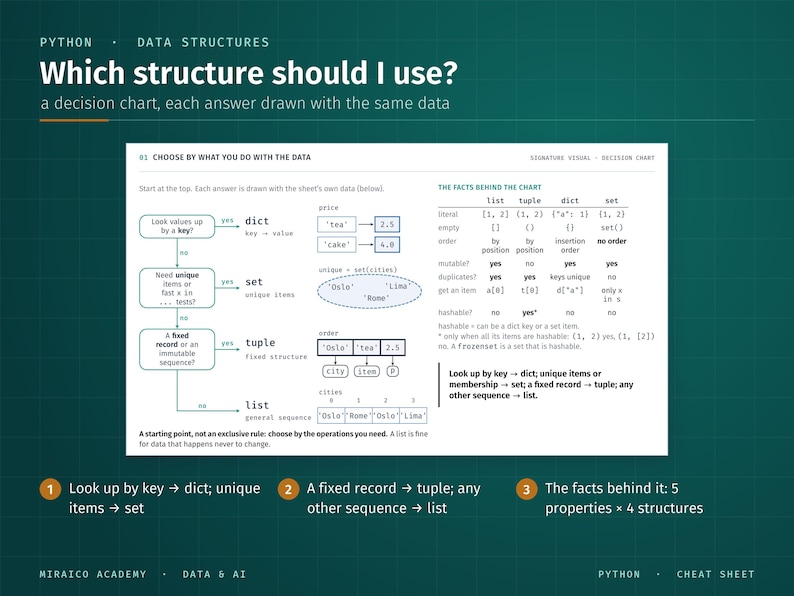
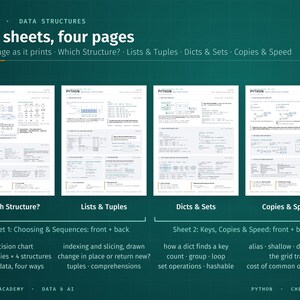
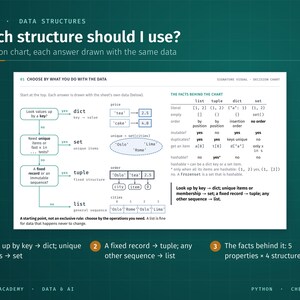
SHEET 1, FRONT - WHICH STRUCTURE SHOULD I USE?
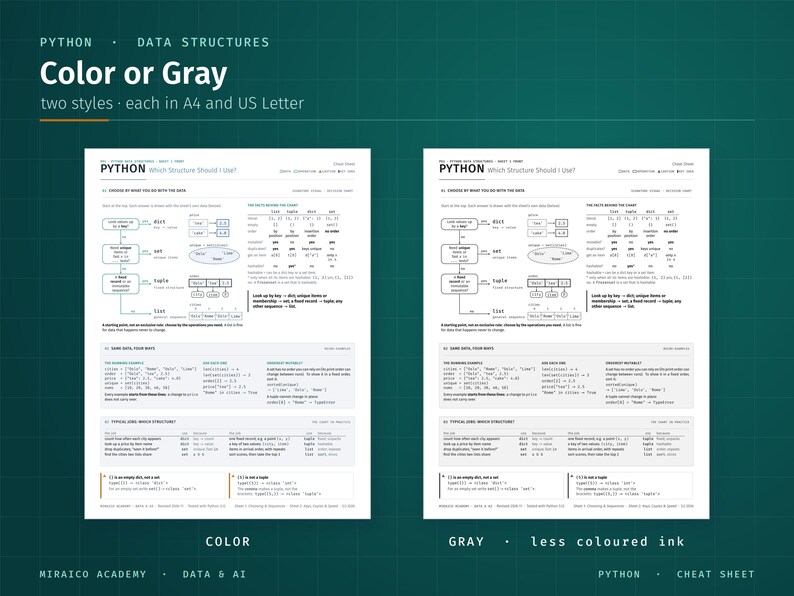
- a decision chart: look up by key, unique items, a fixed record, or any other sequence, each answer drawn with the sheet's data
- the facts behind the chart: ordered? mutable? duplicates? how you get an item? hashable? for all four
- the same data four ways, and typical jobs with the structure that fits each
SHEET 1, BACK - SEQUENCES: LISTS & TUPLES
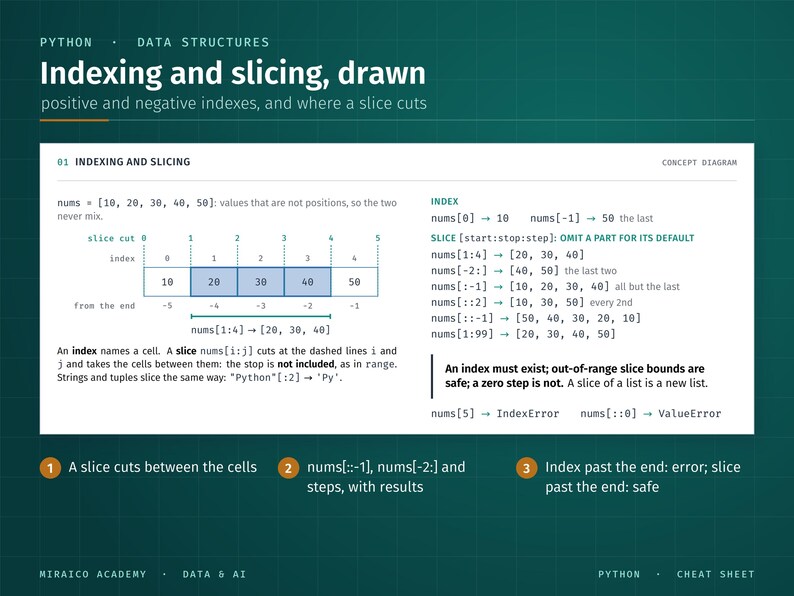
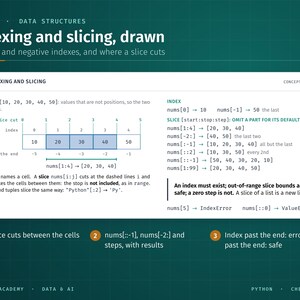
- indexing and slicing drawn: positive and negative indexes, and where a slice cuts
- an index past the end is an error, a slice past the end is not
- change the list or return a new one? append, insert, remove, sort, pop vs sorted, + and slices; append vs extend
- tuples as fixed records: unpacking, *rest, swapping, the one-item tuple
- list comprehensions with a filter
SHEET 2, FRONT - KEYS: DICTS & SETS
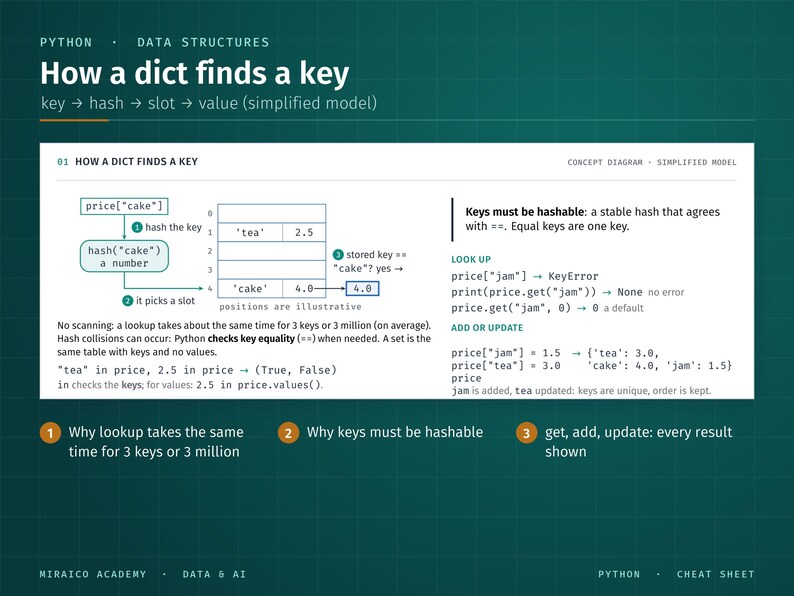
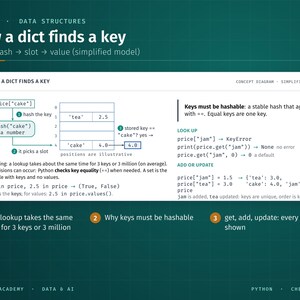
- how a dict finds a key (a simplified model): why lookup is fast and why keys must be hashable
- look up, get with a default, add, update, remove, loop over items()
- counting and grouping with a dict, traced step by step
- sets: unique items and the four operations (union, intersection, difference, symmetric difference) as Venn diagrams
- what can be a key or a set item?
SHEET 2, BACK - COPIES, REFERENCES & SPEED
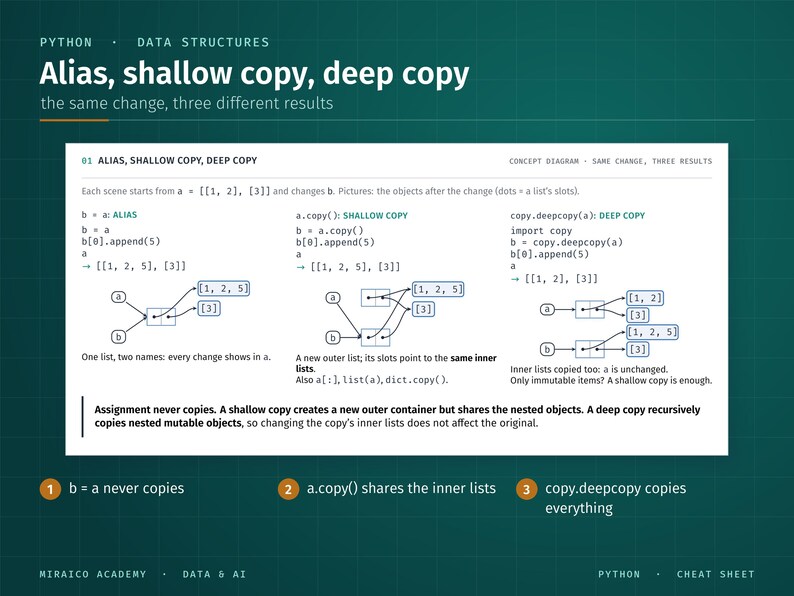
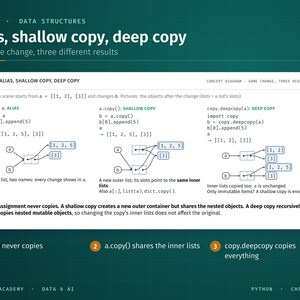
- alias, shallow copy and deep copy: the same change, three different results, drawn
- the [[0] * 3] * 2 grid trap, and += on a shared list
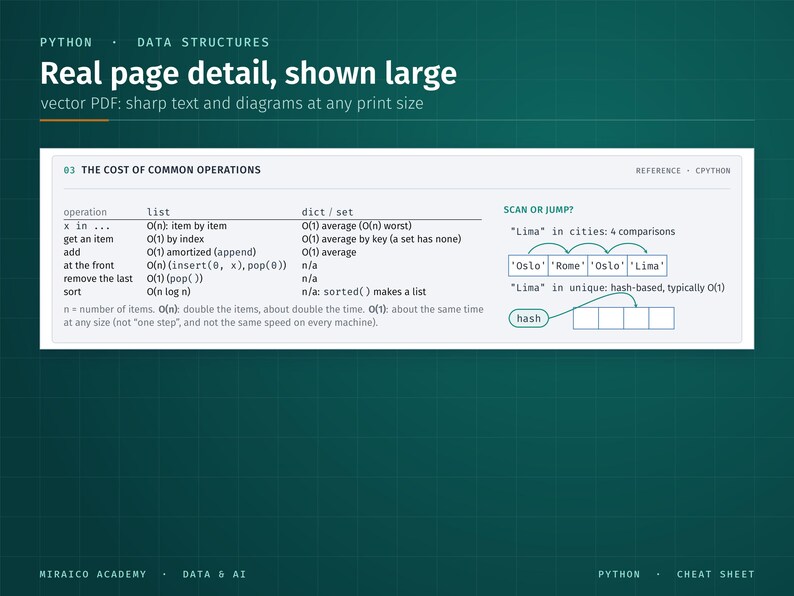
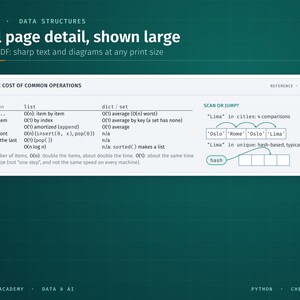
- the cost of common operations for lists and dicts / sets, with the "scan or jump?" picture for "in"
- common selection mistakes: a list for repeated membership tests, parallel lists for lookups, pop(0) as a queue
Common surprises are on small warning cards next to their topic ({} is an empty dict, (5) is not a tuple, x = x.sort() loses the list, a list as a dict key, and more).
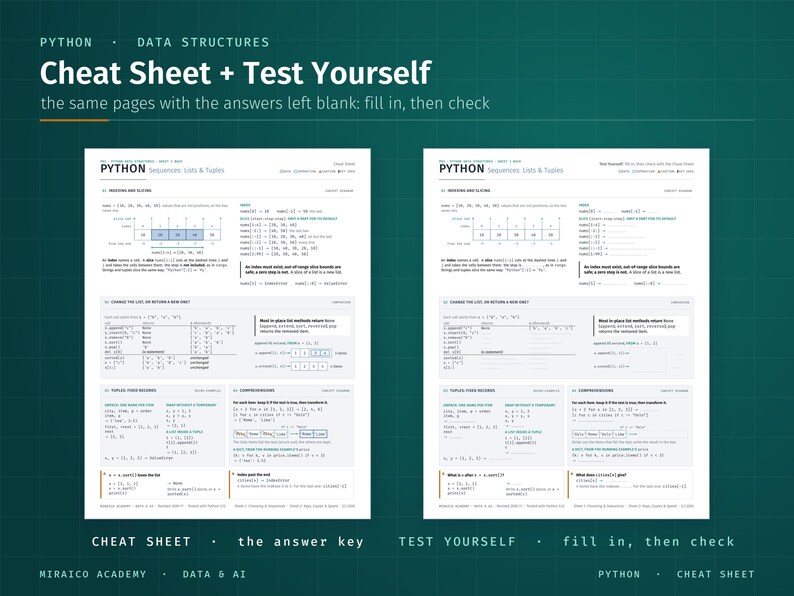
TEST YOURSELF VERSION
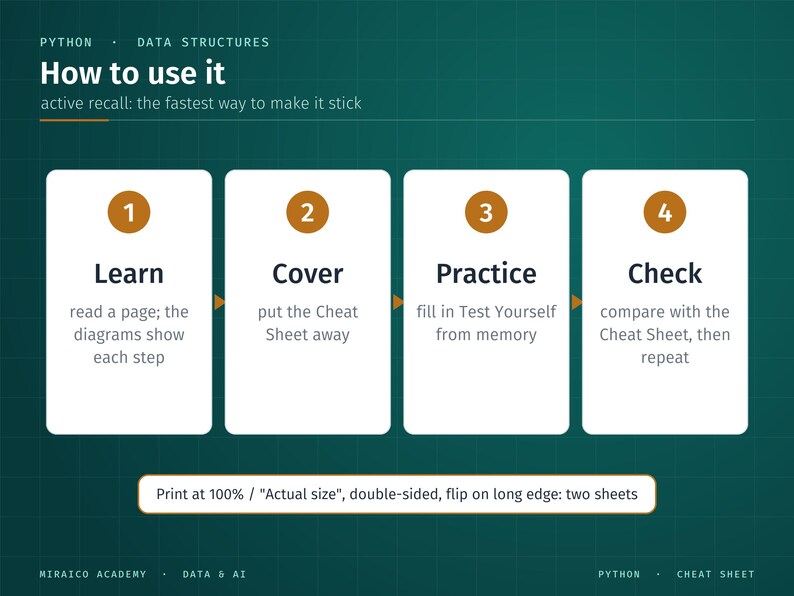
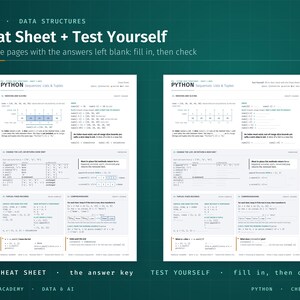
The same pages with the answers left blank: predict the results, fill in the tables and the traces. Fill them in from memory, then check yourself against the cheat sheet.
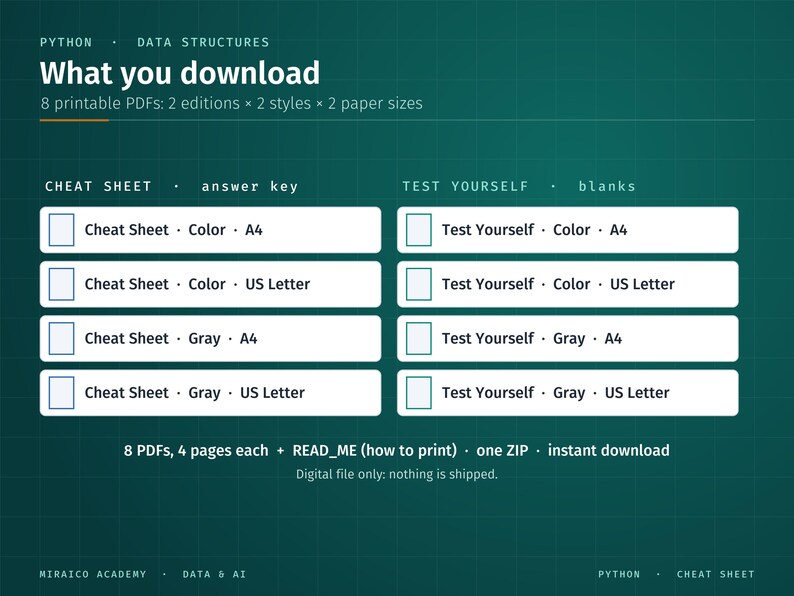
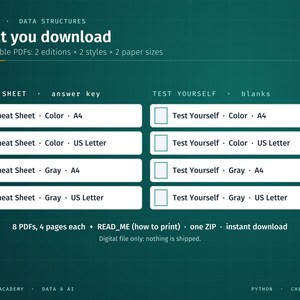
WHAT YOU GET: 8 PDF FILES (in one ZIP)
- Cheat Sheet and Test Yourself
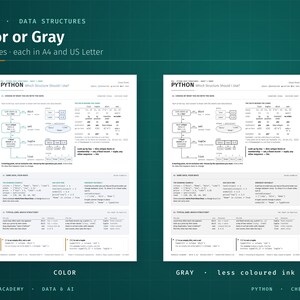
- 2 colour styles: Color, and Gray (uses less coloured ink)
- 2 paper sizes: A4 and US Letter
- each file is two sheets: 4 pages, print double-sided ("flip on long edge")
- a short READ ME with printing tips
WHO IT IS FOR
Beginners who can write a loop and a function and want to use lists, tuples, dictionaries and sets with confidence; students in a first programming course; self-taught learners and career changers; anyone starting a data science or data analysis course. Assumes basic Python.
HOW IT IS MADE
Typeset in LaTeX; every diagram is drawn by code, no AI image generator was used. The content and the code were prepared with help from an AI assistant. Every code example on the sheet was run by a script in Python 3.12 and its result checked, and the content went through several independent reviews.
HOW IT WORKS
1. Purchase the listing.
2. Download the ZIP file instantly from Purchases & Reviews in your Etsy account (or from the link in your confirmation email) and unzip it.
3. Print at home or at a print shop at 100% / "actual size", double-sided, or open the PDF on a tablet.
PLEASE NOTE
- This is a digital product. Nothing will be shipped.
- This is a focused study guide to lists, tuples, dictionaries and sets, not a complete Python reference.
- Due to the nature of digital downloads, refunds are not accepted. Send us a message if you have any problem with your files and we'll gladly help.
- Colours may vary slightly between screens and printers.
- For personal use only. You may print as many copies as you need for yourself. Teachers: please message us about classroom use. Reselling or sharing the files is not allowed. (c) MIRAICO Academy, all rights reserved.
- Independent educational resource. Not affiliated with or endorsed by the projects mentioned.
Also in the shop: Python Essentials (the step before), and the pandas and NumPy cheat sheets, the next steps for data science.
At MiraicoAcademy, we show how things work, not just what to type.
If something goes wrong with an order, we've got your back for all eligible purchases. View program terms
Price:$2.99
You can only make an offer when buying a single item
Delivery
Instant download
Your files will be available to download once payment is confirmed. Here's how.
Instant download items don't accept returns, exchanges or cancellations. Please contact the seller about any problems with your order.
Seller's description
Specifications
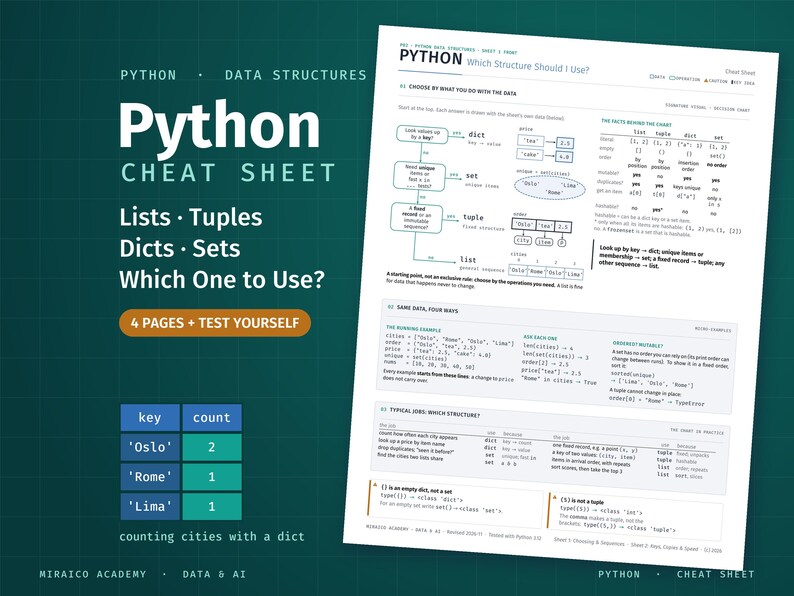
A Python data structures cheat sheet that shows when to use a list, tuple, dictionary or set, with a decision chart and every result drawn.
THIS IS A DIGITAL DOWNLOAD. NO PHYSICAL ITEM WILL BE SHIPPED.
You will receive printable PDF files in one ZIP file. No printed or laminated sheets are included. The photos show how they look once printed.
LIST, TUPLE, DICT OR SET? KNOW WHICH ONE TO USE, AND WHY
A visual study guide to Python's four built-in data structures on two sheets, printed on both sides. It starts with a decision chart (which structure fits what you do with the data?), then shows how each one behaves, drawn on the same small data set: four cities, an order record and a price list. Every code example is short and shows its real result.
SHEET 1, FRONT - WHICH STRUCTURE SHOULD I USE?
- a decision chart: look up by key, unique items, a fixed record, or any other sequence, each answer drawn with the sheet's data
- the facts behind the chart: ordered? mutable? duplicates? how you get an item? hashable? for all four
- the same data four ways, and typical jobs with the structure that fits each
SHEET 1, BACK - SEQUENCES: LISTS & TUPLES
- indexing and slicing drawn: positive and negative indexes, and where a slice cuts
- an index past the end is an error, a slice past the end is not
- change the list or return a new one? append, insert, remove, sort, pop vs sorted, + and slices; append vs extend
- tuples as fixed records: unpacking, *rest, swapping, the one-item tuple
- list comprehensions with a filter
SHEET 2, FRONT - KEYS: DICTS & SETS
- how a dict finds a key (a simplified model): why lookup is fast and why keys must be hashable
- look up, get with a default, add, update, remove, loop over items()
- counting and grouping with a dict, traced step by step
- sets: unique items and the four operations (union, intersection, difference, symmetric difference) as Venn diagrams
- what can be a key or a set item?
SHEET 2, BACK - COPIES, REFERENCES & SPEED
- alias, shallow copy and deep copy: the same change, three different results, drawn
- the [[0] * 3] * 2 grid trap, and += on a shared list
- the cost of common operations for lists and dicts / sets, with the "scan or jump?" picture for "in"
- common selection mistakes: a list for repeated membership tests, parallel lists for lookups, pop(0) as a queue
Common surprises are on small warning cards next to their topic ({} is an empty dict, (5) is not a tuple, x = x.sort() loses the list, a list as a dict key, and more).
TEST YOURSELF VERSION
The same pages with the answers left blank: predict the results, fill in the tables and the traces. Fill them in from memory, then check yourself against the cheat sheet.
WHAT YOU GET: 8 PDF FILES (in one ZIP)
- Cheat Sheet and Test Yourself
- 2 colour styles: Color, and Gray (uses less coloured ink)
- 2 paper sizes: A4 and US Letter
- each file is two sheets: 4 pages, print double-sided ("flip on long edge")
- a short READ ME with printing tips
WHO IT IS FOR
Beginners who can write a loop and a function and want to use lists, tuples, dictionaries and sets with confidence; students in a first programming course; self-taught learners and career changers; anyone starting a data science or data analysis course. Assumes basic Python.
HOW IT IS MADE
Typeset in LaTeX; every diagram is drawn by code, no AI image generator was used. The content and the code were prepared with help from an AI assistant. Every code example on the sheet was run by a script in Python 3.12 and its result checked, and the content went through several independent reviews.
HOW IT WORKS
1. Purchase the listing.
2. Download the ZIP file instantly from Purchases & Reviews in your Etsy account (or from the link in your confirmation email) and unzip it.
3. Print at home or at a print shop at 100% / "actual size", double-sided, or open the PDF on a tablet.
PLEASE NOTE
- This is a digital product. Nothing will be shipped.
- This is a focused study guide to lists, tuples, dictionaries and sets, not a complete Python reference.
- Due to the nature of digital downloads, refunds are not accepted. Send us a message if you have any problem with your files and we'll gladly help.
- Colours may vary slightly between screens and printers.
- For personal use only. You may print as many copies as you need for yourself. Teachers: please message us about classroom use. Reselling or sharing the files is not allowed. (c) MIRAICO Academy, all rights reserved.
- Independent educational resource. Not affiliated with or endorsed by the projects mentioned.
Also in the shop: Python Essentials (the step before), and the pandas and NumPy cheat sheets, the next steps for data science.
At MiraicoAcademy, we show how things work, not just what to type.
-
Designed by
-
Item typeDigital download
-
Digital file type(s)1 ZIP
If something goes wrong with an order, we've got your back on all eligible purchases. View program terms
Meet your seller

More from this shop
-
Digital download
SQL Cheat Sheet, Joins, Group By and Window Functions, Null Values, Data Science Study Guide, Printable Notes
$2.99
-
Digital download
Pandas Cheat Sheet PDF, Python DataFrame Study Guide, Filtering, Groupby, Merge and Reshape
$2.99
-
Digital download
Machine Learning Cheat Sheet Bundle, Which Algorithm, Model Evaluation Metrics, Cross Validation, Data Science Study Guide
$6.49
-
Digital download
Machine Learning Cheat Sheet, Supervised ML Algorithms, Decision Trees, k-NN and SVM, Visual Study Guide
$2.99
-
Digital download
NumPy Cheat Sheet PDF, Python Arrays, Shapes, Axes and Broadcasting, Data Science Study Guide
$2.99
-
Digital download
Python Classes Cheat Sheet, OOP, Dataclasses, Iterators and Generators, Visual Coding Study Guide
$2.99
-

Digital download
Python Cheat Sheet Template Python for Beginners Data Type Coding Functions Python 3 Programming Language Python Cheat Sheet Printable PDF
$4.99
-
Digital download
Python Cheat Sheet for Beginners: Easy Basics & Data Structures (Printable)
Sale Price $2.99
Original Price $3.99
-

Digital download
Python Basics Quick Reference Cheat Sheet | Printable PDF Coding Guide for Beginners
$3.00
-

Digital download
Beginner Python Programming Cheat Sheet: Elegant Design (Digital, Printable)
$2.81
-

Digital download
Python Cheat Sheet Guide, Study Guide, Programming, IT, Tech Related, Software, Digital Goods, Hints, Data Types, Syntax, Coding, Java, C++
$2.00
-
Digital download
Python Cheat Sheet | Python Basics Poster | Computer Lab Decor | Coding Classroom Poster | Beginner Programming Guide for Students Printable
$2.75
-

Digital download
Python Programming 2025 Cheat Sheet for Beginners and Advanced | Coding Quick Reference Guide | Tips & Tricks for Developers | Printable PDF
$8.00
-

Digital download
Python Beginner Cheat Sheet – Pastel Code Guide | Digital Download
$3.00
-

Digital download
Python Cheat Sheet: Coding Guide, Beginner's Reference (Digital Sticker/PDF)
$1.63
-

Digital download
Python Cheat Sheet for Beginners - Quick Reference PDF
Sale Price $4.75
Original Price $6.34
-
Digital download
Python Programming Beginner's Study Guide: 10-Page Notes for Coding Courses (Digital File)
$9.00
-

Digital download
Python Cheat Sheet Poster | Computer Science Poster | Python 3 Beginners Reference | Programming Coding Classroom Printable | GCSE Revision!
$4.14
Shoppers with similar taste loved these
-

Git Cheat Sheet coasters made from a high quality circuit board for software engineers, hackers and programmers
$33.13
-

Powered by CachyOS Sticker – Performance-Focused Linux Vinyl Sticker for Power Users
$3.40
-

Linux Cheat Sheet Desk Mat - Linux Commands Mouse Pad for Programmers and Sysadmins
Sale Price $24.16
Original Price $32.21
-

Digital download
Ethical Hacking Hacking Tools Cheat Sheet Ethical Hacker Gifts CEH Exam CEH Guide Certified Ethical Hacker Device Anonymous Hacker Sheet
$3.99
-

Linux Cheat Sheet Coaster PCB – Computer Science Gift for Programmers & Admins – Tech Desk Decor – Real Circuit Board Design
$33.13
-

Linux Mint Linux Sticker – Waterproof & UV-Proof Vinyl Laptop, PC Case, and Notebook Decal
$4.79
-
The Internet Protocols & Common TCP Ports Cheat Sheet for Network Engineers
$26.27
-

Python Cheat Sheet Desk Mat | Large Gaming Mouse Pad, Developer Gift
Sale Price $31.92
Original Price $39.90
-

Vim Cheat Sheet Coasters – Text Editor Shortcuts on PCB – Programmer Gift for Nerds – Computer Science Decor – Circuit Board Coasters Tech
$33.13
-

Custom Personalized Binary Code Shirt, personalized gift, custom gift, computer science, technology, binary code, computer, CS, cute, gift
$22.00
-

Funny Computer Science Shirt, Software Developer Shirt, Data Scientist Gift Shirt, QA Tester Shirt, Computer Engineering Graduation Shirt
Sale Price $15.00
Original Price $30.00
-

Women In Science Periodic Table Sticker, Science Sticker, STEM Sticker, Medical Sticker, Lab Tech Sticker
$3.00


