

Rare find
Price:$188.88
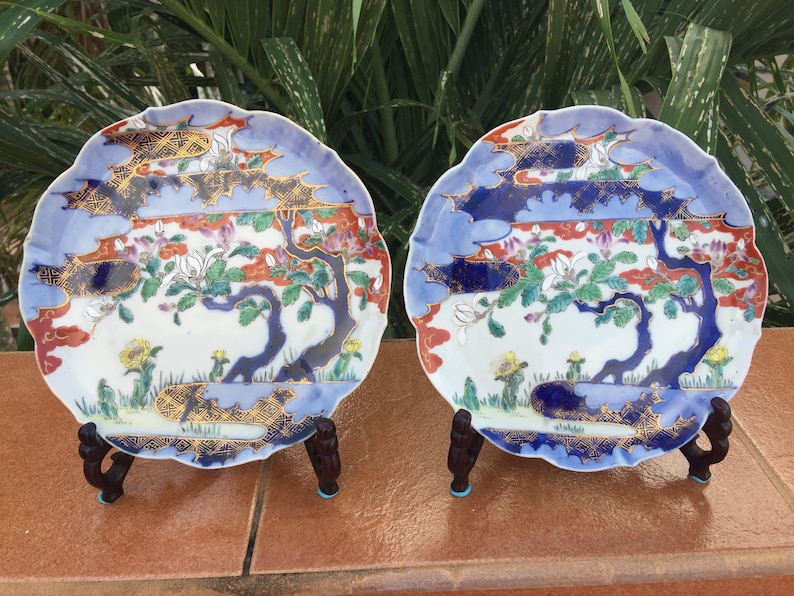
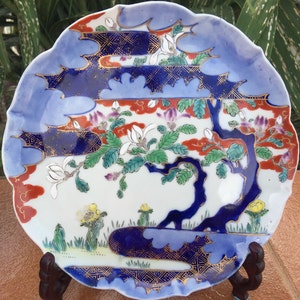
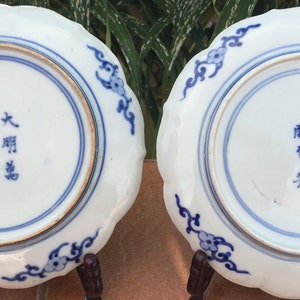
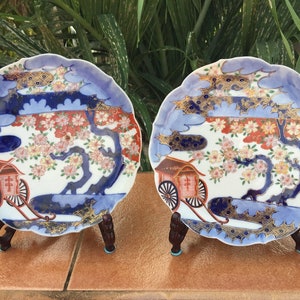
1800's Pair Ko-Imari Somenishiki Plates Two 朴の木 Hoonoki Magnolia Blossoms Porcelain Dish Set 大朋萬暦年製 Dai-Min-Banreki-Nen-Sei Mark Edo Japan
You can only make an offer when buying a single item
Highlights
A wonderful old antique set to actually use and not just display...KO-IMARI SOMENISHIKI PLATES from ARITA, JAPAN
🌸 Please click “+More” to see the full description including size and condition :-)
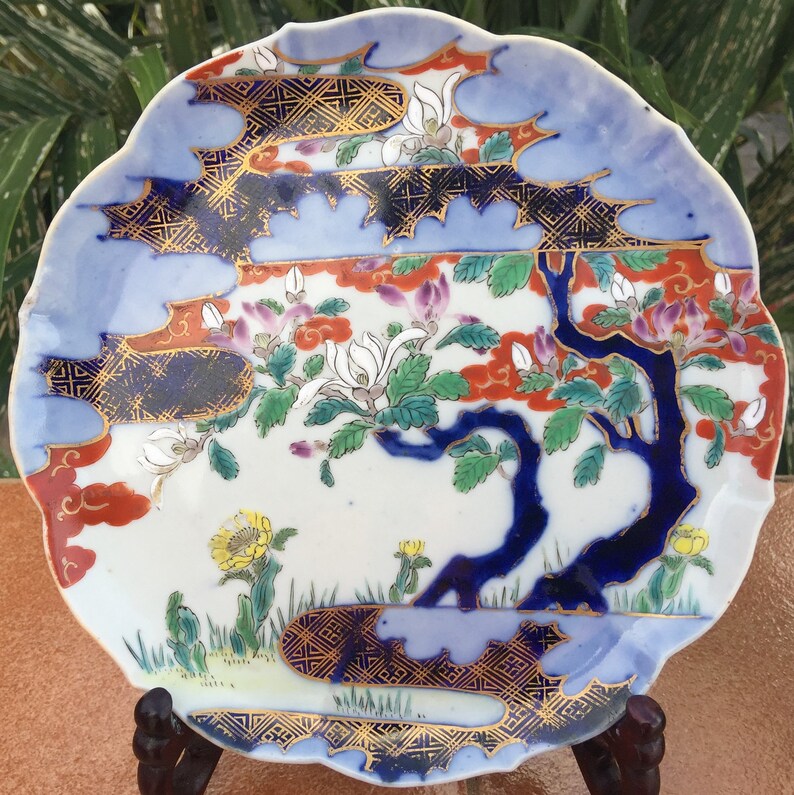
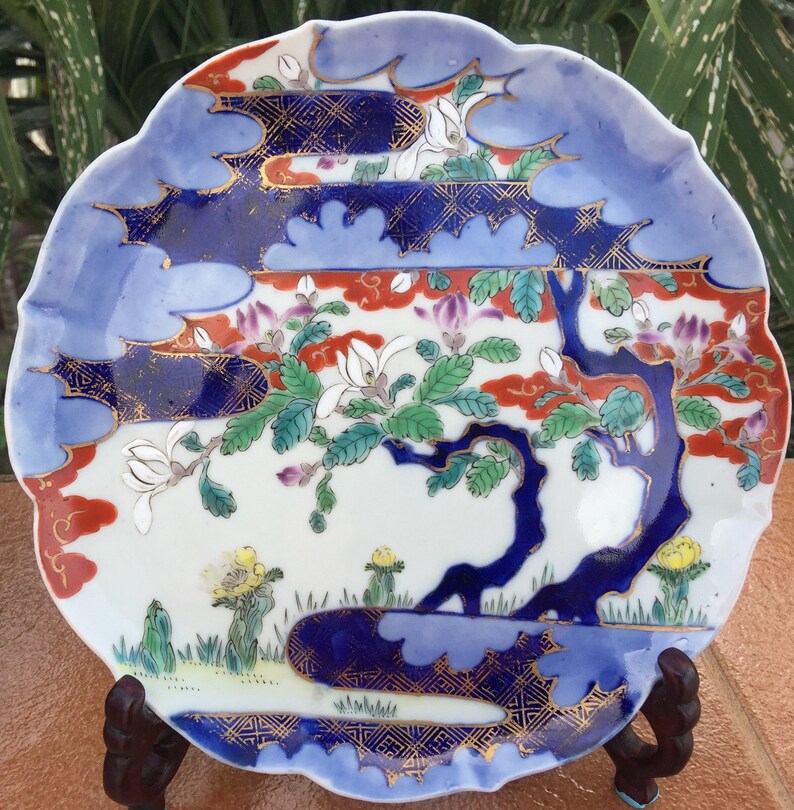
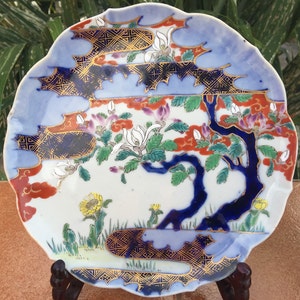
The central tableau features an attractive landscape of a gnarled trunk Magnolia in cobalt blue with gilt outlines. The Magnolia Blossoms are both in White and also Purple. I've seen this type of decor where you have like "tabs" of pattern on top and bottom, in this case filled with a gilt pattern of either rice paper windows or paving stones. The Magnolia tree and blossoms extend upward into the top "tab." There are weeds growing amongst the grass that are flowering in yellow. There are red enamel portions with Japanese karakusa arabesque curlicues that signify clouds?
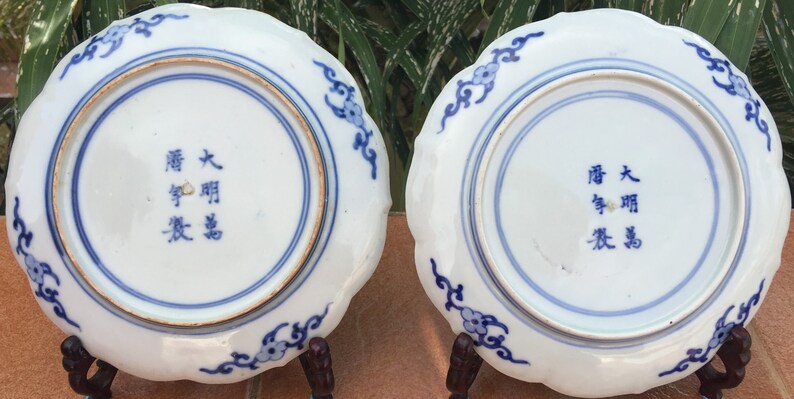
The pseudo Ming Dynasty Wanli Emperor MARK - 大朋萬暦年製 Dai-Min-Banreki-Nen-Sei. Many quality Japanese potteries flatteringly imitated ancient Chinese Imperial Porcelain Marks to give their wares an added value. This dates the actual production to circa 1840-80. The last owner's parents lived in Japan in 1906 :-)
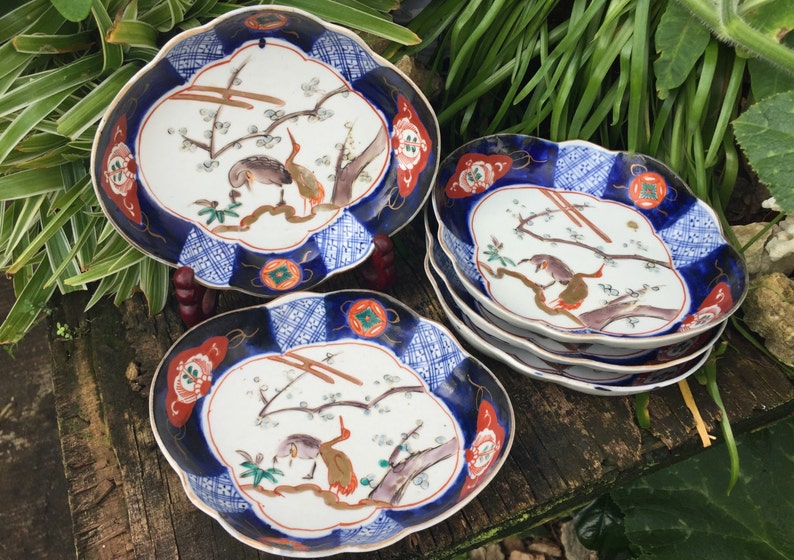
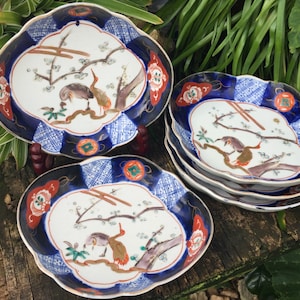
PIC 5 - are from the 1800's KO-IMARI 5pc. SET 鶴 TSURU RED-CROWNED CRANES & 梅 UME PLUM SOMETSUKE QUATREFOIL PORCELAIN DISHES Meiji Period, Japan
https://www.etsy.com/listing/472880271/1800s-ko-imari-plates-5pc-set-he-tsuru
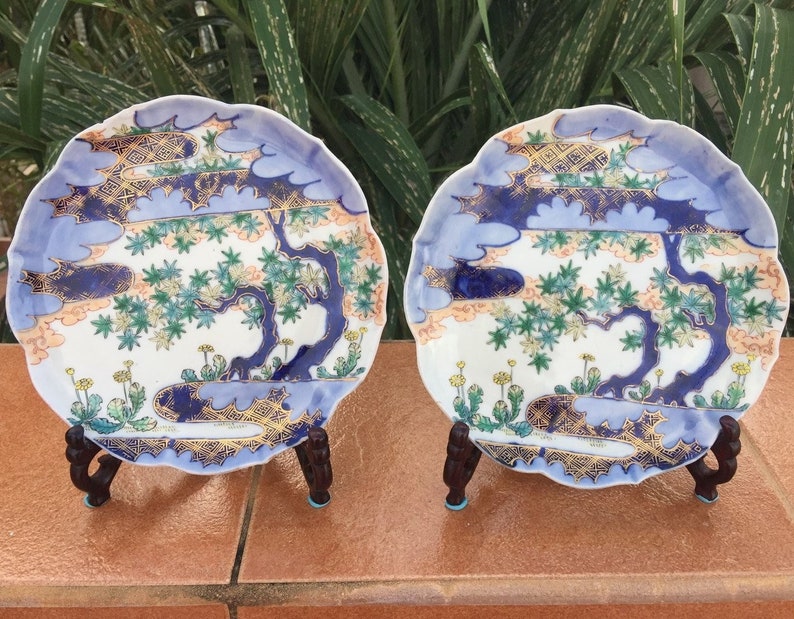
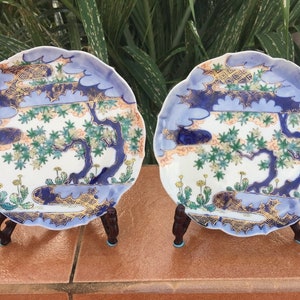
PIC 6 - SISTER PLATES WITH MAPLE LEAVES >
https://www.etsy.com/listing/505618527/1800s-pair-ko-imari-somenishiki-plates
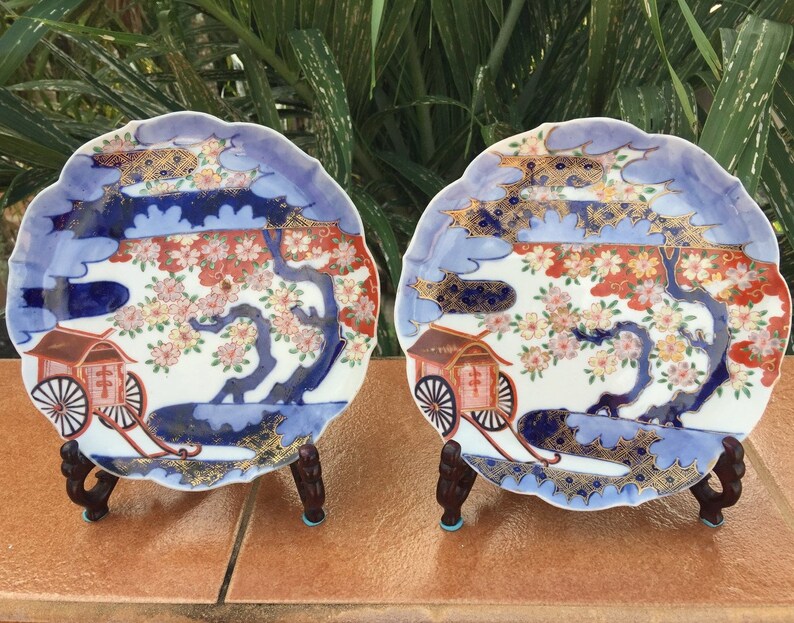
PIC 7- SISTER PLATES WITH SAKURA CHERRY BLOSSOMS >
https://www.etsy.com/listing/505618417/1800s-pair-ko-imari-somenishiki-plates
HOONOKI 朴の木 - Magnolia
IMARI 伊万里 - "Imari in Japanese Kanji has a foreign flavor of the lands far far away.
Since ancient times, the people living on the islands of Japan dreamed about a place
where they have never visited before. From a southern sea port on the island of Kyushu,
Imari porcelain traveled across the seas and finally reached to the shore of Europe. They
were displayed in Kings' & Queens' castles and treasured for years and years. At first, rather a naive and simple white porcelain with a blue decoration, gradually added
more colors with gold for its richness and wealth in red, yellow, green and purple."
SOMENISHIKI 染錦 - the painting technique of polychrome enamels over the glaze with the blue being underglaze.
This is a kewl set to not only display a piece of history dating back a couple of hundred years, but it's meant to be used! They are strong porcelain and in fine condition! I've been using them as share plates for appetizers ;-)
Searching for that PERFECT CHARGER/WALL PLAQUE? Please stroll my shop with over 200 Plates from Old Delft, Chinois, Faience and Antique Japanese Porcelain from the 1700's >
https://www.etsy.com/shop/GuamAntiquesNstuff?section_id=17085618
This would be great housewarming or birthday gift or a fine addition to your collection!
* FREE SHIPPING CNMI, FSM, PALAU, RMI & USA
* DISCOUNTED Shipping Most Countries
* Guahan local PU only
- Please click on the tab above below the pics for SHIPPING & POLICIES
- Combine Shipping & SAVE!
PHOTOS - integral to description, please use zoom feature for detailed views.
MARK - 大朋萬暦年製 Dai-Min-Banreki-Nen-Sei
SPECS - about 8"D x 7/8"H
CONDITION - EXCELLENT!
LEFT
- flake of enamel from rim edge at about 9:30 position
- no hairlines, cracks or crazing
- overglaze enamels in excellent condition
- some minor scratches to the clear glaze here and there
- pattern gilt 80% intact
- expected kiln flaws of glaze pops, grit & carbon spots
RIGHT
- no hairlines, cracks or crazing
- overglaze enamels in excellent condition
- some minor scratches to the clear glaze here and there
- pattern gilt 80% intact
- expected kiln flaws of glaze pops, grit & carbon spots
MY SUBJECTIVE GRADING GUIDE >
Outstanding - pristine, like new
Excellent - excellent considering it's an antique (minor issues)
Good - moderate issues
Fair - more than moderate issues, okay for display, but not a prized piece
Poor - major issues = a bargain deserving of continued existence
🌴 🌴 🌴 🌴 🌴 🌴 🌴 WHERE AMERICA'S DAY BEGINS! 🌴 🌴 🌴 🌴 🌴 🌴 🌴
🌺 HÅFA ADAI from the tropical island paradise of GUAHAN (Guam/USA) 🌺
"Porcelain production began in Japan in the early seventeenth century, several hundred years after it had first been made in China during the Tang dynasty (618–906). This refined white ceramic requires more advanced technology than other ceramic types. The vessels are fired at very high temperatures so that they are strong and vitrified, as opposed to low-fired earthenware, which is porous and easily breakable. Unlike stoneware, which is high-fired but can be made from many different types of clay, porcelain is made from a specific clay mixture that includes a soft, white variety called kaolin. The smooth, semi-translucent surface of porcelain is ideal for painting delicate designs, and has been prized in both the East and West.
The Japanese porcelain industry was actually pioneered by Korean potters living in Japan. Many of them came to Japan during two invasions of Korea led by Toyotomi Hideyoshi in the 1590s. An appreciation of Korean ceramics had recently developed in Japan, and many of the feudal lords who accompanied Hideyoshi brought back Korean potters to build up the ceramic industry in their territories. The Nabeshima lord took Korean potters back to his province of Hizen on Kyushu, the southernmost of Japan's main islands. These potters would eventually become the first producers of porcelain in Japan, but they started out by reviving the production of a type of stoneware called Karatsu ware. This type of ceramic is usually simple, inexpensive, and made rapidly but skillfully on the potter's wheel. The potters also introduced a new type of kiln to Japan, the noborigama, or climbing kiln, which allows for greater precision during firing. Therefore, when in the early seventeenth century the Korean potters living in the Arita district of Hizen found suitable clay for the manufacture of porcelain, the infrastructure for its production was already in place. The Hizen region thus became the major center of porcelain production in Japan.
The first porcelain made in Japan by these Korean potters is known as early Imari. "Imari" refers to a port near the Arita kilns, from which these wares were shipped to the rest of the country. Since these porcelains were primarily for domestic consumption, the term "early" is added to distinguish them from later wares also classified as "Imari" which were typically for export. Most early Imari pieces feature designs painted in cobalt blue on a white ground, then coated in a transparent glaze, in the style known as underglaze blue. The porcelain has a coarse, grainy texture and the designs are generally carried out by a free, fluid hand. The technique of painting pictorial designs under a clear glaze was sometimes employed on Karatsu ware, so early Imari may have in part stemmed from this earlier tradition."
🌸 🎏 家族 🎏 家族 🎏 家族 🎏 家族 🎏 家族 🎏 家族 🎏 家族 🎏 家族 🎏 家族 🎏 🌸
I'm not an expert on Porcelain. The information above is based on my research as a collector. It's time to downsize and find an appreciative home for this exquisite piece!
Feel free to contact me if you have questions or need additional photos.
-
Order today to get by May 20-21
Your order should arrive by this date if you buy today. To calculate an estimated delivery date you can count on, we look at things like the carrier's latest transit times, the seller's processing time and shipping history, and where the order is shipping to and from.
-
Returns & exchanges not accepted
But please contact me if you have problems with your order
-
Free shipping
-
Ships from: Guam
There was a problem calculating your shipping. Please try again.
Etsy Purchase Protection
Shop confidently on Etsy knowing if something goes wrong with an order, we've got your back for all eligible purchases —
see program terms

Be the first to review this item


Smooth shipping Has a history of shipping on time with tracking.
Speedy replies Has a history of replying to messages quickly.
More from this shop
Visit shop-
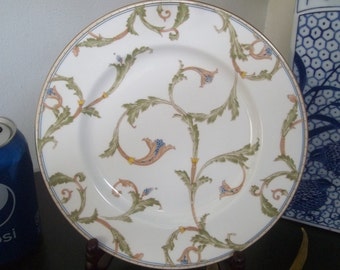
Talara Salad Plate (s) 8.5'' Dessert Dish Noritake 'New Lineage II' Pattern Bone China Porcelain Discontinued Thailand
$16.88
-
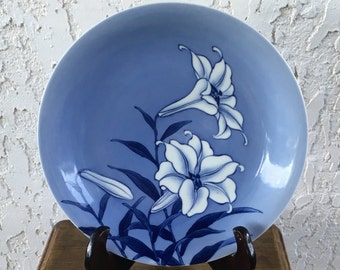
1800's Antique Hirado Porcelain Plate 白百合 Shirayuri White Lily Blossom Charger Floral Osara Dish Bowl Meiji Taisho Japan *Free S&H
$258.88
-
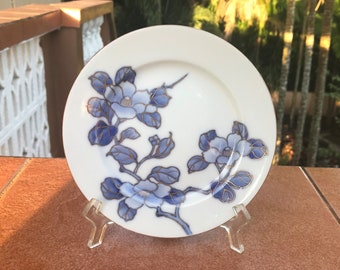
Fukagawa Plate 椿 Tsubaki Camellia Blossoms Dish Schotel Blue & White Gilded Flower Porcelain Gold Floral Schaal Arita Japan
$88.88
-
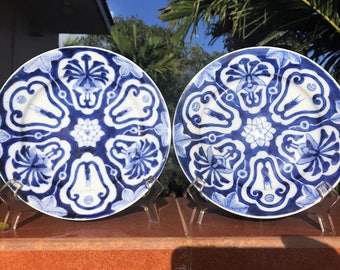
1800's TWO Plates #A Signed Dainippon Hizen Arita Aoki-sei 染付 Sometsuke 阿蘭陀海芋 Calla Lily Blossoms Dish Pair Floral Porcelain Wall Art Japan
$288.88
-
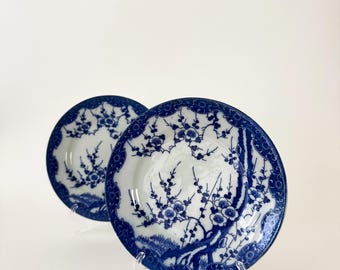
Pair of Antique Japanese Arita Blue & White Plates, “Dai Nippon” Mark, Meiji–Taishō Period (c. 1900–1930)
$42.77
-
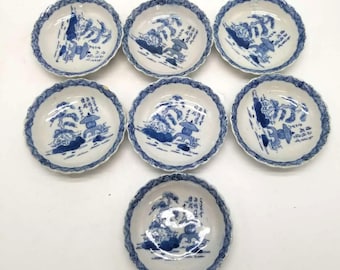
Ko-Imari Landscapes – Antique Arita Blue and White Dishes Set of 7
Sale Price $51.00
Original Price $60.00
-
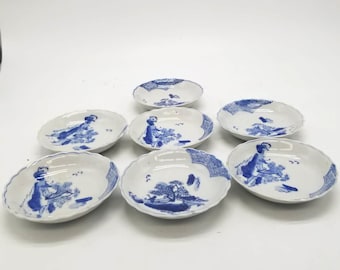
Ko-Imari Landscapes – Japanese Vintage Blue and White Mame Plates Set of 7
Sale Price $51.00
Original Price $60.00
-
Pair of Antique Small Hand Painted Nippon Porcelain Plates
$58.00
-
Vintage Japanese Ko-Imari Porcelain Edo Period Map Plate
Sale Price $76.50
Original Price $90.00
-
Antique Japanese Nippon ORIENTAL PLATE sea of flowers
$49.00
-
Japanese Hand Painted Porcelain Blue and White Plates, Floral Motif, 18cm, 19th Century
$86.06
-
Pair of Japanese Arita Blue & White ‘Twin Koi’ Dishes, Meiji Era, Fuku Mark
$637.12
-
Japanese Imari Edo Period Blue & White 8.5” Porcelain Plates Set of 8
$499.95
-
Nippon Tokusei Japan Porcelain Peacock Gold Gilt Green Plate
$51.33
-

Set of 5 Antique Japanese Imari Plates – 19th Century Arita Porcelain, Hand-Painted Blue, Red & Gold, Edo-Meiji Period (1850–1880)
$304.29
-
Antique Imari Porcelain Plate – Sometsuke Landscape, Edo Period
Sale Price $68.00
Original Price $80.00


