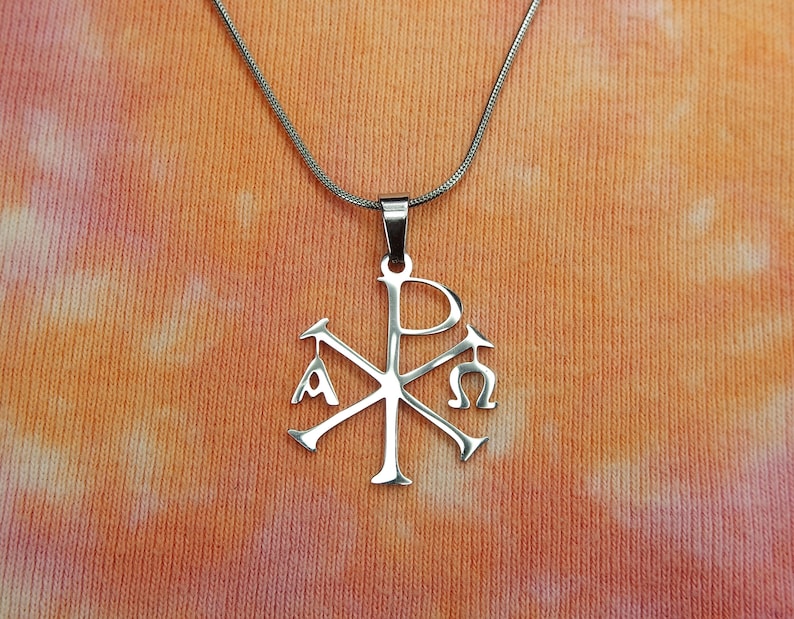
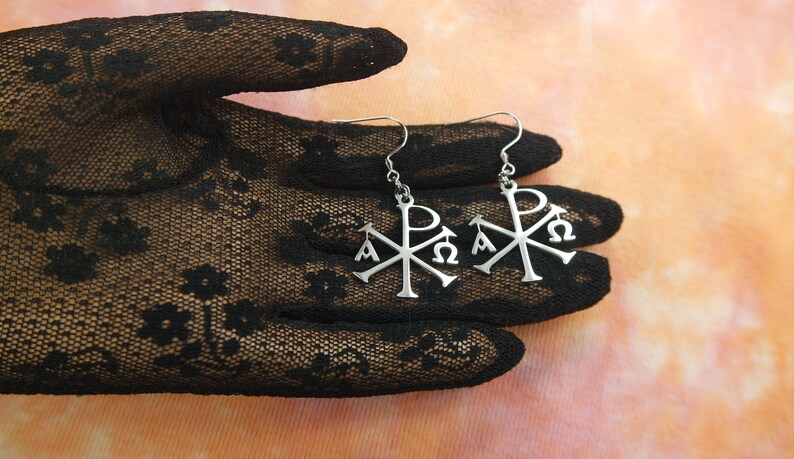
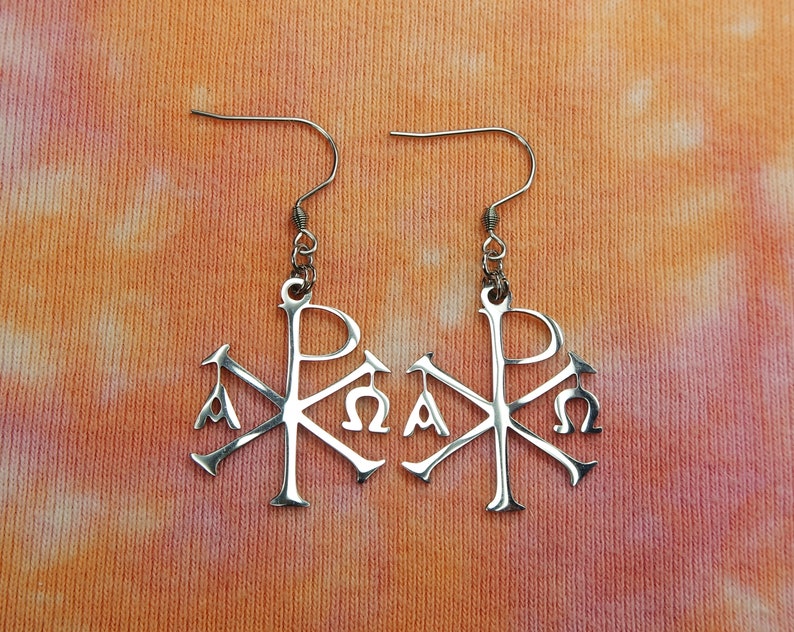




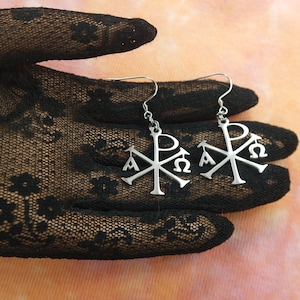
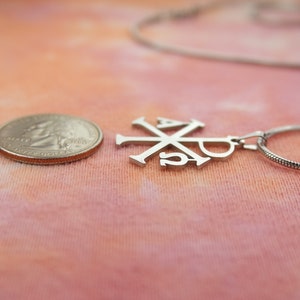


Alpha Omega Chi Rho Necklace, Christogram Chrismon Charm Pendant Waterproof Stainless Steel Christian Cross for Men or Women, fast Ship Gift

Made by Ann
Owner of ShaktiAndShivaDesignWhat to know
Materials
Stainless steel
Dimensions
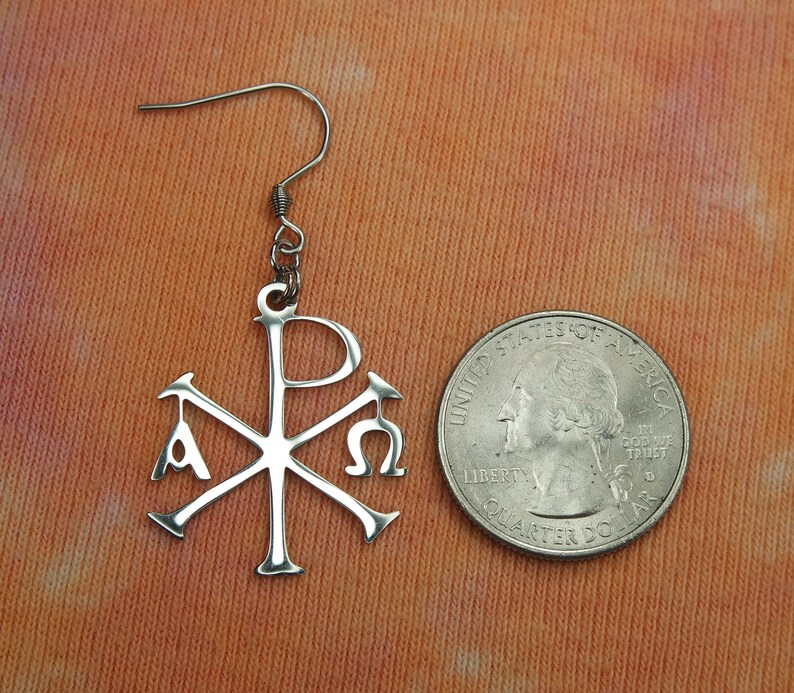
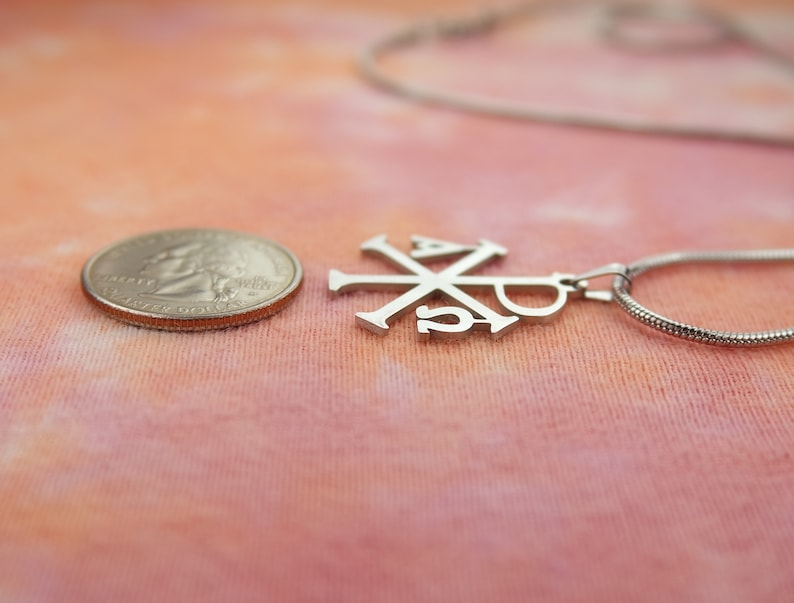
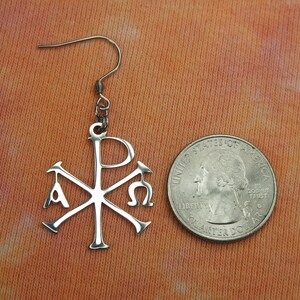
Pendant width: 1 Inches; Pendant height: 1.1 Inches
INCLUDES
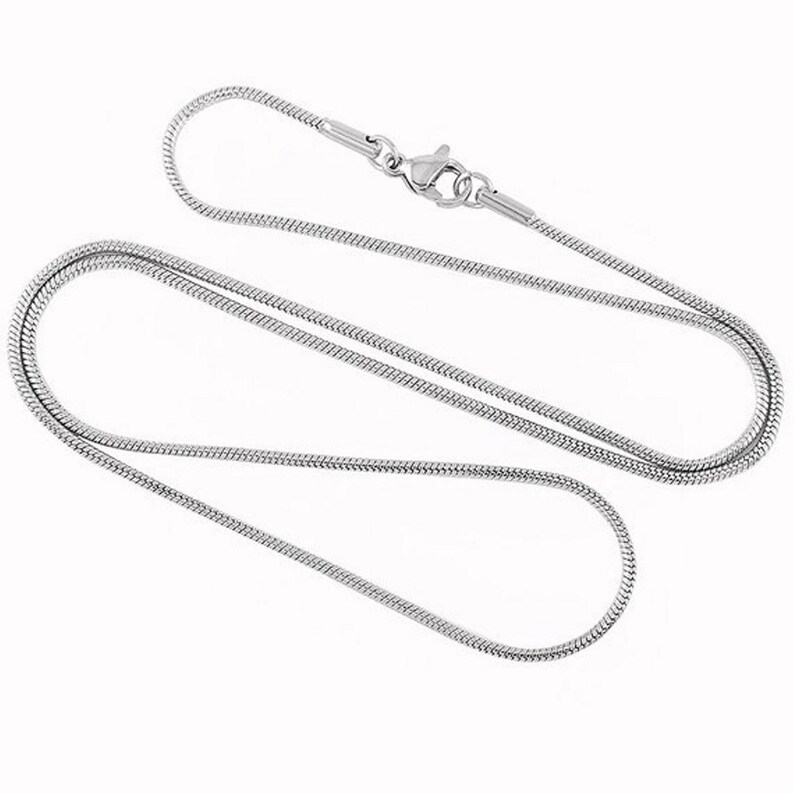
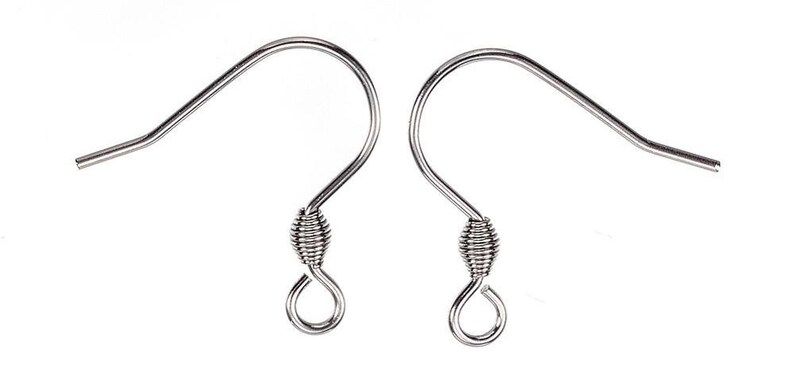
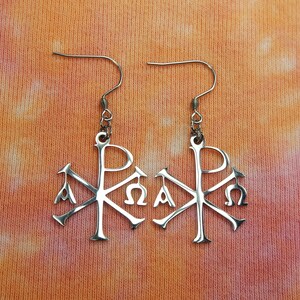
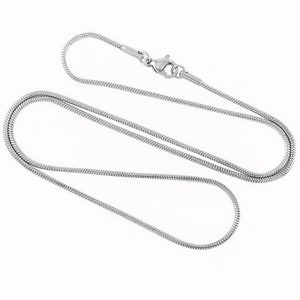
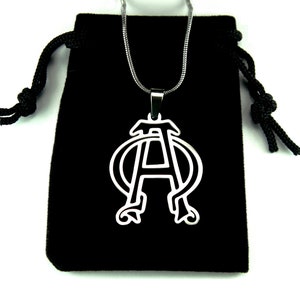
Charm and necklace chain in a black velvet jewelry bag. You can also choose just the pendant alone, to use on your own cord or chain, or have me make a pair of earrings for you by selecting the Earrings option.
MEASUREMENTS
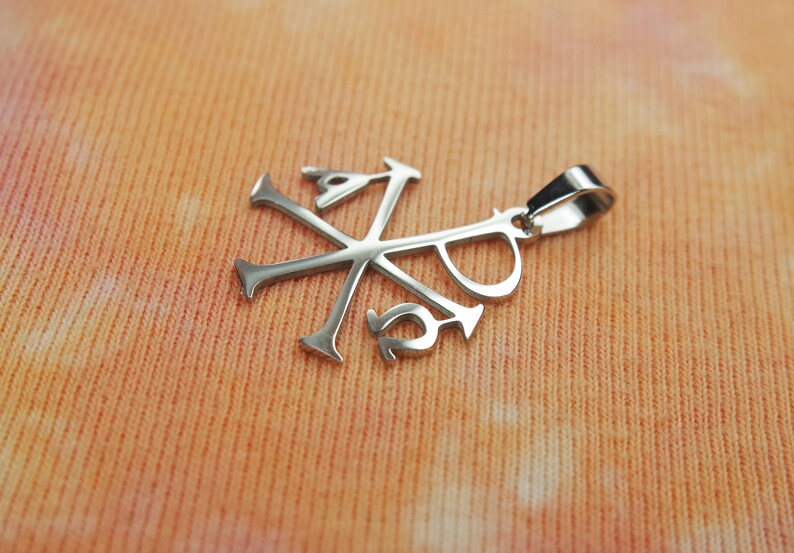
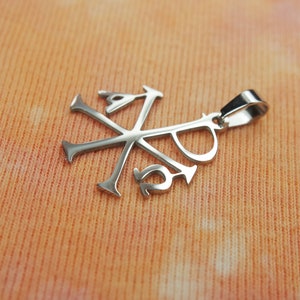
The charm is about 1.11" tall x 1" across x .039" thick (28.2mm x 25.3mm x 1mm)
The necklace chain is offered in your choice of length from 16" to 36" (40cm to 91cm)
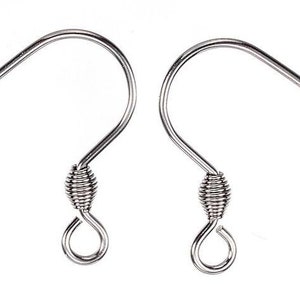
The optional pierced ear wires are made with comfortable 21 gauge hypo-allergenic stainless steel wire.
MATERIALS
All components are made with hypo-allergenic and waterproof 304 Stainless Steel.
ABOUT
The Chi Rho, also known as chrismon or sigla, is one of the earliest forms of christogram, formed by superimposing the first two capital letters chi and rho of the Greek word (Christos) in such a way that the vertical stroke of the rho intersects the center of the chi.
The Chi-Rho symbol was used by the Roman emperor Constantine I (r. 306–337) as part of a military standard (vexillum). Constantine's standard was known as the Labarum. Early symbols similar to the Chi Rho were the Staurogram (Christliche Symbolik (Menzel) I 193 2.jpg) and the IX monogram (Christliche Symbolik (Menzel) I 193 ).
In pre-Christian times, the Chi-Rho symbol was also to mark a particularly valuable or relevant passage in the margin of a page, abbreviating chreston (good). Some coins of Ptolemy III Euergetes (r. 246–222 BC) were marked with a Chi-Rho.
Although formed of Greek characters, the device (or its separate parts) is frequently found serving as an abbreviation in Latin text, with endings added appropriate to a Latin noun, thus XPo, signifying Christo, "to Christ", the dative form of Christus.
The Chi Rho symbol has two Unicode codepoints: U+2627 CHI RHO in the Miscellaneous symbols block and U+2CE9 COPTIC SYMBOL KHI RO in the Coptic block.
According to Lactantius, a Latin historian of North African origins saved from poverty by the Emperor Constantine I (r. 306–337), who made him tutor to his son Crispus, Constantine had dreamt of being ordered to put a "heavenly divine symbol" (Latin: coeleste signum dei) on the shields of his soldiers. The description of the actual symbol chosen by Emperor Constantine the next morning, as reported by Lactantius, is not very clear: it closely resembles a Chi-Rho or a staurogram (Christliche Symbolik (Menzel) I 193 2.jpg), a similar Christian symbol. That very day Constantine's army fought the forces of Maxentius and won the Battle of the Milvian Bridge (312), outside Rome.
Eusebius of Caesarea (died in 339) gave two different accounts of the events. In his church history, written shortly after the battle, when Eusebius hadn't yet had contact with Constantine, he doesn't mention any dream or vision, but compares the defeat of Maxentius (drowned in the Tiber) to that of the biblical pharaoh and credits Constantine's victory to divine protection.
In a memoir of the Roman emperor that Eusebius wrote after Constantine's death (On the Life of Constantine, circa 337–339), a miraculous appearance is said to have come in Gaul long before the Battle of the Milvian Bridge. In this later version, the Roman emperor had been pondering the misfortunes that befell commanders who invoked the help of many different gods, and decided to seek divine aid in the forthcoming battle from the One God. At noon, Constantine saw a cross of light imposed over the sun. Attached to it, in Greek characters, was the saying (“In this sign you will conquer!”). Not only Constantine, but the whole army saw the miracle. That night, Christ appeared to the Roman emperor in a dream and told him to make a replica of the sign he had seen in the sky, which would be a sure defence in battle.
Eusebius wrote in the Vita that Constantine himself had told him this story "and confirmed it with oaths" late in life "when I was deemed worthy of his acquaintance and company." "Indeed", says Eusebius, "had anyone else told this story, it would not have been easy to accept it."
Eusebius also left a description of the labarum, the military standard which incorporated the Chi-Rho sign, used by Emperor Constantine in his later wars against Licinius.
An early visual representation of the connection between the Crucifixion of Jesus and his resurrection, seen in the 4th century sarcophagus of Domitilla in Rome, the use of a wreath around the Chi-Rho symbolizes the victory of the Resurrection over death.
After Constantine, the Chi-Rho became part of the official imperial insignia. Archaeologists have uncovered evidence demonstrating that the Chi-Rho was emblazoned on the helmets of some Late Roman soldiers. Coins and medallions minted during Emperor Constantine's reign also bore the Chi-Rho. By the year 350, the Chi-Rho began to be used on Christian sarcophagi and frescoes. The usurper Magnentius appears to have been the first to use the Chi-Rho monogram flanked by Alpha and Omega, on the reverse of some coins minted in 353. In Roman Britannia, a tesselated mosaic pavement was uncovered at Hinton St. Mary, Dorset, in 1963. On stylistic grounds, it is dated to the 4th century; its central roundel represents a beardless male head and bust draped in a pallium in front of the Chi-Rho symbol, flanked by pomegranates, symbols of eternal life. Another Romano-British Chi-Rho, in fresco, was found at the site of a villa at Lullingstone (illustrated). The symbol was also found on Late Roman Christian signet rings in Britain.
The "Chrismon of Saint Ambrose" (Chrismon Sancti Ambrosii), on display on the eastern wall of Milan Cathedral, is a Chi-Rho combined with Alpha and Omega in a circle. According to Landulf of Milan (12th century), it was used by Saint Ambrose to introduce the catechumens to the mysteries of the Christian faith (whence it was called "oracle" or chresmos of St. Ambrose, written by Landulf as crismon, whence the later New Latin term for the Chi-Rho symbol).
In Insular Gospel books, the beginning of Matthew 1:18, at the end of his account of the genealogy of Christ and introducing his account of the life, so representing the moment of the Incarnation of Christ, was usually marked with a heavily decorated page, where the letters of the first word "Christi" are abbreviated and written in Greek as "XPI", and often almost submerged by decoration. Though the letters are written one after the other and the "X" and "P" not combined in a monogram, these are known as Chi-Rho pages. Famous examples are in the Book of Kells and Book of Lindisfarne. The "X" was regarded as the crux decussata, a symbol of the cross; this idea is found in the works of Isidore of Seville and other patristic and Early Medieval writers. The Book of Kells has a second Chi-Rho abbreviation on folio 124 in the account of the Crucifixion of Christ, and in some manuscripts the Chi-Rho occurs at the beginning of Matthew rather than mid-text at Matthew 1:18. In some other works like the Carolingian Godescalc Evangelistary, "XPS" in sequential letters, representing "Christus" is given a prominent place.
ALPHA AND OMEGA
A Christogram (Latin Monogramma Christi[1]) is a monogram or combination of letters that forms an abbreviation for the name of Jesus Christ, traditionally used as a religious symbol within the Christian Church.
One of the oldest Christograms is the Chi-Rho. It consists of the superimposed Greek letters chi and rho, which are the first two letters of Greek "Christ". It was displayed on the labarum military standard used by Constantine I in AD 312. The IX monogram (Christliche Symbolik (Menzel) I 193 4.jpg) is a similar form, using the initials of the name ??s??? (?) ???st?? "Jesus (the) Christ", as is the ?? monogram (IH Monogram with iota and eta superimposed.jpg), using the first two letters of the name ??s??? "Jesus".
There were a very considerable number of variants of "Christograms" or monograms of Christ in use during the medieval period, with the boundary between specific monograms and mere scribal abbreviations somewhat fluid.
The name Jesus, spelt "??S??S" in Greek capitals, has the abbreviations IHS (also written JHS, IHC, or ??S), the name Christus , spelt "???S??S", has XP (and inflectional variants such as IX, XPO, XPS, XPI, XPO, XPM). In Eastern Christian tradition, the monogram ???? (with Overline indicating scribal abbreviation) is used for ??s??? ???st?? in both Greek and Cyrillic tradition.
A Middle Latin term for abbreviations of the name of Christ is chrisimus.[2] Similarly, Middle Latin crismon, chrismon refers to the Chi Rho monogram specifically.[3]
Alpha (a) and omega (O) are the first and last letters of the Greek alphabet, and a title of Christ and God in the Book of Revelation. This pair of letters are used as Christian symbols, and are often combined with the Cross, Chi-rho, or other Christian symbols.
The term Alpha and Omega comes from the phrase "I am Alpha and Omega" (Koiné Greek: O), an appellation of Jesus in the Book of Revelation (verses 1:8, 21:6, and 22:13). The first part of this phrase ("I am the Alpha and Omega") is first found in Chapter 1 verse 8 ("1v8"), and is found in every manuscript of Revelation that has 1v8. Several later manuscripts repeat "I am the Alpha and Omega" in 1v11 too, but do not receive support here from most of the oldest manuscripts, including the Alexandrine, Sinaitic, and Codex Ephraemi Rescriptus. It is, therefore, omitted in some modern translations. Scholar Robert Young stated, with regard to "I am the Alpha and Omega" in 1v11, the "oldest manuscripts omit" it.
Alpha (A) and omega (O) are the first and last letters, respectively, of the classical (Ionic) Greek alphabet. Thus, twice when the phrase "I am the alpha and the omega" appears it is further clarified with the additional phrase, "the beginning and the end" (Revelation 21:6, 22:13). The first and last letters of the Greek alphabet were used because the book of Revelation is in the New Testament, which was originally written in Greek.
This phrase is interpreted by many Christians to mean that Jesus has existed for all eternity or that God is eternal. Though many commentators and dictionaries ascribe the title "the alpha and the omega" to both God and to Christ, some secular sources argue otherwise. Barnes' Notes on the New Testament (1974) claims: "It cannot be absolutely certain that the writer meant to refer to the Lord Jesus specifically here ... There is no real incongruity in supposing, also, that the writer here meant to refer to God as such." Most Christian denominations also teach that the title applies to both Jesus and his Father.
The letters Alpha and Omega in juxtaposition are often used as a Christian visual symbol (see examples). The symbols were used in early Christianity and appear in the Roman catacombs. The letters were shown hanging from the arms of the cross in Early Christian art, and some crux gemmata, jeweled crosses in precious metal, have formed letters hanging in this way, called pendilia; for example, in the Asturian coat of arms, which is based upon the Asturian Victory Cross. In fact, despite always being in Greek, the letters became more common in Western than Eastern Orthodox Christian art. They are often shown to the left and right of Christ's head, sometimes within his halo, where they take the place of the Christogram used in Orthodox art.
In Rabbinic literature, the word emet meaning "truth"), one of the names of God in Judaism, has been interpreted as consisting of the first, middle, and final letters of the Hebrew alphabet.
The Qur'an gives al'Awwal meaning "The First" and al'Akhir meaning "The Last" as two of the names of God: 57:3.
Christogram
A Christogram (Latin Monogramma Christi) is a monogram or combination of letters that forms an abbreviation for the name of Jesus Christ, traditionally used as a religious symbol within the Christian Church.
One of the oldest Christograms is the Chi-Rho. It consists of the superimposed Greek letters chi and rho, which are the first two letters of Greek "Christ". It was displayed on the labarum military standard used by Constantine I in AD 312. The IX monogram (Christliche Symbolik (Menzel) I 193 4.jpg) is a similar form, using the initials of the name "Jesus (the) Christ", as is the monogram (IH Monogram with iota and eta superimposed.jpg), using the first two letters of the name "Jesus".
There were a very considerable number of variants of "Christograms" or monograms of Christ in use during the medieval period, with the boundary between specific monograms and mere scribal abbreviations somewhat fluid.
The name Jesus, spelt in Greek capitals, has the abbreviations IHS (also written JHS, IHC), the name Christus , has XP (and inflectional variants such as IX, XPO, XPS, XPI, XPO, XPM). In Eastern Christian tradition, the monogram (with Overline indicating scribal abbreviation) is used in both Greek and Cyrillic tradition.
A Middle Latin term for abbreviations of the name of Christ is chrisimus. Similarly, Middle Latin crismon, chrismon refers to the Chi Rho monogram specifically.
What buyers say
“Fast shipping, shipped with care! Beautiful! 🤩”

D
Feb 4, 2026
Price:$12.99+
Shipping & return policies
-
Order today to get by Aug 4-10
Your order should arrive by this date if you buy today. To calculate an estimated delivery date you can count on, we look at things like the carrier's latest transit times, the seller's processing time and shipping history, and where the order is shipping to and from.
-
Returns & exchanges accepted within 30 days.
-
Ships from: Lubbock, TX
-
Cost to ship: $5.99Enjoy free shipping to the US when you spend $35+ at this shop.
-
Deliver to United States, 43215
There was a problem calculating your shipping. Please try again.
This seller consistently earned 5-star reviews, shipped on time, and replied quickly to any messages they received.
If something goes wrong with an order, we've got your back for all eligible purchases. View program terms
Like electric trucks and carbon offsets for every delivery. View more
Reviews for this item
Fast shipping, shipped with care! Beautiful! 🤩
Product as described, fast shipping, easy transaction. Thank you! Very pleased with quality.

Great material, doesn't poke, chain length as-described, and a nice conversation starter to top it off! Thank you! Soli Deo gloria!
Awesome pendant, as described and lightning fast shipping! A++++ Seller!!! Thank you ❤️
All reviews are from verified buyers. Reviews are shown automatically based on factors like recency, whether they include comments, your chosen language, and whether the rating reflects the typical experience with the shop.
Photos from reviews
Meet your seller


Usually responds in a few hours
Smooth shipping Has a history of shipping on time with tracking.
Speedy replies Has a history of replying to messages quickly.
Rave reviews Average review rating is 4.8 or higher.
More from this shop
-

Coptic Cross Necklace or Earrings, Waterproof Stainless Steel, Egyptian Christian Charm Pendant, Gnostic Cross
$12.99
-
Alpha Omega Necklace, Pure 304 Stainless Steel Greek Letters Alphabet Christian Symbol Charm Pendant Men or Women 16-50" long Jewelry nb
$12.99
-

Alpha Omega Chi Rho Necklace, Equal Armed Greek Cross Christogram Chrismon Waterproof Hypo Allergenic Stainless Steel Charm Pendant Chain
$12.99
-
Small Cross of Nails Necklace, Holy Nails, Christian Charm Pendant pick 16-36" long Chain, Gift for Males or Females, Jesus Christ Cross
$12.99
-

Cross of Caravaca Necklace, Pendant or Pair of Earrings, Holy Cross Crucifix, Double Cross, Double Sided Charm
$12.99
-
Heart of Faith Necklace or Earrings, Waterproof Stainless Charm Gift, Have Faith in Troubled Times
$12.99
-
Chi Rho Monogram of Christ jewelry,Christian monogram of Jesus Christ.Christogram necklace,Constantine’s Cross,Alpha and Omega Chi-Rho cross
$20.50
-
Chi Rho Monogram of Christ jewelry,Christian monogram of Jesus Christ.Christogram necklace,Constantine’s Cross,Alpha and Omega Chi-Rho cross
$21.50
-
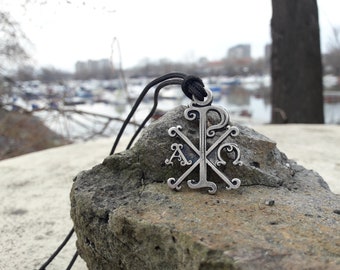
Christogram Jesus Christ monogram necklace,Chi Rho Monogram of Christ jewelry,Constantine’s Cross,Christian Cross,Alpha and Omega Chi-Rho
$21.50
-
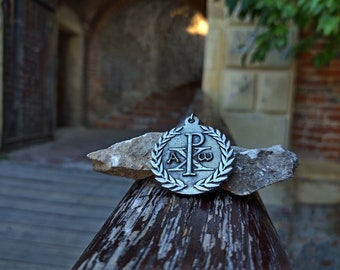
Chi Rho Monogram wreath vintage jewelry,Christian monogram of Jesus Christ,Christogram necklace,Constantine’s Cross,Alpha Omega Chi-Rho
$21.50
-
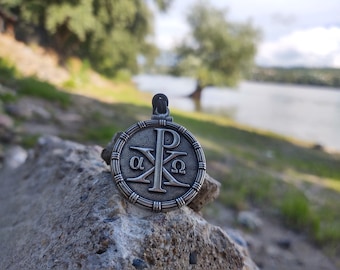
Chi Rho Monogram of Christ jewelry,Christian monogram of Jesus Christ.Christogram necklace,Constantine’s Cross,Alpha and Omega Chi-Rho cross
$20.50
-
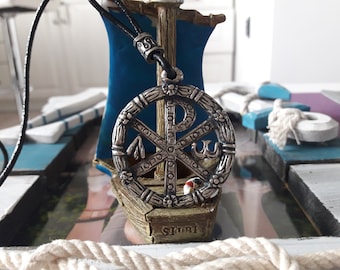
Christian monogram of Jesus Christ leather necklace,Christogram,Chi Rho Labarum Chrismon Constantin's cross,Religious symbol,alpha & omega
$22.00
-

Chi Rho Necklace | Gold Christogram Pendant, XP Cross Pendant, Christian Symbol Religious Jewelry, Constantine Monogram, Chrismon Charm
Sale Price $38.00
Original Price $95.00
-

Chi Rho Necklace | Gold Christogram Pendant, XP Cross Pendant, Christian Symbol Religious Jewelry, Constantine Monogram, Chrismon Charm
Sale Price $38.00
Original Price $95.00
-
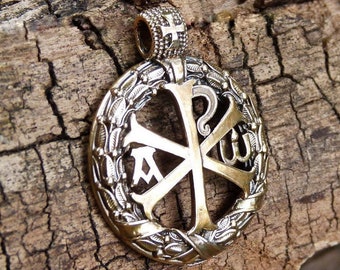
Alpha Omega Chi Rho Necklace Pendant, Christogram Jesus Christ monogram, Constantines Cross
$53.94
-
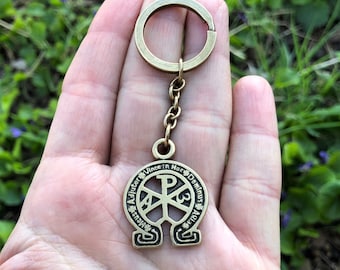
Alpha and Omega Chi-rho Chrismon Keychain or Necklace, Monogram of Christ, Labarum. Cross Christian symbols, Constantine Cross Amulet
Sale Price $15.28
Original Price $16.98
-
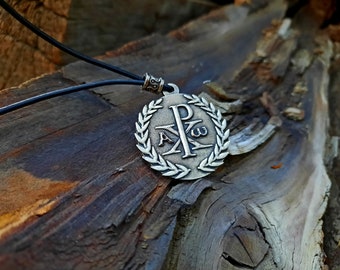
Christogram necklace,Monogram of Christ sign jewelry,Chi Rho XP, Constantine Cross,Religious symbol, IX monogram,Alpha and Omega,Christian
$22.00
-
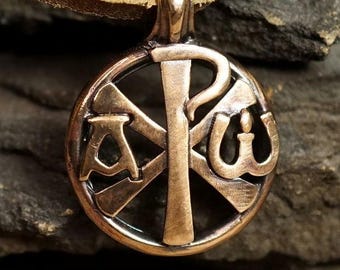
Chi Rho Pendant – Christian Christogram Necklace, Monogram of Jesus Christ Symbol Jewelry
$53.94


Looking for more? Find it on Etsy