
















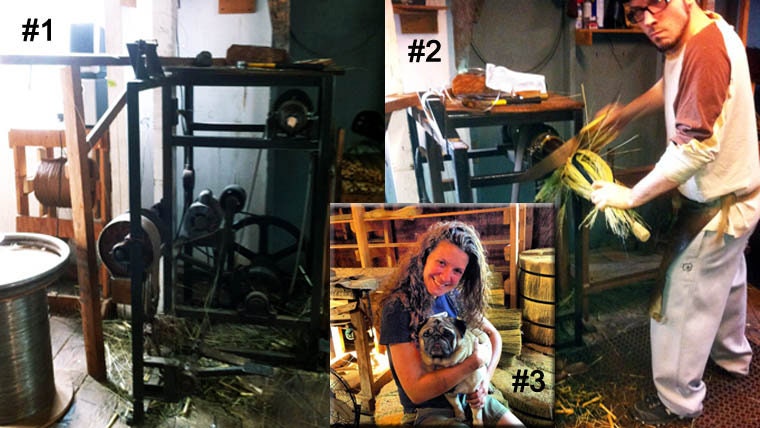
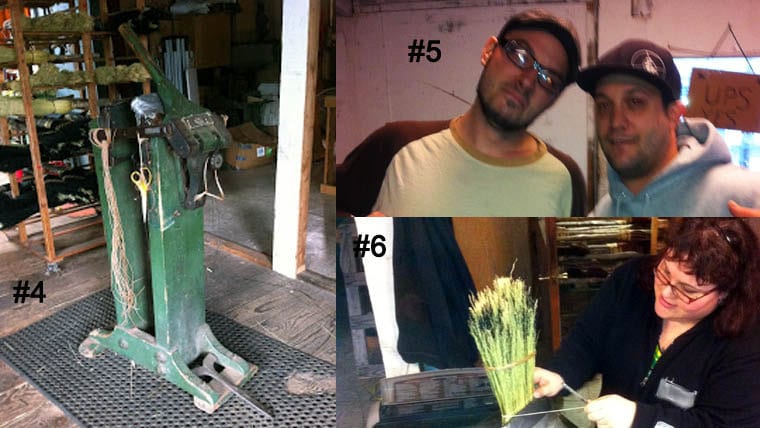

Faisons le tour de la boutique de balais !!
Let's tour the broom shop!!
Salut! Je m’appelle Samantha, également connue sous le nom de « Broomchick » et nous sommes SCHEUMACK BROOM COMPANY, d’Eugene, Oregon!
Je reçois parfois des courriels de gens qui sont sceptiques quant à la façon dont nos balais sont fabriqués parce que la qualité est si bonne qu’ils supposent qu’ils sont fabriqués à la machine, alors je vais essayer de vous faire un tour des outils que nous utilisons et du processus de fabrication des balais dans notre magasin, Scheumack Broom Company, et vous présenter le reste de l’équipe de balais.
Sur la photo #1, vous voyez notre machine à enrouler à pédale que nous utilisons pour enrouler le maïs à balai sur le manche à balai. C’est l’un des travaux les plus difficiles et les plus dangereux dans le magasin de balais et je peux voir Seth enrouler des balais sur la photo #2. Dans le passé, nous avons utilisé des bâtons de sassafras que nous obtenons des Ozarks de l’Arkansas où le bois pousse à l’état sauvage, mais maintenant la plupart de notre bois est acquis à partir d’un projet local de reboisement durable juste à l’extérieur d’Eugene, en Oregon. Les jeunes arbres récoltés seront une variété de bois du nord-ouest, y compris le cerisier, l’érable et le noisetier, et tous passeront par le processus de séchage au four. Notre maïs à balais est cultivé par les Amish, dans le sud de l’Illinois, et nous teignons nous-mêmes le maïs dans une variété de couleurs (principalement de la rouille ou du noir), la photo n ° 3 est Emily et son carlin, Tater, qui sont responsables de la mort de tout le maïs à balais au magasin de balais.
Une fois que le maïs à balais est enroulé sur le bâton, il va ensuite à l’égout qui le charge dans l’historique « Shaker Vice » qui est ce qui rend les balais plats. L’étau shaker qui est présenté photo #4 a un moulage en fer qui remonte à 1878. Seth et Michael (photo #5) cousent des balais à mains nues avec une aiguille plate qui a son trou au centre de l’aiguille. Les garçons ont durci leurs mains au point qu’ils n’ont plus besoin d’utiliser du ruban adhésif et des poignets en cuir, contrairement à moi. Quand je m’assois pour coudre un balai avec mes doigts de fille sissy, je scotche presque tous les doigts avec du ruban chirurgical, puis je mets des poignets épais en cuir et en métal et je me mets au travail. Je perds probablement 10 bonnes minutes à me préparer à coudre. Sur la photo #6, vous pouvez me voir coudre un balai sur l’étau du shaker sans ruban adhésif. La plupart des balais prennent environ 3 rangées de coutures, les plus petites sur lesquelles nous faisons deux rangées.
Lorsque le balai est cousu, il va ensuite dans une pile à côté de la table de placage où il sera éventuellement plaqué. Le placage est ce que nous appelons la décoration de tissage de panier qui passe sur le fil d’enroulement métallique au sommet du balai. Les plats sont en fait le stock de la plante de maïs à balais et nous les coupons en sections d’environ 8 pouces, puis les coupons en deux et nous les trempons dans des seaux d’eau pour les ramollir, puis en utilisant l’engin que nous appelons une table d’enroulement (vu sur la photo #7 avec Brutus le carlin Broomchick), nous utilisons nos pieds sur la roue pour la tension pendant que nous tissons les plats sur le balai. Tout comme la couture, cela nécessite beaucoup de force dans le haut du corps et nous obtenons tout un entraînement en plaisantant. Sur la photo #8, vous pouvez voir Michael en train de plaquer un balai d’aile de dinde.
La dernière étape de la fabrication des balais est ce que nous appelons « garniture, trou et cuir » et c’est exactement cela. Nous utilisons une tondeuse de style guillotine pour couper le maïs à balai à plat, puis à l’aide d’une perceuse, nous perçons un trou au sommet du bâton et finissons avec un morceau de cuir.
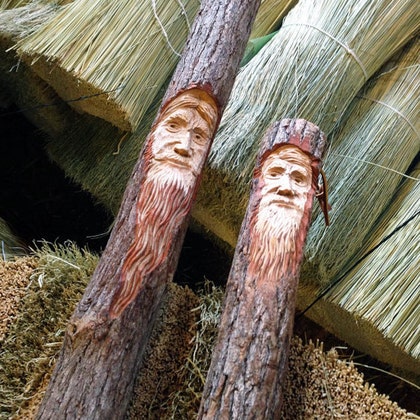
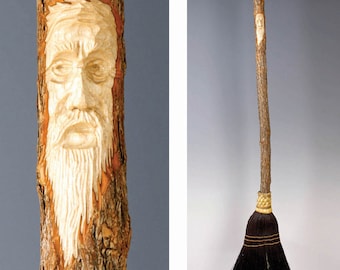
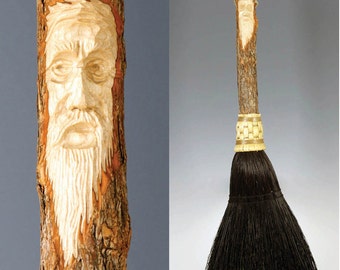
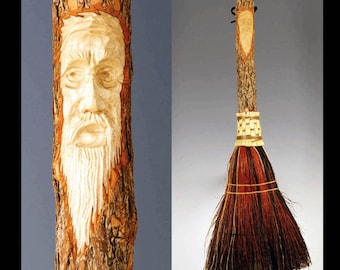
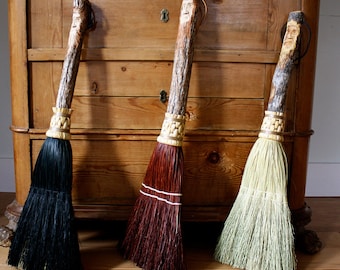
Certains de nos balais (le balai de cuisine et le balai de foyer) sont offerts avec des esprits d’arbre sculptés à la main. Sur la photo #9, notre mentor Thurman Scheumack, montre la sculpture d’un Tree Spirit dans un manche à balai de cuisine à l’aide d’outils de sculpture à la main allemands traditionnels.
Pour en savoir plus sur la boutique de balais, consultez ces liens:
Qui sommes-nous:
www.broommagic.com/#!about-us/c1d72
À propos de l’équipage :
www.broommagic.com/#!the-crew/izgjc
À propos des sculptures:
www.broommagic.com/#!the-carvings/vxyy7
Voilà! J’espère que vous avez apprécié votre visite de la boutique de balais!
Vive le balayage propre !!
~ Samantha (Broomchick)
Entreprise de balais Scheumack
Hi there! My name is Samantha, also known as the "Broom Chick" and we are SCHEUMACK BROOM COMPANY, of Eugene, Oregon!
I sometimes get emails from folks who are skeptical about how our brooms are made because the quality is so good they assume that they are machine made, so I will attempt to give you a tour of the tools we use and the broom making process at our shop, Scheumack Broom Company, and introduce you to some of the broom crew.
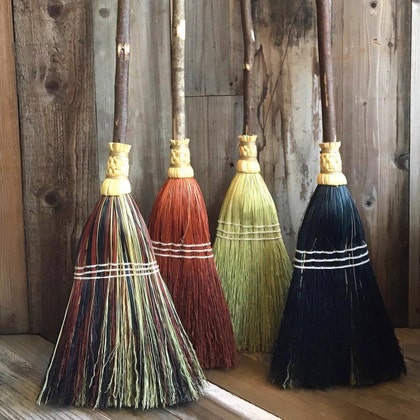
In photo #1 you see our pedal operated winding machine which we use to wind the broom corn onto the broom stick with. This is one of the hardest and most dangerous jobs in the broom shop and I you can see Seth winding brooms in photo #2.In the past we have used sassafras sticks which we get from the Ozarks of Arkansas where the wood grows wild but now most of our wood is acquired from a local sustainable reforestation project just outside of Eugene, Oregon. The saplings that are harvested will be a northwest variety of woods including Cherry, Maple and Hazel and all will go thru the kiln drying process. Our broom corn is grown by the Amish, in Southern Illinois, and we dye the corn ourselves in a variety of colors (mostly rust, or black), photo #3 is Emily and her pug, Tater, who are responsible for dying all of the broom corn at the broom shop.
Once the broom corn is wound onto the stick it then goes to the sewer who loads it into the historic "Shaker Vice" which is what makes the brooms flat. The shaker vice that is featured photo #4 has iron casting that dates back to 1878. Both Seth and Michael (photo #5) sew brooms bare handed with a flat needle that has its hole in the center of the needle. The boys have hardened their hands to the point that they no longer needs to use finger tape and leather palm cuffs, unlike me. when I sit down to sew a broom with my sissy girl fingers I tape nearly every finger with surgical tape, then I put on thick leather and metal palm cuffs and get to work. I probably waste a good 10 minutes just prepping to sew. In photo #6 you can see me sewing a broom on the shaker vice without tape on. Most brooms take about 3 rows of stitching, the smaller ones we do two rows on.
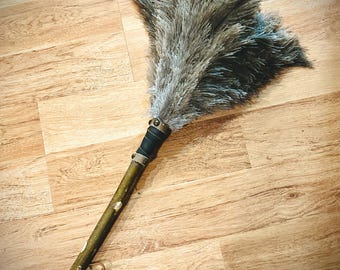
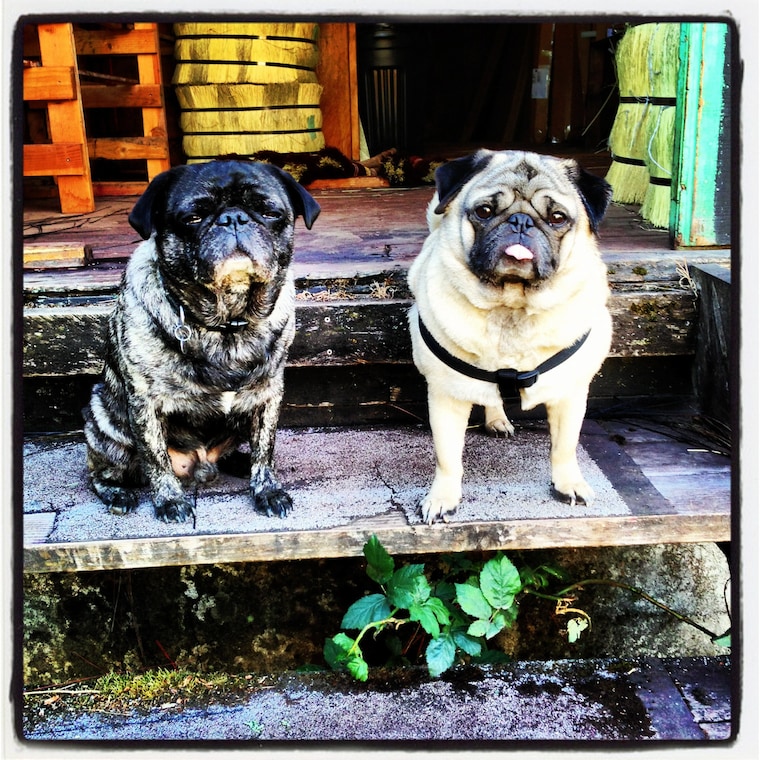
When the broom is sewn it then goes into a pile next to the platting table where it will eventually be platted. Platting is what we call the basket weave decoration that goes over the metal winding wire at the top of the broom. The plats are actually the stock of the broom corn plant and we cut them into about 8 inch sections then slice them in half and we soak them in buckets of water to soften them up, then using the contraption we call a winding table (seen in photo #7 with Brutus the Broomchick Pug) we use our feet on the wheel for tension as we weave the plats onto the broom. Much like sewing this requires a great deal of upper body strength and we get quite a workout from platting. In photo #8 you can see Michael platting a Turkey Wing Broom.
The final stage of broom making is what we call "trim, hole and leather" and it's exactly that. We use a guillotine style trimmer to trim the broom corn flat, then using a drill press we drill a hole at the top of the stick and finish up with a piece of leather.
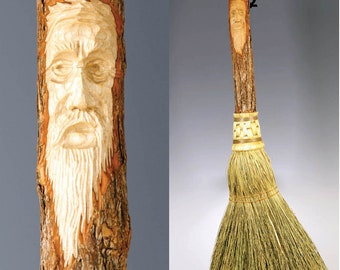
Some of our brooms (the Kitchen Broom and the Hearth Broom) are offered with hand carved tree spirits. In photo #9, our mentor Thurman Scheumack, demonstrates carving a Tree Spirit into a Kitchen Broom handle using traditional German hand carving tools.
To learn more about the broom shop check out these links:
About Us:
http://www.broommagic.com/#!about-us/c1d72
About the Crew:
http://www.broommagic.com/#!the-crew/izgjc
About the Carvings:
http://www.broommagic.com/#!the-carvings/vxyy7
There you have it! I hope you have enjoyed your broom shop tour!
Cheers to making a clean sweep!!
~ Samantha (Broomchick)
Scheumack Broom Company


