

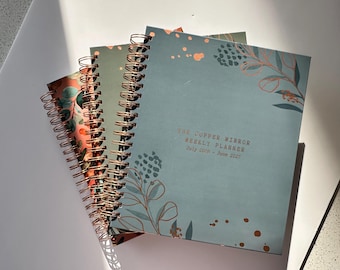





One planner for your whole self — everyday life and Jewish life, finally on the same page.
I've kept my life in a paper planner for decades. And every year I'd do the same thing: buy a beautiful planner, then pencil Shabbat times and holidays into a calendar that starts in January — right in the middle of a Hebrew year that began the previous September. Most planners acknowledge maybe four Jewish holidays, first day only. Sukkot, my favorite, never made the cut. Counting the Omer, Shavuot, Simchat Torah? Never. There's a billion-dollar lifestyle-planner industry, and not one built with a Jewish woman in mind.
You get used to not being seen. Then one day you decide you shouldn't have to.
For over ten years — between jobs and raising three kids — I circled the idea of a planner built around the Hebrew calendar. When an ad for a five-day design challenge crossed my feed, something said now. By the end of that week I'd dug out old files and started over.
I wanted the Hebrew calendar as the foundation, not a footnote. My kids' pickups and my deadlines on the same page as Shabbat and every holiday, major and minor, marked on the day it actually begins. No second calendar on the kitchen wall. No writing myself into the margins. And I wanted it to hold the whole spectrum of Jewish women — cultural, secular, traditional, interfaith, and everywhere between — whether you're well-versed or just beginning.
The name came from Parashat Vayakhel. When the Israelites build the Mishkan, the women bring their copper mirrors to be melted down for the washing basin. Moses first rejects them as vanity; God overrules him — "these are more beloved to Me than all the rest." In Egypt, it was the women who kept our people going through small, private acts of stubborn faith. Something ordinary became something holy. I named my company Copper Mirror Press for them.
That's the whole idea. Not grand gestures — small things done faithfully, one ordinary day at a time. A planner, it turns out, can hold that quiet work: keeping Jewish time in front of you on the everyday days, with room for whatever speaks to you — what you already observe, what you're only curious about, the parsha you want to read this week. Whatever intention you bring, there's no wrong way to use it. Which is exactly the point.
We've spent our lives living between two calendars. I built this so we wouldn't have to.