
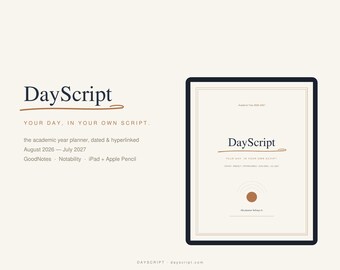

it feels like paper. it knows what day it is.
DayScript started as eleven pages I drew by hand: cream paper, ink-navy serif, a copper underline with a little loop at the end. I had a drawer of beautiful paper planners, each abandoned by March, because paper can't remind you of anything — and a phone full of planner apps abandoned even faster, because filling them in felt like data entry. I wanted the thing in between: a page that still feels like paper, but quietly knows what day it is.
So I built it. Every DayScript is fully dated and hyperlinked — 518 pages where every tab, month, week, and day is a working link — and behind the pages is a method that asks for less memory, not more discipline. You write the ending first (three storylines). You make dreams calendar-sized (five chapters, each with a date). Then the cascade carries them down: one goal a month, three things a week, the plot of today.
I had rules while I designed it. The habit tracker gets no streaks and no guilt — six habits, a dot a day, and one question at month's end: what does the pattern say? The mood tracker fits in one line, in your own voice. Nothing anywhere is dark or heavy — cream, ink, and copper only. And because a planner you smile at is a planner you open, I hid 48 little one-liners in the pages. Coffee first. Legibility second.
I make every edition myself, start to finish. This little shop is chapter one of its own storyline — thank you for being in it.