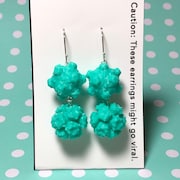



We love jewelry that sparks science communication.
Mission Statement: To dovetail with the future nonprofit, which has the mission statement to engage the world with the utility of microorganisms through education and applications.
We were preparing for the opening of Community of Microbes (https://www.communityofmicrobes.com/) and Leonora wanted to have a special gift for everyone involved. Leonora and her husband, J.J. (a Makerbot Certified Educator and communications media professor), worked together to create earrings for the event. The constant compliments and interest in them (and the conversations they sparked) at the opening drove Anne and Leonora to discuss creating these for others in order to support starting a non-profit related to microbe education: thus, Microbially Speaking was born while surrounded by Rothko paintings at the Met.
Context for the earrings:
What is a virus? It is a microscopic organism that infects (enters) another cell and uses the machinery of that cell to make more copies of itself. They are usually much smaller than the cells they infect. Viruses have different ‘species’ just like animals and plants do. Some viruses only infect human cells, while others only infect bacterial cells. Scientists still debate whether viruses are living creatures, or just inorganic packets of some protein and DNA (or RNA) that hijack the systems of living creatures.
These microbe earrings highlight that even the very small can be mighty!
How big is a virus?
Viruses are VERY small. They range in size, but over 500 of them can fit across the width of one human hair. Viruses are about as long as your fingernails grow in less than a minute.
About 30 virus particles (units) can fit across one bacterial cell
About 15 bacterial cells can fit across one human cheek cell
One cheek cell (which is shaped like a fried egg) is the same length as the width of one human hair.
Phi X (short for Phi X 174 virus) –
In the wild this virus that infects E. coli, just like some cold viruses only infect people – yes, bacteria can get viral infections too! This virus is harmless to animals and plants.
In the lab this virus is often sequenced (the DNA sequence is recorded) as a quality control standard whenever the microbiome of a person, animal, or plant is sequenced (deciphered). By being a helper in all of these lab experiments, the PhiX virus has the most frequently sequenced genome of anything on earth!
This is definitely a microbe symbol for hard workers who don’t get the credit they deserve!
Adenovirus
In the wild this virus infects human cells, causing respiratory infections and viral pink eye.
In the lab, scientists are discovering new ways that modified versions of this virus can help us better target cancer therapies. Eventually these viruses may help doctors move cancer medications to within cancer cells (just as the virus would enter a normal human cell).
We may not like these microbes during cold season, but this virus is a symbol of how humans can work with nature to solve some of our biggest challenges.
Microbially speaking, if your earrings were life-sized viruses, then the width of one human hair would be 2.5 stories tall.
This project and shop was inspired by Dr. Anne A. Madden's Microbe Hat Project. Functional Fashion & 3D printing to Engage w/Science
Science offers new inspiration, and tools for art and design. Engaging with the aesthetic of science offers opportunities to reach new audiences while fighting stifling and antiquated stereotypes.
A new project launch is the #MicrobeHatProject which uses fashion as an innovative tool for engaging the public with the utility of microorganisms in our world. This series features fascinator style hats that are adorned with more fascinating 3D printed microorganisms. Each hat helps spark a discussion and tells the story of a microorganism in our world that is often ignored, yet helps in remarkable ways. This includes the Antimicrobial Hat featuring the microbe that lives in the soil and is used to make Neosporin, one of our commercial antibiotics that helps save lives. Another is the Climate Change Hat, featuring a 3D printed microbial species that lives in bird feathers and is used to produce enzymes (molecules) that we use in laundry detergents. These enzymes allow us to wash our clothing at cooler temperature, thus allowing us to save considerable amounts of energy. Yet another is the FoodHat, featuring a 3D printed yeast cell, the species of yeast that help us make donuts, beer, and wine.
EXHIBITS: This project was first showcased in the conference audience of the TED 2019 conference. The first digital mention of this project garnered more than 250,000 impressions on twitter. This project was presented on the TED Speaker Community Theater stage at TED SUMMIT 2019. Hats have been accepted for display by the National Museum of Hats (North America) and the World of Hat Museum (Europe).
More: https://anneamadden.wordpress.com/about/new-design/

