
Runes anciennes. Esprit moderne. Vie légendaire.
Ancient runes. Modern mind. Legendary life.
Je ne suis pas venu chercher de la magie aux runes. Je suis venu chercher un système.
Ces dix dernières années, j'ai été ce que certains appelleraient un psychonaute. J'ai passé la majeure partie de ce temps à me plonger dans la PNL, qui enseigne comment une identité se construit et comment la réécrire. Cela fonctionnait pour mon activité, mais jamais pour ce que je pensais être ma propre valeur. Alors, je me suis mis en quête de quelque chose de plus ancien.
Puis j'ai entendu les mythes nordiques pour la première fois, et les noms ont commencé à me paraître familiers. Týr. Odin. Thor. Frigg. Je les avais prononcés chaque semaine de ma vie sans jamais les entendre vraiment — quatre jours de notre semaine portent le nom de ces mêmes dieux. Rien ne survit à treize siècles par simple ornement. Il y avait quelque chose de plus profond.
J'ai découvert que le Futhark ancien n'a jamais été un jeu de divination. C'était une façon de nommer les forces en présence, dans le monde et en la personne qui le porte. Fehu ne signifie pas « l'argent arrive ». Fehu représente ce que vous êtes prêt à recevoir. C'est une question psychologique, et elle a une réponse.
Assise avec eux, je reconnaissais sans cesse les mêmes structures que la PNL m'avait enseignées, décrites mille ans plus tôt dans un autre langage. Vingt-quatre forces. Vingt-quatre points de blocage dans une vie.
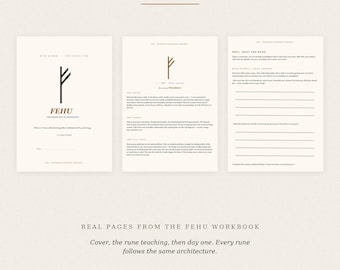
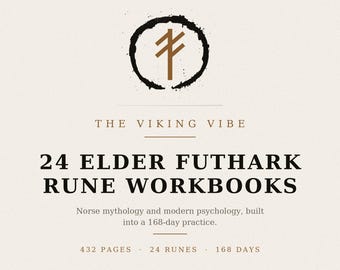
J'ai donc créé ce que je cherchais et que je ne trouvais pas : un cahier d'exercices par rune, sept jours chacun, le mythe d'un côté et la psychologie de l'autre. Pas de casques à cornes.
Je fais tout moi-même ici : l'écriture, la recherche, la conception.
Runes anciennes. Esprit moderne. Vie légendaire.
I didn't come to the runes looking for magic. I came looking for a system.
In the last ten years I've been what some would call a psychonaut. Most of that was spent inside NLP, which teaches you how an identity gets installed and how to rewrite it. It worked on what I did. It never touched what I thought I was worth. So I went looking for something older than the technique.
Then I heard the Norse myths for the first time, and the names started sounding familiar. Týr. Odin. Thor. Frigg. I'd been saying them every week of my life without once hearing them — four days of our week are named for those same gods. Nothing survives thirteen hundred years by being decorative. There was something underneath it.
What I found was that the Elder Futhark was never a fortune-telling deck. It was a way of naming forces — in the world, and in the person carrying it. Fehu isn't "money is coming". Fehu is what you're willing to receive. That is a psychological question, and it has an answer.
Sitting with them, I kept recognising the same structures NLP had taught me, described a thousand years earlier in a different language. Twenty-four forces. Twenty-four places a life gets stuck.
So I built the thing I wanted and couldn't find: one workbook per rune, seven days each, myth on one side and psychology on the other. No horned helmets.
I make everything here myself: the writing, the research, the design.
Ancient runes. Modern mind. Legendary life.
