

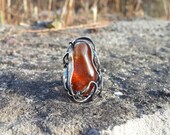

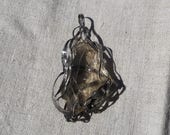
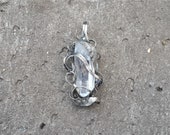

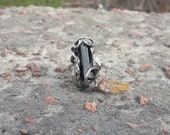
About a Master
I'm asked over and over again, where did my husband study art hammer-work and what inspires him.
Let me tell you, that Dima has been an imaginative visionary since childhood, and has always been interested in metals, creating his first copper wire rings for his mom in adolescence. He has never studied art-hammering in any school and for many years he had been improving in different kinds of activities, until he discovered that his copper handiworks were appreciated not only by his family members but by other people as well. It was then when he decided to improve his craftsmanship in art-hammering. It's all coming from his heart. Dima often says, that the stones themselves have taught him how to set them in metal.
Like any other creative artist's work, his hammering depends on inspiration and state of mind... So what does inspire him?
Here is what he thinks about it:
It's all around us... When I look at the world around, I see beauty and harmony in chaos. For example, there is some elusive secret order in interweaving shrub branches. A peculiar captivation is perceived in a seemingly chaotic intertwinement. It fascinates me.
Or think, for instance, of a rock, entwined with grass, it's like a gemstone in a setting. It seems as if plants are flowing around it, lulling it to sleep and keeping their way. And sunflecks are building a natural chiaroscuro on a moss-covered surface. That's why I never make symmetrical works, they are dead and statical for me. On the contrary, allowing metal to flow without restraint, just slightly aligning it, accepting its naturalness, listening to it carefully – lets the Master create an object of art. A grateful Metal flows like grasses, it has its own life, moves. Thus I chose an ancient way of stonesetting – an art-hammering. A hammered metal is different. It has it's own temper. A hammersmith must feel it, for he does not possess or govern it, but listens to what metal suggests to him. He must capture the beauty on one of the stages. Or the semi-finished work can go to the scrap heap, distorted, odd and unexpressed. By the way, hammersmiths were the first jewellers. Too bad, that art-hammering is so rare in jewelry.
Dmitriy Volokhov
So what is art-hammering exactly? Let's take a closer look at the process of creating jewelry from the beginning to the end.
So, the master takes a metal sheet and stretches it with a rolling press, setting its thickness. Then he cuts off a strip of a required width.
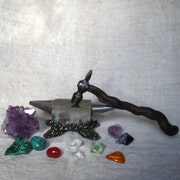
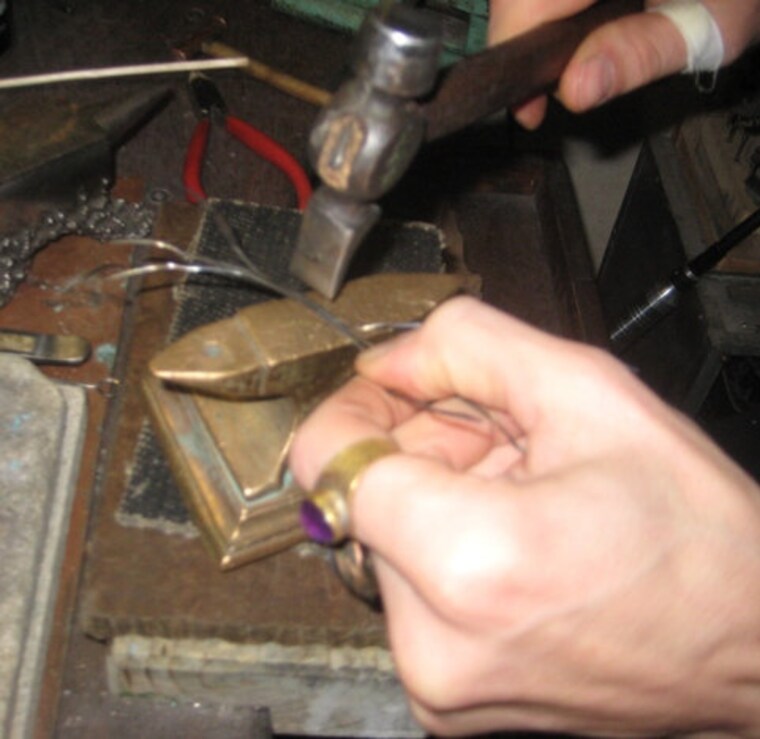
He cuts off several narrow stripes with tin snips, and hammers them in shape of branches and leaves on the anvil. Stripes width and quantity may vary depending on the sort of created jewelry (ring, pendant, hairpin etc).
Different hammers are used to build required surface texture.
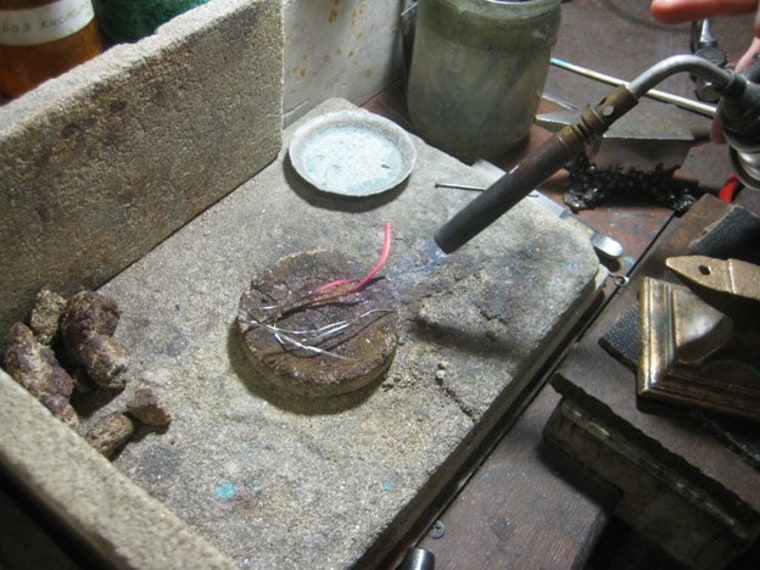
As a part of the hammering process metal should be repeatedly burned off to let it down and to bring its resilience back, for it gets really hardened while texture-building.
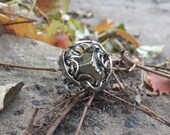
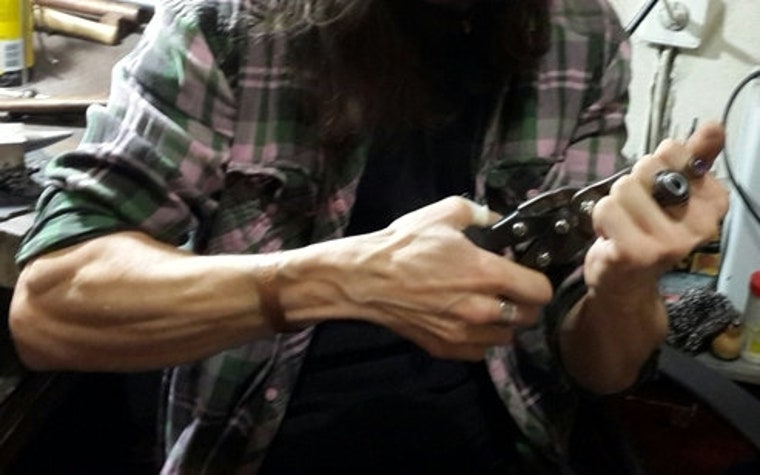
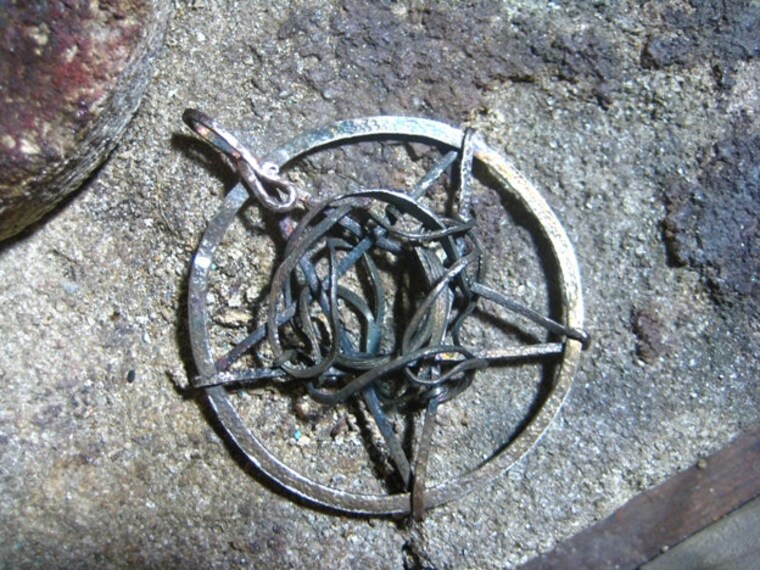
Hammered and burned off branches are then banded together with needle-nose pliers (kind of special-purpose pincers) to create a jewelry.
It's a crucial point, since the master must feel how metal lies down, in order not to spoil natural harmony. In fact, art-hammered jewelry never is created according to some exact and pre-readied drawing, only its general appearance draft is planned.
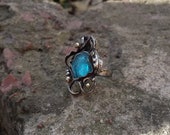
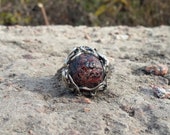
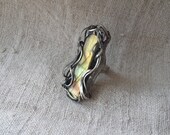
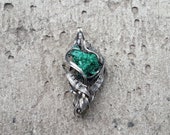
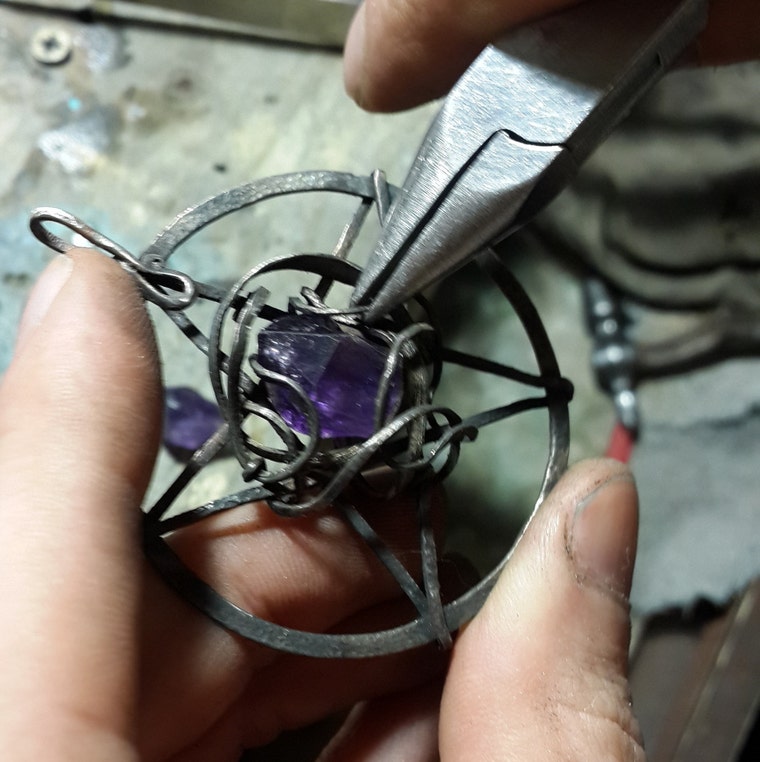
It should be pointed out, that natural stones are used, and they all have their own unique form, so metal entwists around them in a different way every time. It guarantees complete individuality of every work, so there can't be identical ones.
Before the final stone-setting the jewelry is hammered along the contour in places, where high mechanical strength is required. The branches are left resilient.
The jewelry is not burned off anymore, just slightly polished preserving natural patina from heating in hollows, which gives a more expressive, dimensional and vintage look to the metal.
Then the stone is set carefully, squeezed and entwisted with metal branches. Wobbled a bit to make sure that it's settled firmly. The branches should emphasize the stone, entwine around it and not hide its naturalness. The stone should look like a natural part of a jewelry, not an extraneous detail in set.
Final stage: polishing the jewelry with different dremel tool cones and polishing pastes. Polishing must be especially careful near the stone, in order not to scratch it (some stone kinds are quite soft).

