





How "Vlads Test Target" Came to Be
When somewhere in August of 2019 I decided to scan my very old 35 mm chromes, I realized that the time I would spent cleaning and remounting slides, capturing them with digital camera, processing them in Photoshop or Lightroom would be wasted if the quality of the digital capture was to be bad. I was not going to do scanning twice. My Minolta Dimage Scan II film scanner collects dust as I could never got used to its slowness. So I started with inexpensive Canon t4i camera, Nikon ES-1 adapter and couple of old lenses which I used 40 years ago to actually duplicate hundreds of 35 mm slides for my DJ friends. It took me few shots to realize that neither Russian Industar 61LZ, nor German CZJ Pancolar 1.8/50 lenses were up the task. Those are very good primes but they perform really poor at 1:1 .6 scale. I started the research and found the Facebook group "Digitizing film with a digital camera" which was eye-opener for me. The more I read and bought more equipment (like Schneider Kreuznach Componon-S 5.6/80 mm lens) the better I realized that we are dealing with the quite a few complex engineering problems. The most obvious one is very shallow depth of field when frame on original film is photographed by a digital camera at 1:1 scale. That leaves literally no wiggle room to components' misalignment. The next issue was the deterioration of sharpness toward the image corners which can only be solved by employing the true fixed-focus macro lens with the good flatness of field. The third one was the quality of illumination - color and uniformity. The forth was the mechanical rigidity of the setup - unlike the negative strips, inserting and removing mounted transparencies disturbs scanning rig badly enough to force one to focus on each individual slide.
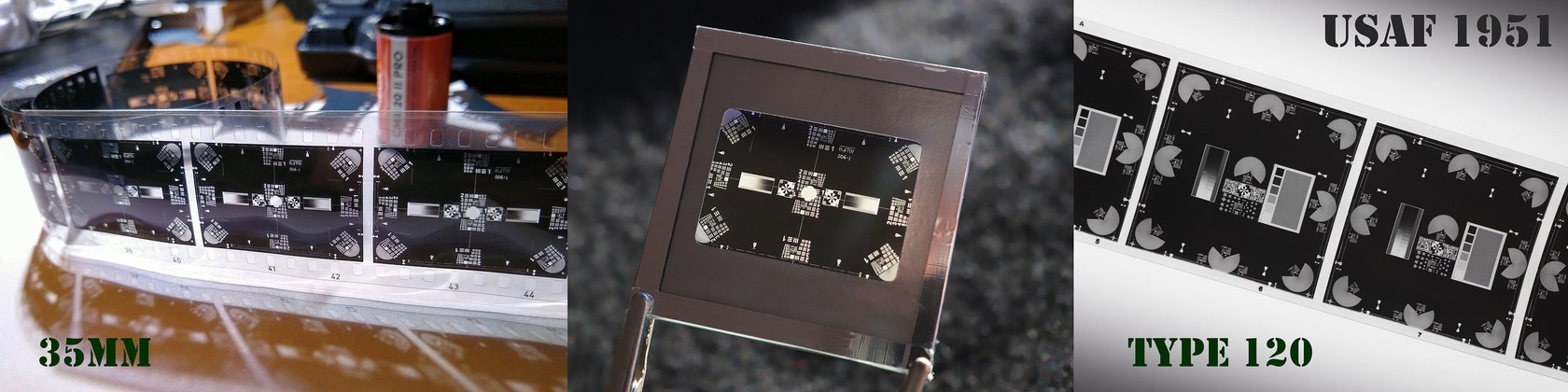
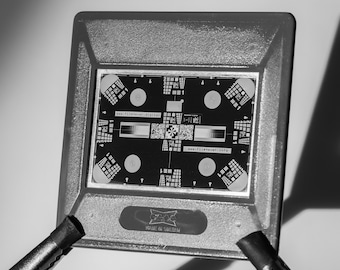
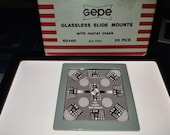
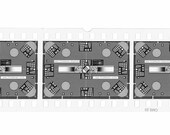
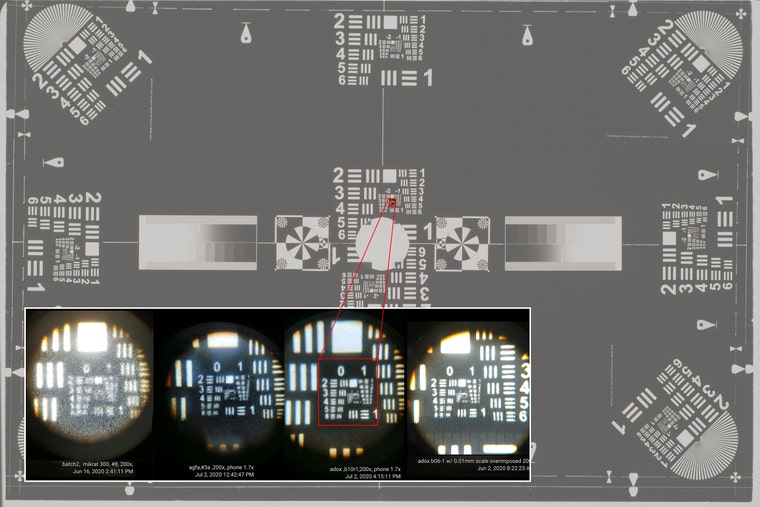
The only way for those procedures to make any sense was having a good _test target_ readily available to check lens focusing and film holder alignment. In short, the task was to create a film frame which would exceed the resolution of the conventional negatives, be of high contrast - to help with focusing, contain image elements which can help assess sharpness and resolution of the digital capturing device across the frame - center vs sides vs corners.
The premise was simple enough and I thought that the whole exercise will take me couple nights and may be extra $50 in expenses for a film, developer, thermometer and a couple of beakers.
What could be easier than to print bunch of targets from a PDF file on a laser printer, glue them to a poster board and shoot them on some high resolution, high contrast film? Everybody would agree that this is quite trivial task. Anybody who knows that you have to take lens cap off before taking a shot, can perform that easily with just one left hand while scrolling thru their IG feed with the right hand.
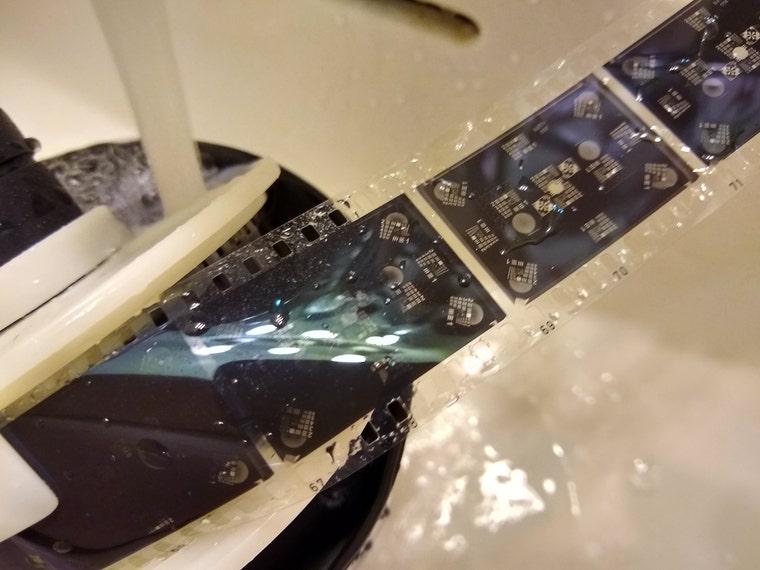
Well, it is easier to say then do. Which film would you use since Kodak Technical Pan or Kodalith are no longer readily available and asking price for 1 roll of a film expired 40 years ago is eye-popping US $20 ? After trying a couple of films I found the One!
Does 600 dpi Canon laser printer is capable of producing strokes so small that good film cannot resolve them from the distance of 100 inch? Astonishingly enough it does not!
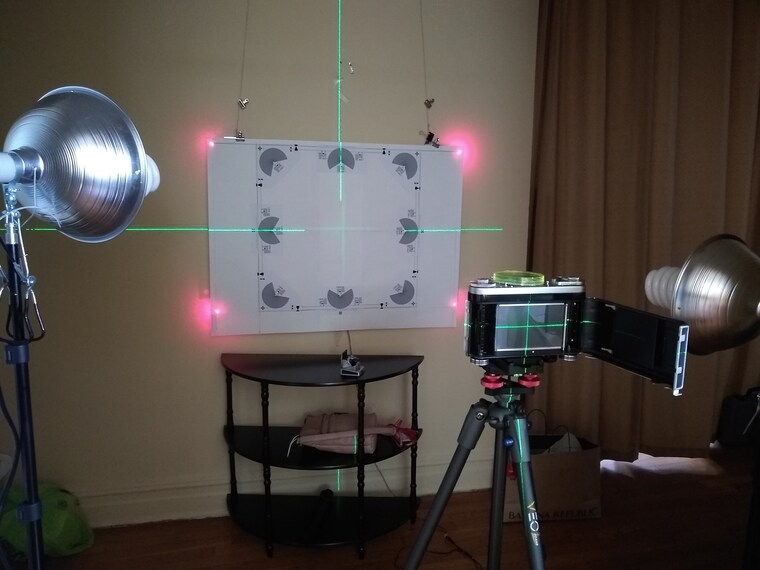
How do you point your camera exactly to the center of the 24x36 inch chart from 3 yards away - without any professional lab equipment - and avoid skewing the perspective and still filling the film frame?
How do you fill the frame from edge to edge having camera viewfinder cover only 90% of the view?
How do you shoot the film which is ISO 6 - 36 frames in a row - when regular portable flashes like Canon Speedlight are too slow and battery-hungry to produce say hundred shots in a quick succession?
What developer do you use to process the film and how do you know that you are getting the best negatives for the given film?
How do you illuminate 24x36 inch target uniformly (with variance less then 1/4 of stop) without expensive $200 light meter?
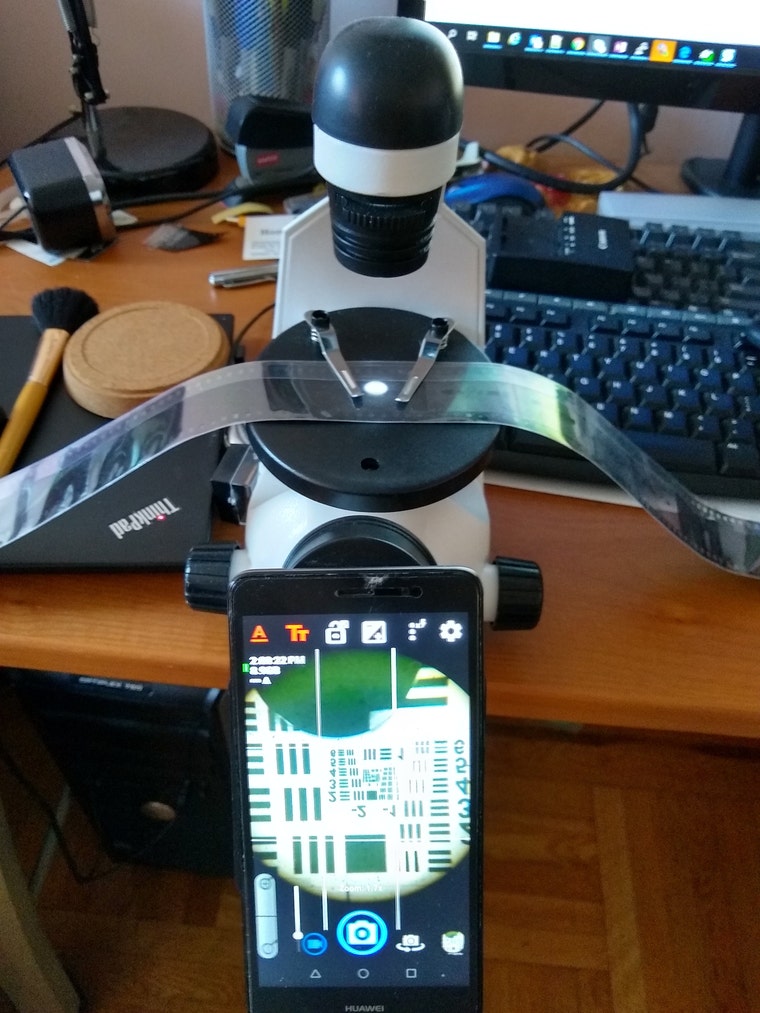
How do you calculate and then measure line pairs/mm resolution of your lens/film combination?
How do you keep your focus when world around you suddenly goes topsy-torvy with pandemic?
Read more at my blog at https://film4ever-digital.blogspot.com/