



Why Do I Have StagPath?
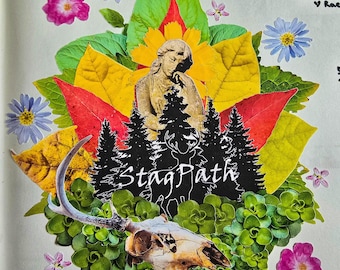
I started StagPath because I had always wanted to make a career of my art, and at the time I was feeling some financial pressure, along with anxiety problems limiting my work opportunities, so I began listing my own centerpieces and handcrafted jewelry on Etsy, all partially made with objects from nature. I've always had an immense interest in nature, so it made sense the theme would carry over into my artwork, but I had no idea how StagPath would transform into what it is today.
10 years ago I was out hiking and a plant brushed across my leg. Suddenly my skin began to burn and itch with intensity. I had to learn about the plants in the woods. I had to find out about that plant. That plant turned out to be wood nettle (closely related to stinging nettle) and it was just the beginning of a life changing adventure.
After the wood nettle stung me I went online with the intent of purchasing a book about poisonous plants so that I could better prepare myself for more adventures in the woods, but I ended up buying two books; The North American Guide to Common Poisonous Plants and Mushrooms by Nancy J. Turner and Patrick von Aderkaus and Edible Wild Plants by John Kallas. John Kallas ruled my world, and shortly after so did the teachings of Samuel Thayer and Sergei Boutenko. I invested in several books each year on plant identification, mushroom identification, foraging, and later on wilderness survival skills, primitive cooking, and food preservation. I learned about gardening, permaculture, ecosystems, self reliance, self responsibility, voluntarism, and so many other wonderful things over the years.
My life changed, and StagPath changed alongside me. I wasn’t having many sales for the first couple of years, but I knew I could make it as a niche market if I found my people. One of my repeat customers, Annette from Chicago, ordered some ornaments from me, and I happily packaged up the ornaments, putting a few extra things, like a beautiful fossil, and a handwritten note, but the box got stolen. I told Annette not to worry about the stolen package, and that I would send her new ornaments. I had been thinking about creating a sort of home goods basket, and I decided to surprise Annette with not only replacement ornaments, but a small mixed media painting, some squash from my garden, a fossil, and other lovely things. This little surprise basket for Annette was the first ever StagPath Mystery Box. It wasn’t like what it is today, with these informative notes, but it was the beginning of a beautiful adventure. I keep in touch with Annette to this day and I think it’s really special she was part of my journey. After I listed the StagPath Mystery Box on Etsy I discovered people really did want to know more about foraging, fossils, insects, and gardening. They were curious about ecology, and permaculture, and nature beyond surface level aesthetics. These people not only listened to me ramble on about my interests, but hung onto every word and encouraged me not just as a business woman, but as a person...or even as a friend. :) Conversations would go on well passed delivery dates and it was all because I wanted to say more than “Thank you for your purchase.” And they wanted to say more too, and learn more! I even started getting postcards and a few Patreon subscribers! StagPath could be someone’s wood nettle experience, someone’s shock to the system that encourages learning and growth. I think people come to StagPath because they have an appreciation for nature, but my hope is some of them leave with a seed planted within their minds about what their life and the lives of others around them could be like with just a little more understanding about the world around them. I want to turn wanderlust into an unstoppable wondering about everything. I want StagPath to lead to lifelong adventure.
✨More About My Goals✨
I have been a naturalist all of my life, meaning I have always had a deep appreciation and interest in the natural world. As a preschooler I wanted to be a forest ranger, and for a brief moment in college I majored in forestry, but I switched my college focus to art and adolescent psychology later on. For the last decade I have been learning about ecology, my local flora and fauna, what species are considered native, invasive, weedy, or naturalized and what impact those labels have on their perception. In recent years my novice work with ecology has been very much out in the field (literally) as I am in the process of working with 10 acres of retired agricultural land in early to mid succession. We believe biodiversity is of great importance for us to focus on maintaining and building upon, because we are largely surrounded by vast patches of farmland and non-beneficial lawns. My partner and I have big plans to restore and preserve much of the wild land, while also maintaining botanical gardens with a heavy focus on native plants, and we're even planning for permaculture food forests throughout the property, using what is already here as a template. This will be a large scale process taking all of our lives and done with much documentation. I want to show others that humans CAN interact with nature in a positive way. WE DO NOT HAVE TO SEPERATE OURSELVES FROM NATURE in order to preserve it, we only need to educate ourselves and interact with it, thus giving true value to all we understand. Value through use. Conservation through use. With just a little more understanding, the unknown weed in the garden can be revealed to be a rare native wildflower not yet in bloom. The sweat bee you fear will sting may turn out to be the harmless hover fly trying to find a place to rest after pollinating your flowers. You might even find out that strange person you see off trail staring at the plants is actually just out there surveying the land and perhaps even controlling the invasive garlic mustard population encroaching upon a patch of endangered goldenseal. We will never know unless we start to make observations and ask the right questions. We can talk the talk, but we really should be walking the walk, or maybe in this case hiking the hike, even if it means we have to crawl sometimes. We should all be learning as individuals, not just copying what’s cool. Nature isn’t a fad, so let's stop treating it that way! Let's explore beyond using it as a backdrop in photos, and take the time to learn a little more about this wild world we live in!
✨More About the Woods Goods✨
I strive to obtain both the natural and manmade resources I use for my art with a proactive approach to learning how and where materials are made and distributed. The natural materials I use in my work are thoughtfully collected with the individual specimen in mind, as well the local ecology. I spend a lot of time learning not only the identity of what I harvest, but it’s function within the ecosystem in which it lives. Oftentimes I leave the woods empty handed, but have instead put my efforts in controlling an invasive species crowding out an at risk native, or simply picking up trash. I like to examine where the materials I purchase come from too, and I try to get what I am able to locally (Ohio for me), while also forever striving to keep ethics and sustainability in mind. I prefer the products I use, and the food I eat, to come from my area, or at least my country, and I also try to repurpose and reuse many materials. This is good for my local community both economically and environmentally. I will continue to seek out more self sufficient and self reliant ways to live and as such my business will change alongside me.

