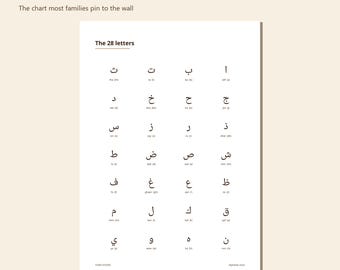

We make animated stories of the Prophets. These are the printables we make for the same families.
We are a studio making animated stories of the Prophets for Muslim families. These
printables began as the thing we kept looking for and not finding: resources careful
enough to sit alongside the stories, for families teaching at home.
Tuwa is the sacred valley where Musa was first spoken to. We took the name from it
because it is where a story begins — and because "remove your sandals" sets the tone
we want for this work.
WHAT MAKES THE WORKSHEETS DIFFERENT
Most Arabic tracing sheets show a letter once, on its own. But Arabic letters change
shape depending on where they sit in a word, and a child who has only ever seen the
isolated form cannot read or write a single real word.
Every letter in our sets is shown in all of its forms — isolated, final, medial and
initial — laid out right to left, the way the language is read. Six letters never join
to the letter that follows them, and their pages say so and explain why. That rule is
the difference between writing Arabic and drawing Arabic, and almost no worksheet set
teaches it.
MADE TO ACTUALLY BE PRINTED
Every set comes in A4 and US Letter as separate files, so it prints properly whether
you are in Manchester or Michigan — no cropped edges, no guesswork.
White backgrounds, no heavy colour, no full-page fills. Letters for tracing are drawn
as fine outlines. You can print a whole set more than once without emptying a
cartridge, which matters when you are teaching the same letter for a week.
BEFORE ANYTHING IS LISTED
The Arabic is checked. Letterforms are verified against an independent source before a
file is built, and the letter names are confirmed by someone who reads the language. We
would rather delay a listing than put a wrong shape in front of a child learning from it.