


Where were you when the lights went out?
In the spring of 1931, Lord Ashcombe announced that bridge bored him. From then on, his Friday guests played something better. Cards were dealt in silence and the lamps went out for one minute. When they came back on, one guest lay on the floor and everyone else stood exactly where they had been. Nobody could move. Nobody could lie. From their statements alone, the club had to name the murderer.
His secretary, Miss Pell, wrote every game into a ledger. A year later, Lord Ashcombe raised a glass to the club and did not live to see midnight. Miss Pell left the next morning, and her ledger was found in the library with some of its entries shaded in pencil.
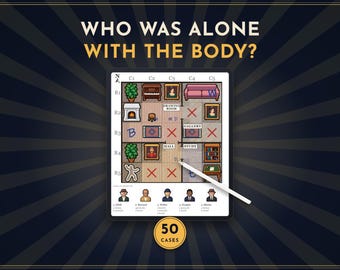
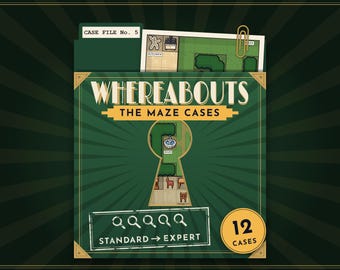
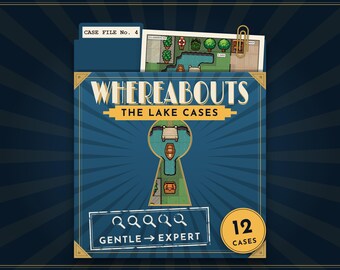
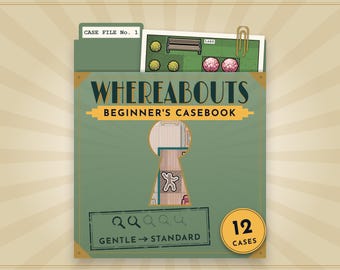
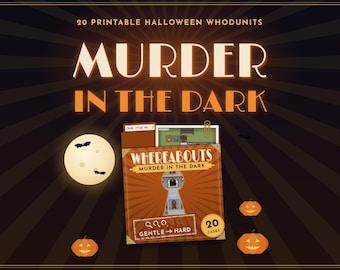
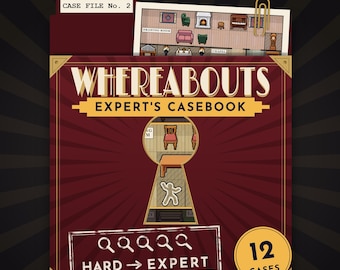
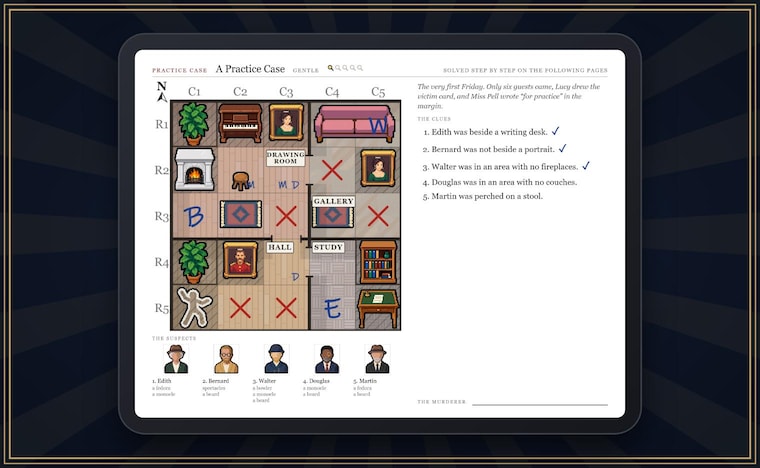
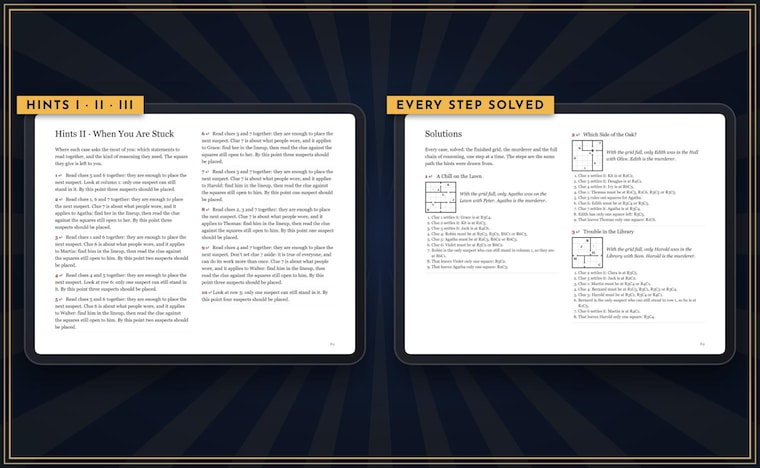
That ledger is the first Whereabouts book: murder mysteries that play like sudoku and end like a country-house whodunit. Each case gives you the floor plan of the house, the suspects who were in it and what each of them said. Place one suspect in every row and every column, and the one who stood in the room with the body is the murderer.
THE NAME
Whereabouts asks the one question every case turns on: where was everyone? The mark is a keyhole figure standing in the one lit room of a dark house. Someone stood exactly there, and you are looking in.
WHO MAKES THEM
I write these books under the pen name Victor Knox. The name tips its hat to Ronald Knox, who in 1929 set down rules for fair-play detective stories, chief among them that the reader must be able to solve the case from what they are given. That is the promise here too.
HOW EVERY CASE IS CHECKED
Every case is built and then checked by my own solver software, which works through it the way a person would, one deduction at a time. A case only goes into a book if it has exactly one answer and that answer can be reached without a single guess. The step-by-step solutions at the back follow that same path, so they show reasoning you could have found yourself.
HOW AI WAS USED
The puzzles themselves (where everyone stood, the suspects' statements and every step of the solutions) come from my own generator and solver, which are ordinary software, not AI. The illustrations (the portraits, furniture and floors) were made with PixelLab, an AI image tool, then retouched and composed by my own pipeline. The writing around the puzzles (the story, the rules, the case titles and the wording of the hints and solutions) was drafted with AI help (Claude) and edited by me.
THE TABLET EDITION
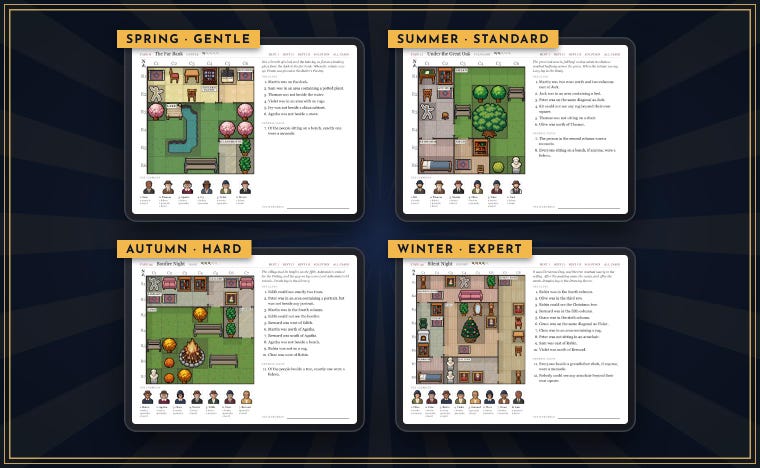
The shop's book is the tablet edition of Whereabouts: Murder Sudoku, with fifty cases and a practice case in one hyperlinked PDF, a case to a screen, made for a tablet held sideways and a pen app. It prints at home on Letter or A4 paper too.
Impressum
Csars Ventures GbR
vertreten durch die Gesellschafter Arthur Kaiser und Alexander Kaiser
Goethestraße 1
64859 Eppertshausen
Deutschland
Telefon: +49 178 8501090
E-Mail: csarsventures [!at] gmail.com
Umsatzsteuer-Identifikationsnummer gemäß § 27a UStG: DE464769261
Legal notice (Impressum)
Csars Ventures GbR (a German civil-law partnership)
represented by its partners Arthur Kaiser and Alexander Kaiser
Goethestraße 1
64859 Eppertshausen
Germany
Phone: +49 178 8501090
Email: csarsventures [!at] gmail.com
VAT identification number under § 27a of the German VAT Act: DE464769261
