

Seltenes Fundstück
Preis:347,46 €
1700's 乾 Kenryu-Nen-Sei Mark Ko-Imari 鯉 Koi Morisara Large Charger 染付 Sometsuke Goldfish Porcelain Plate Carp Dish Edo Japan *Free SH
Du kannst nur dann ein Angebot machen, wenn du einen einzelnen Artikel kaufst.
Highlights
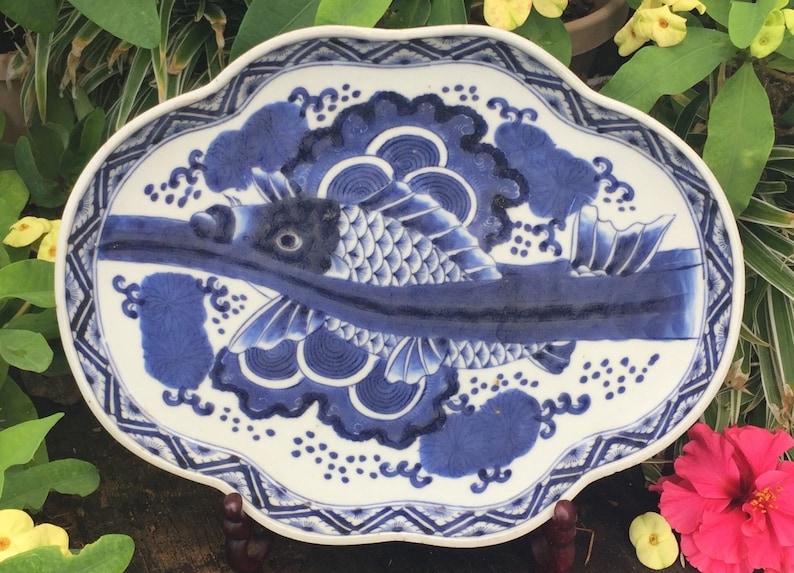
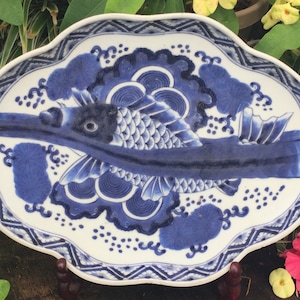
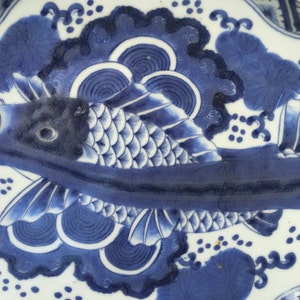
A classical HUGE SOMETSUKE KOI KENRYU-NEN-SEI QUATREFOIL MORISARA/PLATTER!
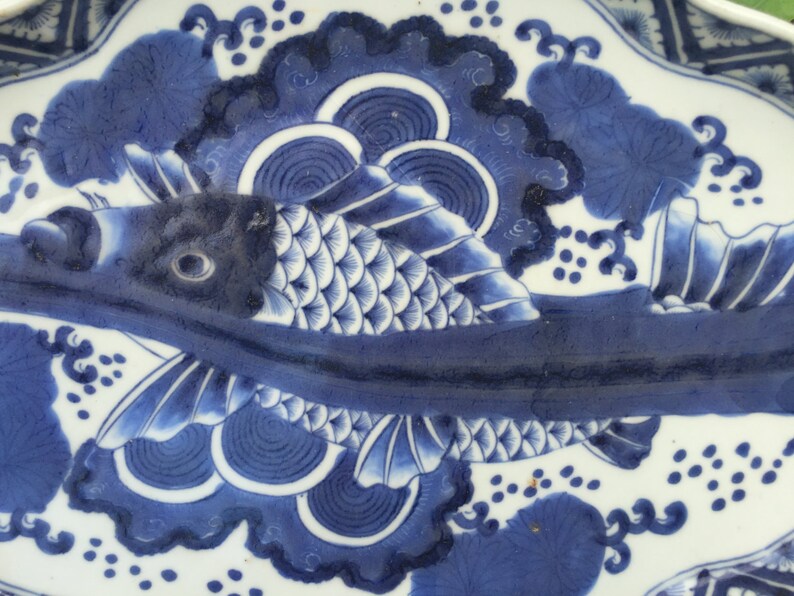
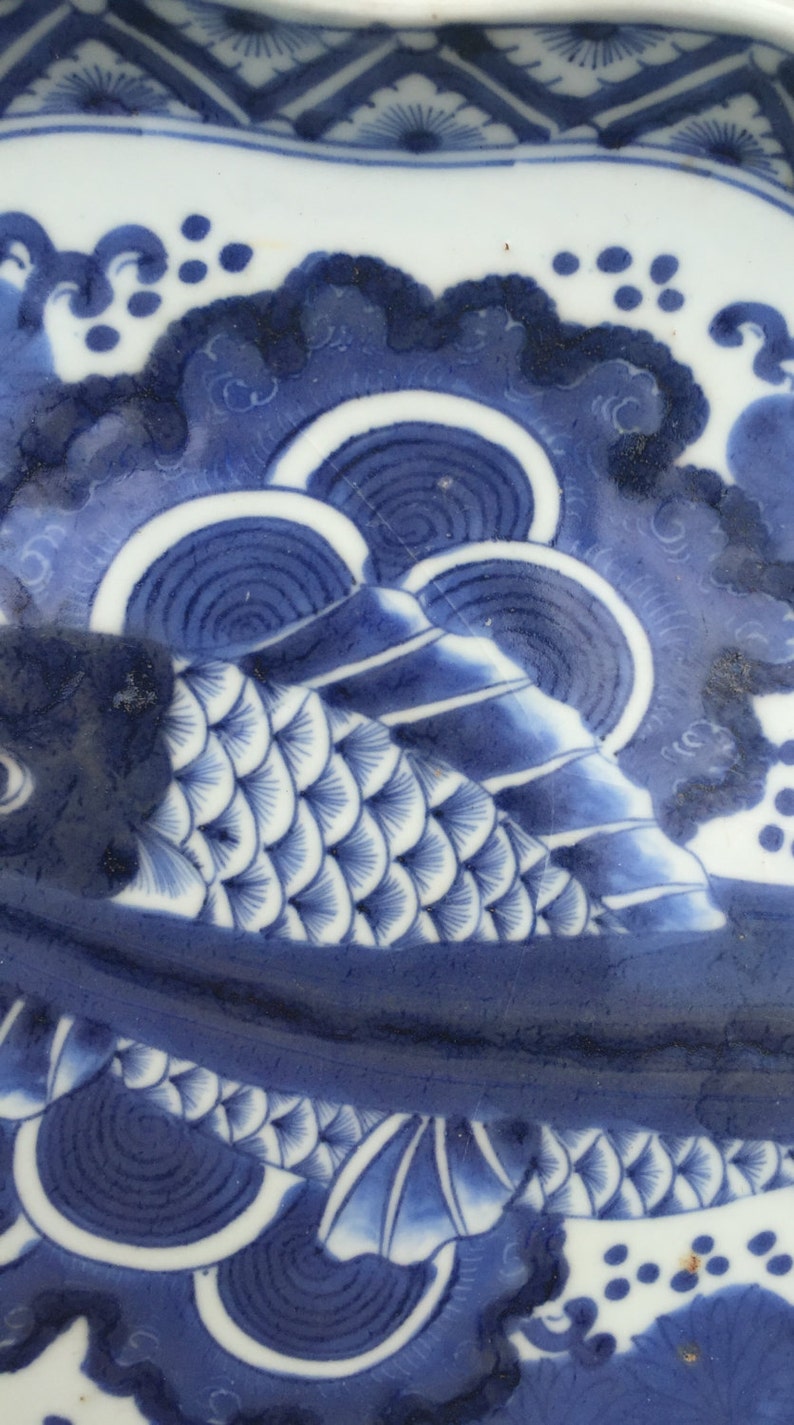
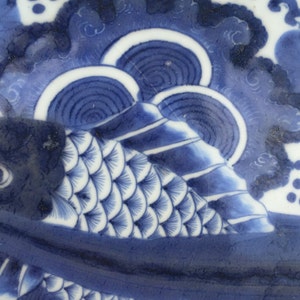
Sometsuke with dark and blue contrasts! It features a large KOI taking up most of the plate! (that's what got my attention, lol!) The koi's scales are painstakingly detailed with lines to fill in the scale...stunning! The dark splotch-like depictions are lotus flowers, I believe. Extending from those lotus blossoms are "karakusa" arabesque curlicues. There's a ribbon/banner running across the platter...no clue...perhaps water current? The concentric circles above and below the koi, no clue? If they were half moons of concentric lines, then that's a water feature...hmm?
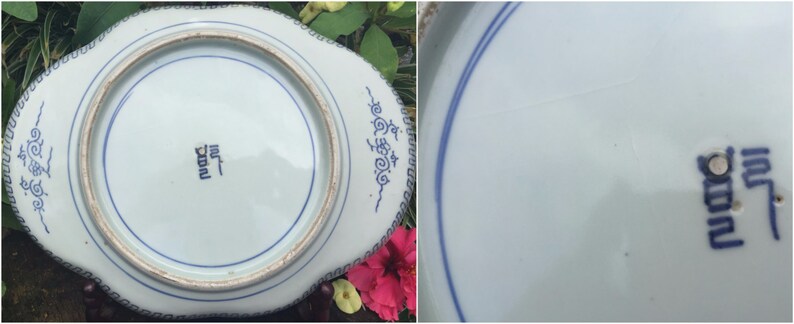
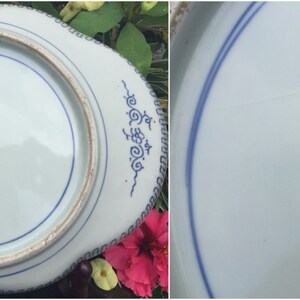
The border trim is "ishidatami" meaning paving stones. On the exterior sides of the plate is a repetitive border of lines that aren't quite "comb" borders of Nabeshima style, hmm? The bottom two sides contain elaborate karakusa curlicues. The mark is present in the center.
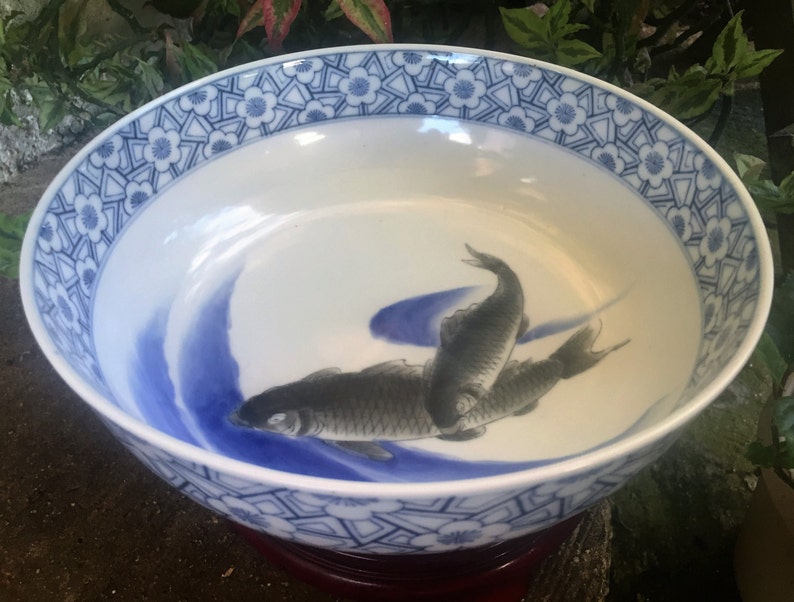
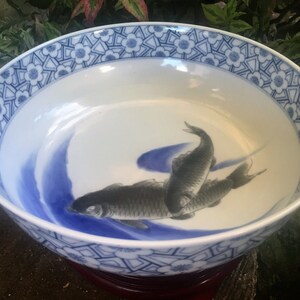
PIC 5 - A BEAUTIFUL KOI & SAKURA BLOSSOMS BOWL BY AOKI >
https://www.etsy.com/de/listing/482679645/aoki-ko-imari-grosse-punschschale-koi
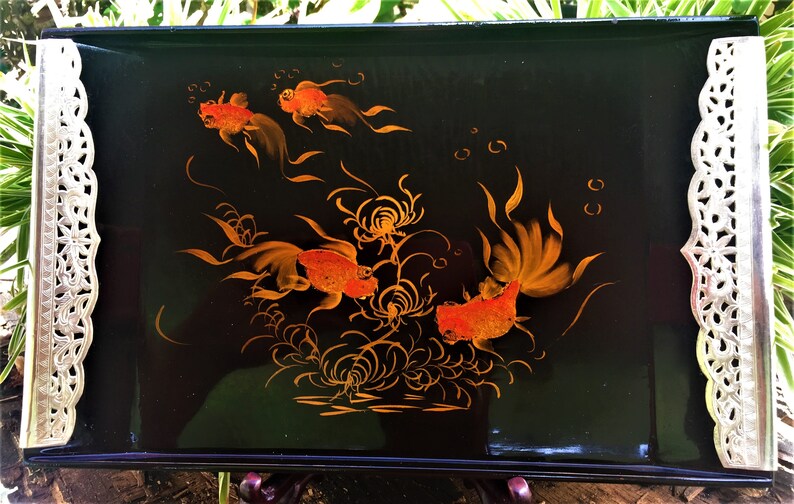
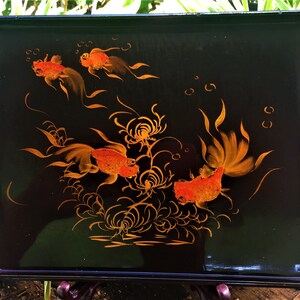
PIC 6 - STUNNING GOLDFISH SHIKKI LACQUER SILVER HANDLED TRAY >
https://www.etsy.com/de/listing/497421789/q-qi-silber-shikki-schwarz-lack-ware
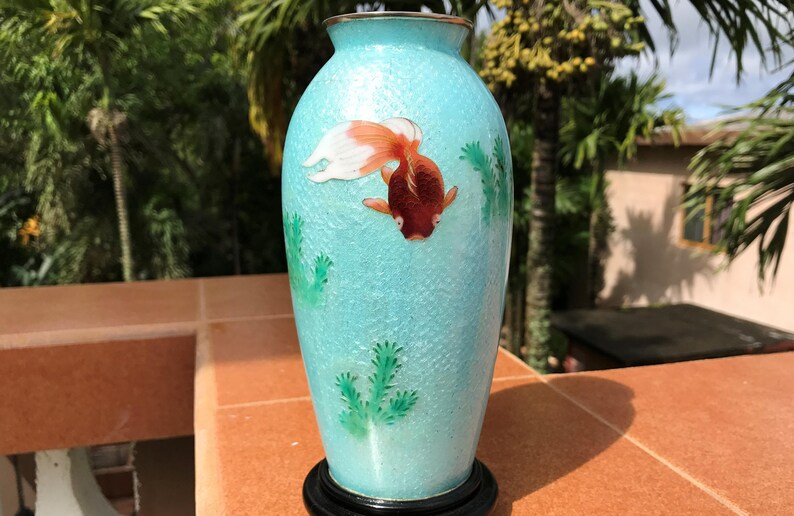
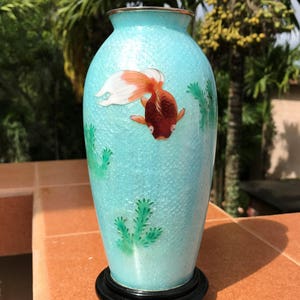
PIC 7 - A FINE ANDO SILVER WIRE CLOISONNE GOLDFISH/KOI VASE >
https://www.etsy.com/de/listing/516882543/ando-yu-xian-q-bo-yusen-shippo-silver
KOI Symbolism >
- YAMABUKI: The gold fish represents (of course) gold, wealth and prosperity.
- OGON: The platinum colored fish also represents the fulfillment of wealth in the form of success in business.
- KUMONRYU: A midnight black colored fish that is named after a Japanese dragon of transformation - and this fish is said to bring about change in life circumstances.
- KOHOKU: A white and red fish (known as a "cap" fish with white body and a red mark on its head) believed to encourage advancement in career.
- KUCHIBENI: Also white and red (known as a "lipstick" fish with a white body and red markings around the mouth) said to inspire long lasting, loving relationships.
> Lotus - purity
> Lotus flower - enlightenment
A set of Nakazara and Kozara plates that are the same maker >
https://www.etsy.com/de/listing/240217854/1800s-ko-imari-plates-6pc-set-sometsuke
A kozara sized sansui/landscape >
https://www.etsy.com/de/listing/244543399/1700s-qian-kenryu-nen-sei-marked-ko
A totally awesome pair of lidded teacups by same maker featuring good luck BATS >
https://www.etsy.com/de/listing/246145507/1700s-two-koimari-rn-fu-sometsuke
Searching for that PERFECT CHARGER/WALL PLAQUE? Please stroll my shop with over 200 Plates from Old Delft, Chinois, Faience and Antique Japanese Porcelain from the 1700's >
https://www.etsy.com/shop/GuamAntiquesNstuff?section_id=17085618
This would be great housewarming or birthday gift!
* FREE SHIPPING MOST COUNTRIES
* Guahan local pu only
- Please click & review SHIPPING & POLICIES TAB above (just below pics)
PHOTOS - integral part to description, please use zoom feature for detailed views.
MARK > 乾
"Mark 乾 in underglaze blue: Ken. This kanji character, ken in Japanese is from the kanji characters of kenryu-nen-sei which stands for the Chinese Qianlong period (1736-1795). Japanese porcelain with 'Imari' decoration. Late Edo period (1780-1860)."
Information from an avid collector who has a marks book in Japanese >
"According to the book this is a Japanese seal script version of the Chinese 清 乾降 period but only the 乾 part of it. The book further explains that having the character 日 under the 山 part on the left is the rarest version of this mark with most versions having 口 in that position."
Please review photos carefully as they're an integral part of my description >
SPECS- about 13.375"L x 10.125"W x 1.75"H
CONDITION - Good!
- Pics 2 & 3 > there's a tight hairline that originates above the dorsal fin and comes down the dorsal fin and down to the end of the anal fin.
- Pic 4 bottom > the hairline is more visible in back and is longer and contained INSIDE the foot ring
--- Feeling this and carrying, the hairline is stable...I would still use it not only for display, but to serve food with, just not anything too liquidy/wet as eventually, that would seep under the glaze and stain the plate.
- There are to be expected black and brown carbon spots, grit pops and glaze pops
- There are a few "frits" along the rim edges...if this was Delft, it would be expected for such an age, but this is Japanese porcelain, so they're "small chips." They are smooth to the touch, allowing for use as a serving platter
- Personally, I would rate this as "excellent" for an antique porcelain piece, however, I'm being tough on grading as it's for sale and subjective grading systems are tough as it is
MY SUBJECTIVE GRADING GUIDE >
Outstanding - pristine, like new
Excellent - excellent considering it's an antique (minor issues)
Good - moderate issues
Fair - more than moderate issues, okay for display, but not a prized piece
Poor - major issues = a bargain deserving of continued existence
🌴 🌴 🌴 🌴 🌴 🌴 🌴 WHERE AMERICA'S DAY BEGINS! 🌴 🌴 🌴 🌴 🌴 🌴 🌴
🌺 HÅFA ADAI from the tropical island paradise of GUAHAN (Guam/USA) 🌺
"Porcelain production began in Japan in the early seventeenth century, several hundred years after it had first been made in China during the Tang dynasty (618–906). This refined white ceramic requires more advanced technology than other ceramic types. The vessels are fired at very high temperatures so that they are strong and vitrified, as opposed to low-fired earthenware, which is porous and easily breakable. Unlike stoneware, which is high-fired but can be made from many different types of clay, porcelain is made from a specific clay mixture that includes a soft, white variety called kaolin. The smooth, semi-translucent surface of porcelain is ideal for painting delicate designs, and has been prized in both the East and West.
The Japanese porcelain industry was actually pioneered by Korean potters living in Japan. Many of them came to Japan during two invasions of Korea led by Toyotomi Hideyoshi in the 1590s. An appreciation of Korean ceramics had recently developed in Japan, and many of the feudal lords who accompanied Hideyoshi brought back Korean potters to build up the ceramic industry in their territories. The Nabeshima lord took Korean potters back to his province of Hizen on Kyushu, the southernmost of Japan's main islands. These potters would eventually become the first producers of porcelain in Japan, but they started out by reviving the production of a type of stoneware called Karatsu ware. This type of ceramic is usually simple, inexpensive, and made rapidly but skillfully on the potter's wheel. The potters also introduced a new type of kiln to Japan, the noborigama, or climbing kiln, which allows for greater precision during firing. Therefore, when in the early seventeenth century the Korean potters living in the Arita district of Hizen found suitable clay for the manufacture of porcelain, the infrastructure for its production was already in place. The Hizen region thus became the major center of porcelain production in Japan.
The first porcelain made in Japan by these Korean potters is known as early Imai. "Imari" refers to a port near the Arita kilns, from which these wares were shipped to the rest of the country. Since these porcelains were primarily for domestic consumption, the term "early" is added to distinguish them from later wares also classified as "Imari" which were typically for export. Most early Imari pieces feature designs painted in cobalt blue on a white ground, then coated in a transparent glaze, in the style known as underglaze blue. The porcelain has a coarse, grainy texture and the designs are generally carried out by a free, fluid hand. The technique of painting pictorial designs under a clear glaze was sometimes employed on Karatsu ware, so early Imari may have in part stemmed from this earlier tradition."
🌸 🎏 家族 🎏 家族 🎏 家族 🎏 家族 🎏 家族 🎏 家族 🎏 家族 🎏 家族 🎏 🌸
I'm not an expert on Porcelain. The information above is based on my research as a collector. It's time to downsize and find an appreciative home for this exquisite piece!
Feel free to contact me if you have questions or need additional photos.
#Schaal
-
Bestelle heute für eine Lieferung bis 08.-09. Mai
Deine Bestellung sollte bis zu diesem Datum eintreffen, wenn du sie heute kaufst. Um einen Liefertermin zu berechnen, auf den du dich verlassen kannst, berücksichtigen wir Dinge wie die aktuellen Laufzeiten des Versandanbieters, die Bearbeitungszeit und die Versandhistorie des Verkäufers sowie wohin und von wo die Bestellung verschickt wird.
-
Rückgaben und Umtausch werden nicht akzeptiert
Aber kontaktiere mich bitte, falls du Probleme mit deiner Bestellung hast.
-
Kostenloser Versand
-
Versand aus: Guam
Bei der Berechnung deiner Versandkosten ist ein Problem aufgetreten. Bitte versuche es erneut.
Etsys Einkaufsschutz
Kaufe beruhigt auf Etsy ein, denn wenn bei einer Bestellung etwas schief geht, stehen wir dir für alle berechtigten Einkäufe zur Seite –
siehe Programmbedingungen

Gibt die erste Bewertung für diesen Artikel ab


Mehr aus diesem Shop
Shop besuchen-
Talara Salatteller(n) 21 cm Dessertteller Noritake 'New Lineage II' Muster Bone China Porzellan Abgesetzt Thailand
17,95 €
-
1800's Antique Hirado Porcelain Plate 白百合 Shirayuri White Lily Blossom Charger Floral Osara Dish Bowl Meiji Taisho Japan *Free S&H
231,31 €
-
Fukagawa Plate 椿 Tsubaki Camellia Blossoms Dish Schotel Blue & White Gilded Flower Porcelain Gold Floral Schaal Arita Japan
94,50 €
-
1800's TWO Plates #A Signed Dainippon Hizen Arita Aoki-sei 染付 Sometsuke 阿蘭陀海芋 Calla Lily Blossoms Dish Pair Floral Porcelain Wall Art Japan
258,11 €
-
Antike Arita-Porzellanschale: Edo-Periode Imari Karpfen-DekorBefindet sich in Kanada
Sale-Preis 175,34 €
Ursprünglicher Preis 213,83 €
-
Antiker japanischer Imari-Phönixteller | Hizen-Porzellan aus dem 19. Jahrhundert | Blau-weiße Arita-Ware | Ungewöhnlich geformter Teller | Ko-Imari
Sale-Preis 207,07 €
Ursprünglicher Preis 276,09 €
-
Antiker japanischer Imari-Teller mit Fuß | Blau-weißes Arita-Porzellan aus dem 19. Jahrhundert | Landschaftsmotiv | Blütenförmige Süßspeisenschale | Ko-Imari
Sale-Preis 364,54 €
Ursprünglicher Preis 486,06 €
-
Vintage japanische Porzellanteller, Indigo-Karpfen-Design, INBAN IMARI, 8er-Set
169,76 €
-
Antikes JAPANISCHES IMARI Ladegerät NABESHIMA Peony Powder Blue Hichozan Artia Meiji
159,48 €
-
Antike Japanische KOIMARI WARE Handbemalte Platte Dish Japan Vintage Imari
Sale-Preis 83,73 €
Ursprünglicher Preis 111,64 €
-
Antike japanische Imari Sometsuke quadratische Servierplatte Arita Ko-Imari Blau-Weißes Porzellan, Edo oder frühe Meiji-Periode #JI7
73,36 €
-
Antike japanische Edo-Periode Blau-Weiß-Porzellan Sometsuke Imari Platzteller Ken Marked 15-3 / 4 "
445,85 €
-
Japanische Imari-Porzellanschüssel 7,5 "Handgemalte signierte signierte Kirschblüte-Koi-Fisch
Sale-Preis 31,88 €
Ursprünglicher Preis 42,51 €
-
Antiker Imari Platzteller aus der Meiji-Periode: Japanisches Porzellan mit Kintsugi (46 cm)
491,42 €
-
Antike japanische Arita Imari Porzellanplatte aus dem 19. Nr. 1
93,33 €
-
Vintage Imari Ware Teller: Japanische Landschaft, Showa Periode
Sale-Preis 83,73 €
Ursprünglicher Preis 111,64 €


